Most Harley-Davidson engines run 20W-50. If you own a Twin Cam, a Milwaukee-Eight, an Evo Big Twin or a Sportster, that is almost certainly the grade on the bottle you need, and choosing the best oil for a Harley-Davidson is mostly a question of which brand of 20W-50 you trust and how much you want to spend.
But “what oil” is only a third of the question, and it is the part most guides stop at.
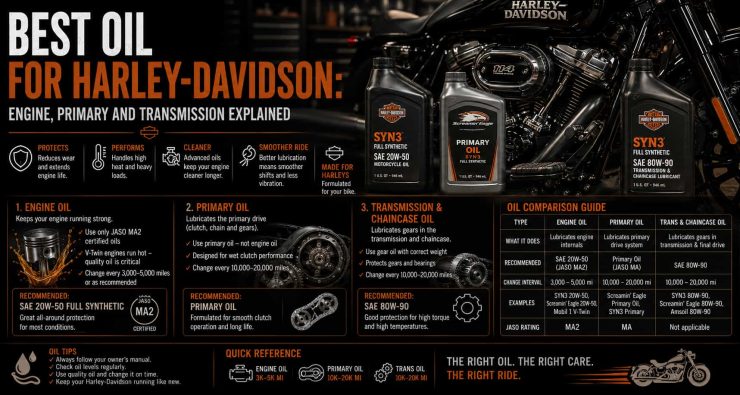
A Big Twin does not have one oil. It has three separate systems, each with its own drain plug, its own fluid and its own capacity: the engine, the primary chaincase and the transmission. Riders call servicing all three a 3-hole oil change. Pouring engine oil into all three works on some bikes and causes a notchy clutch on others. Pouring the wrong thing into the primary is the single most common mistake new owners make.
This guide covers all of it: what 20W-50 actually means and why your bike needs it, the difference between the three systems, which oil suits which engine, how much each one holds, and the products worth buying for each. Capacities are listed by engine family, from the 1340 Evo through to the Revolution Max.
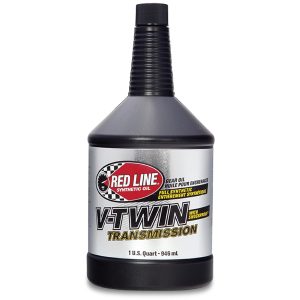
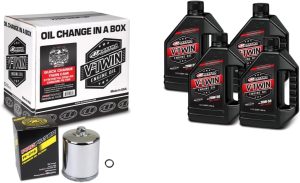
#1 Pick: Best Oil for Harley-Davidson
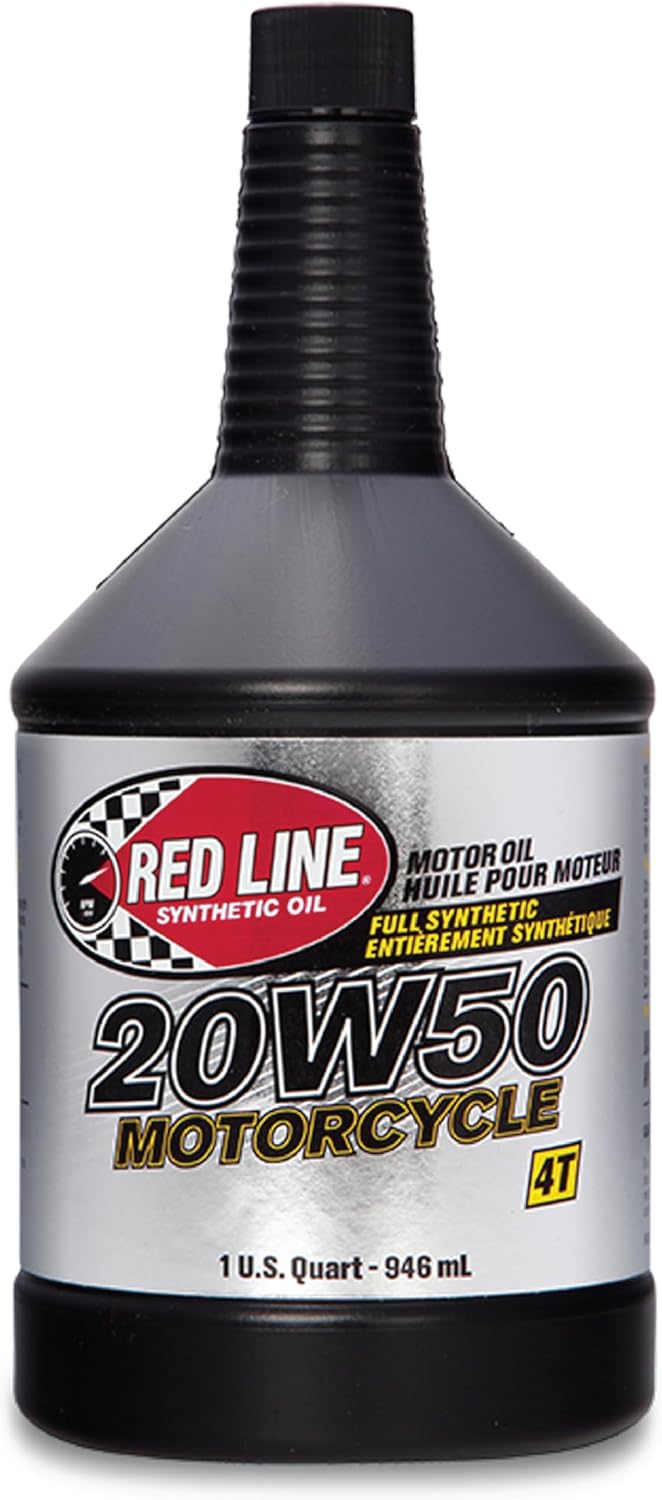
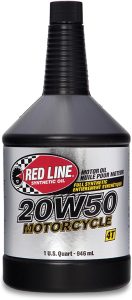
Red Line 42504 20W-50 Motorcycle Oil
If you want one answer without reading further: a full-synthetic 20W-50 that carries JASO MA or MA2. Red Line’s 42504 is the strongest technical package in this guide – ester and PAO base stocks, ZDDP around 2,200 ppm, and matching primary and transmission fluids so a full 3-hole change stays on one brand. On a budget, the Valvoline further down this page does the same job for about a third of the price.
The top best product [hide]
Your Harley Has Three Separate Oils
This is the part that trips people up, so it is worth getting straight before anything else.
On a Big Twin – Touring, Softail, Dyna – three separate compartments hold fluid, and they do not share:
1. Engine oil (the crankcase)
This is the one everybody thinks about. It lubricates the pistons, cams, lifters and bearings, and on an air-cooled V-twin it also does a lot of the cooling work that a radiator would do on another bike. This is where 20W-50 goes. On Big Twins the engine oil lives in its own tank and never touches the gearbox.
2. Primary chaincase
Behind the left-hand cover sit the primary chain, the compensator and the clutch. The clutch runs wet, meaning the friction plates are bathed in this fluid. That single fact drives everything: the oil in there has to lubricate a chain and simultaneously let a clutch grip. Purpose-made primary fluid is formulated for exactly that balance.
3. Transmission
The gearbox is its own sealed compartment with its own drain plug. It takes a heavier gear-type oil. This is where shift quality lives – riders who complain about clunky shifts and false neutrals are often running the wrong fluid or old fluid here.
The Sportster is different
An Evo Sportster has two holes, not three. Engine and transmission share a common sump, so one fill of 20W-50 covers both. The primary chaincase is separate and takes its own fluid. If you own a Sportster and someone tells you to do a 3-hole change, they are describing a Big Twin.
Can you just use engine oil in all three?
Plenty of riders do, and their bikes survive. Harley’s own position is to use the fluid specified for each compartment, and there is a practical reason beyond warranty language: gear oil and primary fluid are built for shear and clutch friction, engine oil is not. Some owners report a smoother clutch on 20W-50; others report drag and notchy shifts. If your clutch already feels grabby, dedicated fluids are the cheaper experiment.
One thing is not debatable: never put automotive gear oil marked GL-5 in a Harley primary. It contains additives that are hard on the yellow metals in a clutch basket.
The three systems at a glance
| System | What it lubricates | Fluid type | Separate drain plug? |
|---|---|---|---|
| Engine | Pistons, cams, lifters, bearings | 20W-50 motorcycle oil | Yes |
| Primary chaincase | Primary chain, compensator, wet clutch | Primary chaincase fluid | Yes |
| Transmission | Gears, shift forks | Gear oil / transmission fluid | Yes |
On an Evo Sportster the engine and transmission share one sump, so the bike has two fills rather than three.
What 20W-50 Actually Means and Why Harley Needs It
The two numbers are two different measurements, not a range.
20W describes how the oil behaves cold – the W is for winter. Lower means it flows more easily on a cold start. 50 describes how thick the oil stays once it is up to operating temperature. A 20W-50 flows like a 20-weight when you thumb the starter and protects like a 50-weight once the motor is hot.
That second number is the reason Harley specifies it. An air-cooled V-twin sitting in traffic on a hot day runs oil temperatures a car engine never sees, and it has larger internal clearances than a modern liquid-cooled four. Thin oil at those temperatures stops holding a film where it matters. A 50-weight hot rating covers that.
The wet clutch is the other half of the story
Because a Harley clutch runs in oil, anything that makes the oil more slippery in the wrong way makes the clutch slip. This is why you look for JASO MA or JASO MA2 on the bottle. That standard certifies the oil has the friction characteristics a wet clutch needs. Motorcycle-specific oils carry it. Most car oils do not.
Why automotive 20W-50 is not the same thing
You can buy a jug of car 20W-50 for a third of the price, and this comes up in every forum thread ever written about Harley oil. Two real differences:
- Friction modifiers. Modern passenger-car oils are formulated for fuel economy, which means additives designed to reduce friction. Good in a car. In a wet clutch, that is exactly what you do not want.
- ZDDP. Zinc dialkyldithiophosphate is an anti-wear additive that matters enormously in a flat-tappet, pushrod engine with high valve-spring pressures – which describes every air-cooled Harley motor. Emissions regulations have pushed ZDDP levels down in car oils to protect catalytic converters. Motorcycle oils keep it high. Red Line’s 20W-50, for example, runs around 2,200 ppm.
Some riders run car oil for decades without a problem, usually in older bikes and mild climates. The point is not that your engine will grenade tomorrow. It is that a purpose-built oil costs a few dollars more per change and removes the question entirely.
When 20W-50 is not the answer
If you regularly start the bike below freezing, a 15W-50 or 10W-40 will get oil to the top end faster. And the liquid-cooled Revolution Max 1250 in the Pan America and Sportster S has its own specification – 20W-50 is the preferred grade, with 15W-40 and 10W-40 listed as alternatives depending on ambient temperature. Check the manual for your specific year rather than assuming.
Synthetic, Semi-Synthetic or Conventional
All three will keep a Harley alive. They differ in how long they hold up and what you pay.
Full synthetic
Built from engineered base stocks – PAO, esters – rather than refined crude. The molecules are uniform in size, which is why synthetics resist thermal breakdown and hold their viscosity when the motor is hot and sitting still. On an air-cooled twin in summer traffic, that is the scenario that matters. Expect roughly $20 to $25 a quart for the good stuff.
The practical benefit riders actually notice: oil that still looks like oil at the end of the interval instead of turning black at 1,500 miles.
Semi-synthetic (synthetic blend)
A mix of synthetic and mineral base stock. Better heat tolerance than straight conventional, cheaper than full synthetic. A reasonable middle ground for a bike that sees moderate miles in a temperate climate.
Conventional (mineral)
Refined from crude. It lubricates perfectly well – Harleys ran on it for eighty years – but it breaks down sooner under heat and wants shorter change intervals. Where it still makes sense: older Evo and Shovelhead motors, break-in on a fresh rebuild, and riders who change oil often and would rather do it three times a season with cheap oil than twice with expensive oil.
Worth knowing: Lucas 10700, a bottle you will see recommended constantly, is a conventional oil. Lucas’s full synthetic is a different part number, 10702. Plenty of reviews online call the 10700 synthetic. It is not.
Can you switch between them?
Yes. The old story about a high-mileage engine starting to leak after switching to synthetic is largely myth – synthetics do not attack seals. What can happen is that a synthetic’s better detergency loosens deposits that were plugging a seep that was already there. If your motor is dry now, it will almost certainly stay dry.
Best Engine Oils for Harley-Davidson
Six 20W-50 engine oils worth considering, from the strongest technical package to the best value. Each card notes which engines it suits.
Fits: Twin Cam 88/96/103/110, Milwaukee-Eight, Evo Big Twin, Sportster – engine
Rating: 4.8 / 5 from 667 ratings
If you want the strongest technical case in this list, this is it. Red Line builds the 42504 on ester and PAO base stocks rather than refined crude, and runs ZDDP at roughly 2,200 ppm – a meaningful number in a pushrod motor with heavy valve-spring pressure. It carries JASO MA/MA2, so the wet clutch is covered. What owners consistently report is that it stays clean deep into the interval instead of turning black at 1,500 miles, and that the gearbox is quieter on bikes where the oil is shared. It is not the cheap option and Red Line makes no attempt to be. Where it earns the money is a hot-running Twin Cam 103 or a Milwaukee-Eight worked hard in summer traffic. Red Line also makes matching primary and transmission fluids, so a full 3-hole change on one brand is straightforward.
What owners say: “I have 2 bikes with 103s and an older 88. – mark twain, verified purchase”
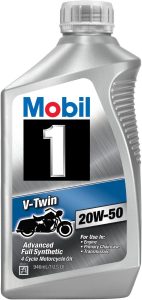
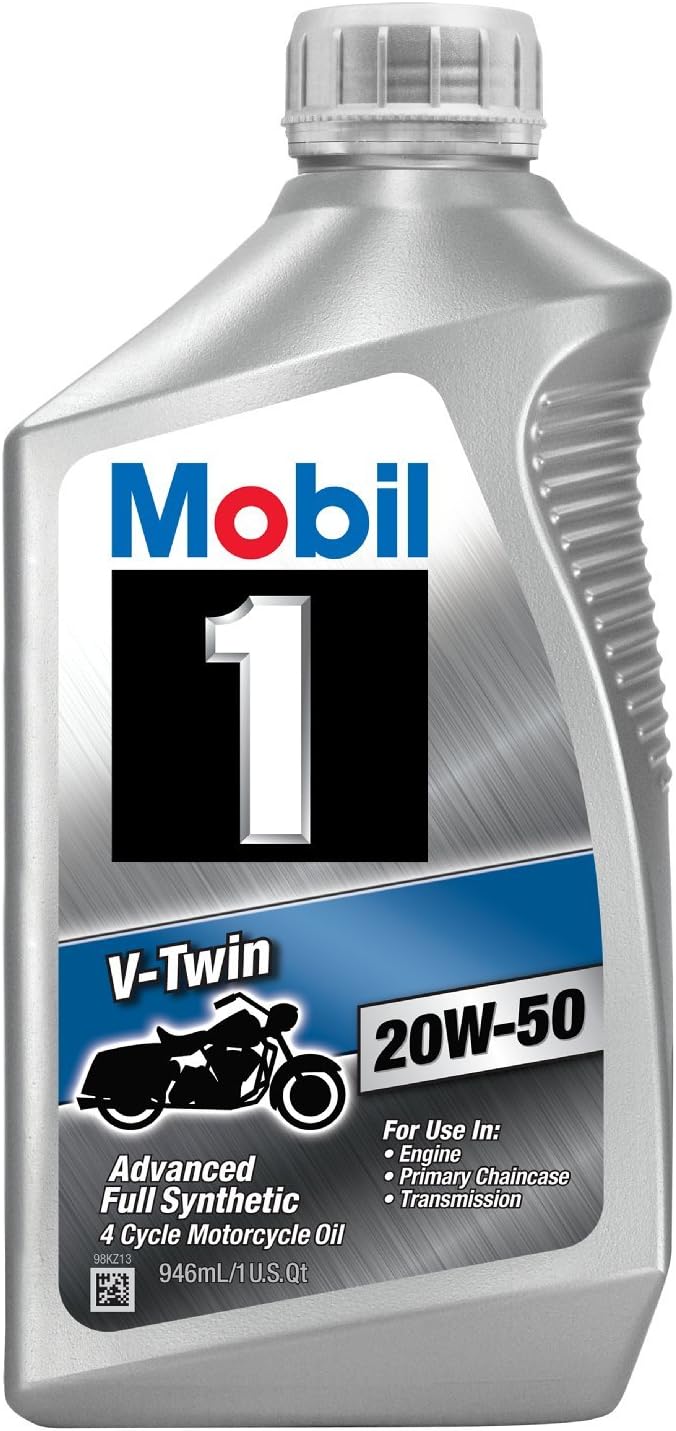
Mobil 1 96936 V-Twin 20W-50 Synthetic
Fits: Twin Cam, Milwaukee-Eight, Evo Big Twin, Sportster – engine
Rating: 4.8 / 5 from 2,554 ratings
With over 2,500 ratings this is the most scrutinised oil in the category, and it holds 4.8 stars, which tells you most of what you need to know. Mobil formulates the V-Twin specifically for engines that either share a sump with the transmission or run separately, and states outright that it is designed to provide the frictional characteristics a wet clutch needs. It exceeds API SH, SG/CF and CD. The practical argument for it over more exotic synthetics is availability: you can buy it at almost any auto parts counter in the country, which matters when you are mid-service and a quart short on a Sunday. Riders running it in everything from a 2003 Dyna Wide Glide to a 2016 Street Glide report the same thing – it does the job and it does not surprise you.
What owners say: “Been using this on my 2016 Harley Street Glide for years now, runs great in main case, primary, and transmission. Definitely a good 3 hole oil to use. – Blaze, verified purchase”
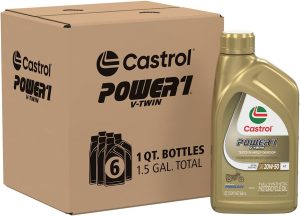
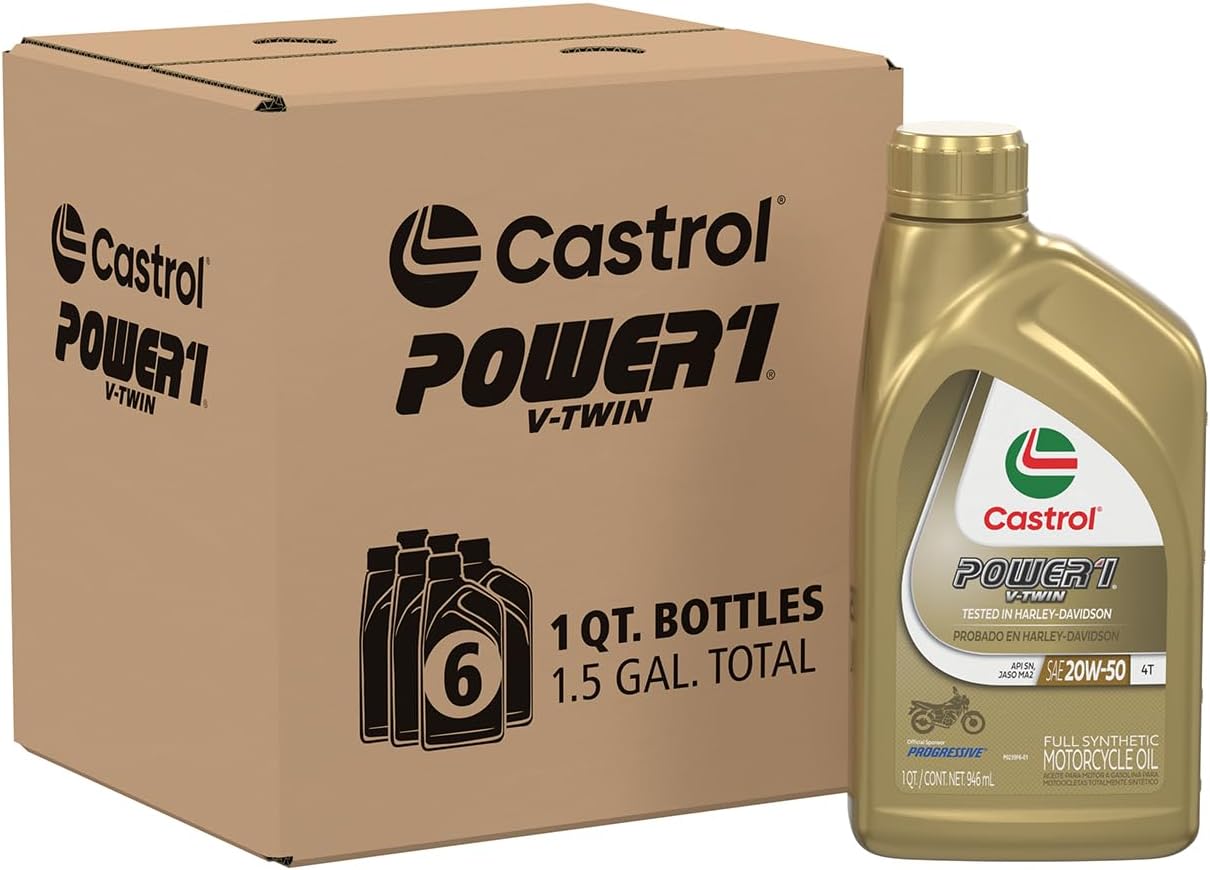
Castrol Power1 V-Twin 20W-50 Full Synthetic
Fits: Twin Cam, Evo Big Twin, Sportster – engine, and usable in primary and transmission
Rating: 4.8 / 5 from 1,721 ratings
Castrol’s V-Twin line is the sensible default: a full synthetic from a brand everyone recognises, exceeding API SL and JASO MA-2, priced below Red Line and AMSOIL. Castrol positions it as suitable for engine, transmission and primary chaincase, which makes it a straightforward single-brand answer for owners who would rather not stock three different bottles. Reviews come from riders on everything from a 2011 Road King to an Indian Thunderstroke, and the recurring theme is smoothness rather than any dramatic transformation – which is what you want from an oil. One warning that belongs on this card: Castrol also sells GTX 20W-50, a conventional automotive oil in a similar-looking bottle at a much lower price. It is a different product, it is not built for a wet clutch, and the label needs to say V-Twin.
What owners say: “Seems to work pretty good for my 2011 Road King, good price. – chris, verified purchase”
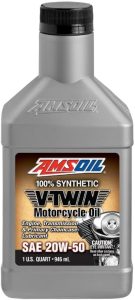
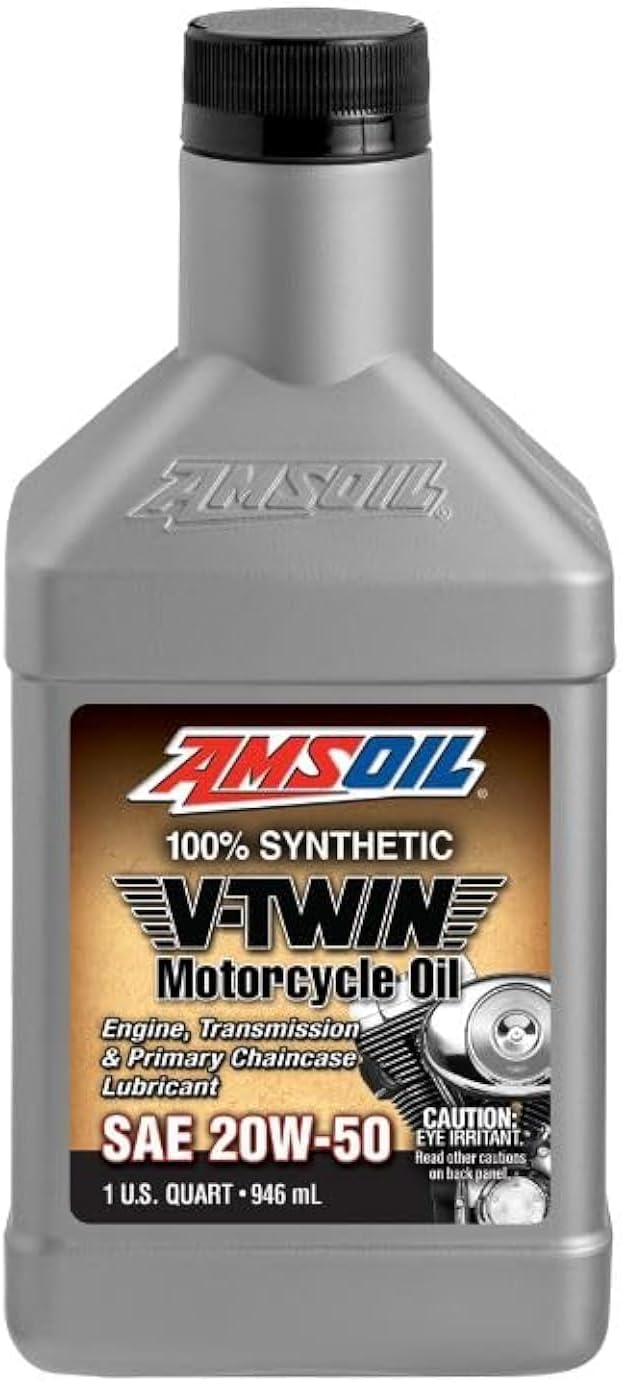
AMSOIL 20W-50 Full Synthetic V-Twin Motorcycle Oil
Fits: Twin Cam, Milwaukee-Eight, Evo Big Twin, Sportster – engine, transmission and primary
Rating: 4.8 / 5 from 468 ratings
AMSOIL has a long-standing following among V-twin owners and turns up constantly in discussions where people are comparing used-oil analyses rather than trading opinions. The 20W-50 carries JASO MA/MA-2 along with API SG/SL/CF and CG-4, and AMSOIL formulates it to work in the engine, the transmission and the primary chaincase – which is the appeal for riders who want one product for the whole 3-hole service rather than three bottles from three brands. Owners running it in a 2013 Heritage Softail and various Sportsters report the same consistent picture over multi-year use. The one practical caveat is distribution: AMSOIL sells substantially through its own dealer network, so availability on Amazon moves around and stock on any given listing can be thin.
What owners say: “Amsoil is my go to for my 2013 Heritage Softail Classic! – Danny Sawyer, verified purchase”
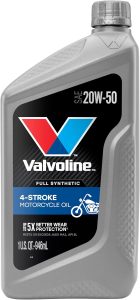
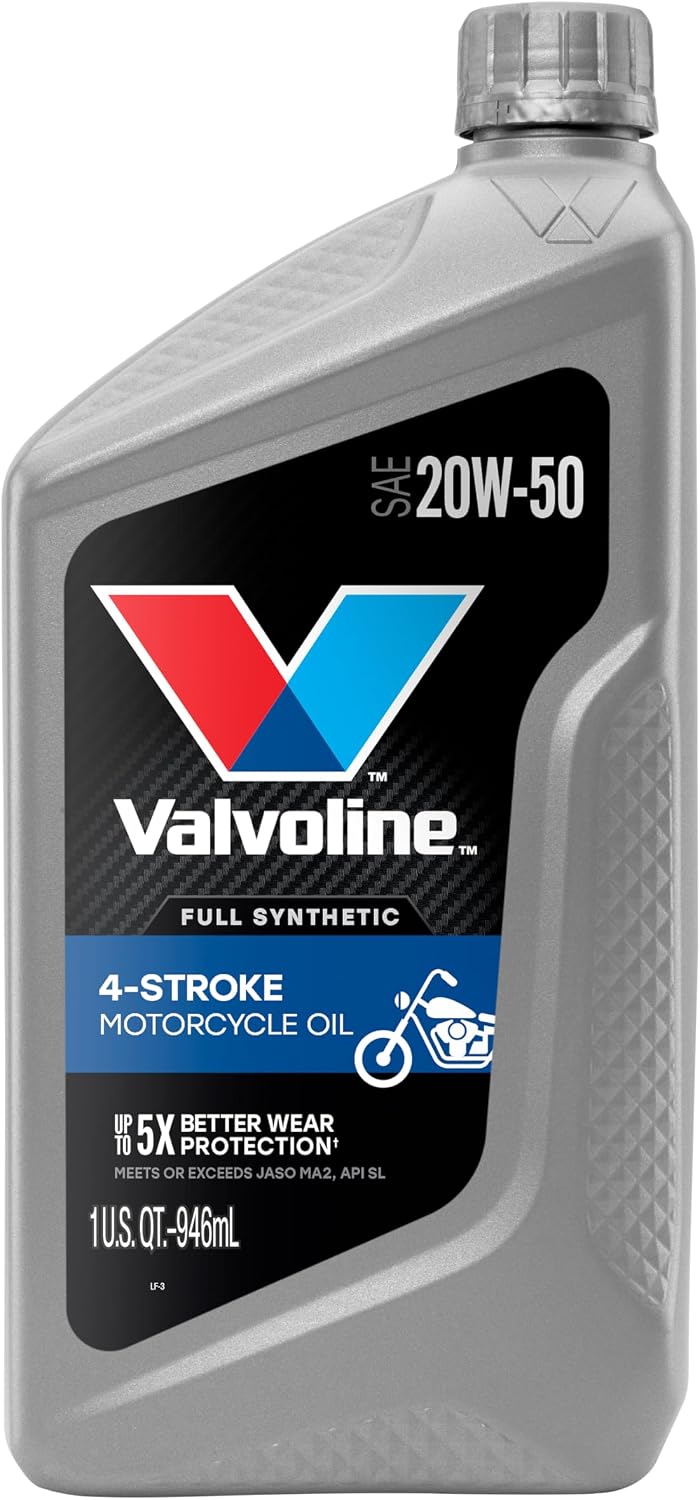
Valvoline 4-Stroke 20W-50 Full Synthetic
Fits: Twin Cam, Evo Big Twin, Sportster – engine, clutch and gearbox
Rating: 4.8 / 5 from 386 ratings
This is the value entry, and it is a serious one rather than a compromise pick. Valvoline’s 4-Stroke is a genuine full synthetic that meets or exceeds API SL and JASO MA2, formulated for motorcycles where the oil serves the engine, the clutch and the gearbox – and it sells for roughly a third of what the premium brands charge per quart. At 4.8 stars it is not being carried by price alone. The argument for it is simple: if you change oil on schedule rather than stretching intervals, the marginal benefit of a $22 quart over a $10 quart is small, and the difference across a season pays for a set of tires. Riders switching from more expensive brands on an 08 Fat Bob and a 2017 Sportster both reported the bike running quieter, which is more than you would expect at the price.
What owners say: “1st time I’ve used Valvoline in my 08 Fat Bob – I’ve used the more expensive Lucas, this Valvoline actually runs quieter and seemingly cooler. – Michael R Cothran, verified purchase”
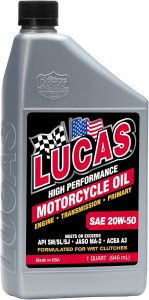
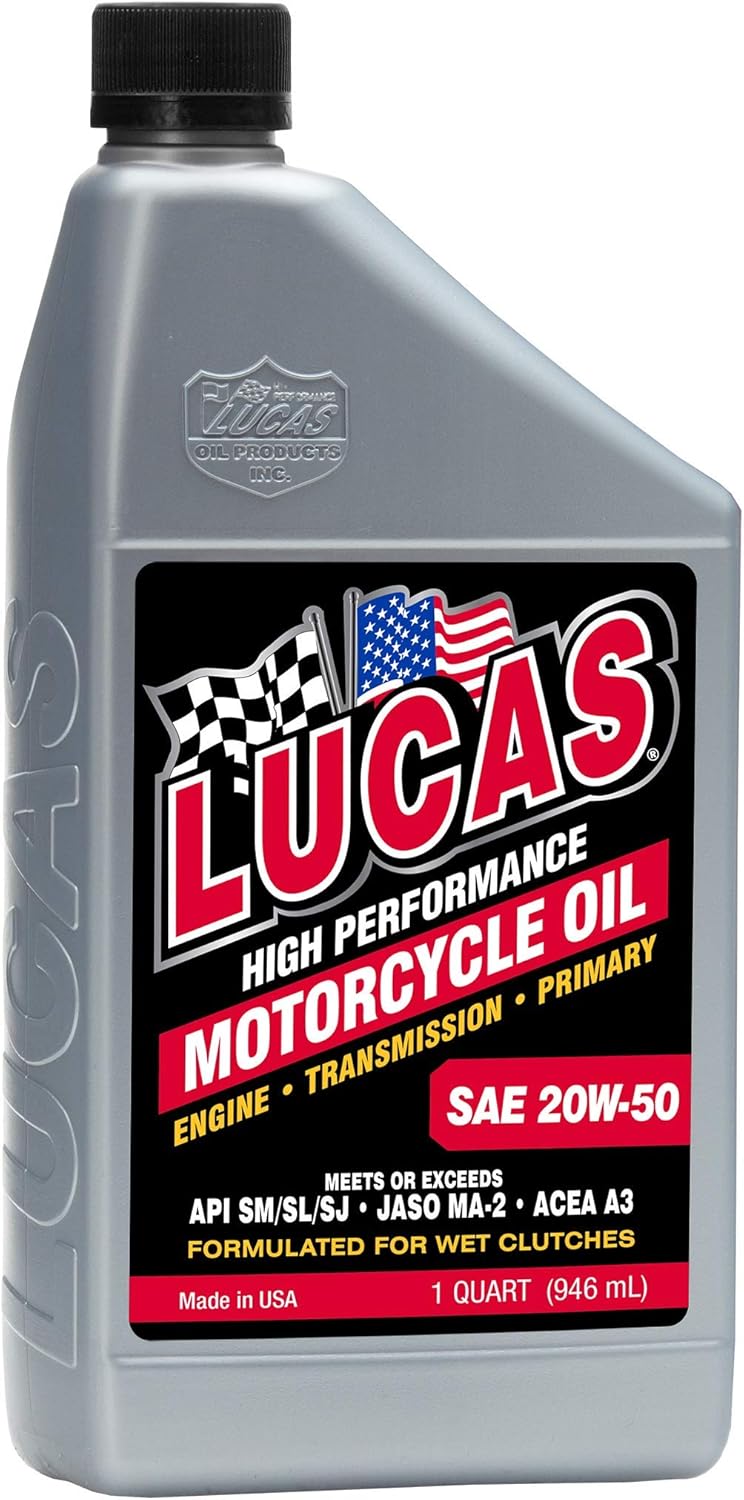
Lucas Oil 10700 High Performance 20W-50
Fits: Evo Big Twin, older Twin Cam, Sportster – engine
Rating: 4.8 / 5 from 682 ratings
One clarification first, because a great many reviews get it wrong: the Lucas 10700 is a conventional oil, not a synthetic. Lucas does make a full synthetic 20W-50 – it is part number 10702. If you specifically want synthetic, buy that one instead. Taken for what it actually is, the 10700 is a well-regarded conventional 20W-50 with a strong additive package, and it has a legitimate place. On an Evo Big Twin, a Shovelhead or any older motor that has run mineral oil its whole life, a good conventional changed on a short interval is a perfectly sound strategy and arguably better than a synthetic changed rarely. It is also the sensible choice during break-in after a rebuild. Riders who change oil three times a season rather than once will find the economics work in its favour.
What owners say: “Great oil and great priced. I use this in my Harley, it’s good oil and it’s cheaper than Harley oil. – Tim Monteforte, verified purchase”
Best Oil for Each Harley Engine
The grade barely changes across the range. What changes is how hard the motor works the oil, and that is what should drive how much you spend.
Evolution Big Twin (1984-1999)
The 1340 Evo is a low-stress, low-compression motor by modern standards, and it is forgiving. A quality conventional or semi-synthetic 20W-50 is genuinely adequate here, and many long-term Evo owners deliberately stay on mineral oil with shorter intervals. If the bike sits a lot or you ride in heat, a full synthetic is still the safer choice. Best oil for a Harley-Davidson Evo engine: Castrol Power1 V-Twin or Lucas 10700 if you change often.
Twin Cam 88, 96, 103 and 110 (1999-2017)
The Twin Cam runs hotter than the Evo, especially the 103 and 110 in Touring trim, and it is harder on oil. This is the engine family where full synthetic earns its money. Cam chain tensioners on early Twin Cams are a known weak point and clean oil is part of keeping them alive. Best oil for a Harley-Davidson Twin Cam: Red Line 42504 or Mobil 1 V-Twin. For best oil for Twin Cam 88 specifically, either works; the 88 is less thermally stressed than the 103.
Milwaukee-Eight 107, 114 and 117 (2017 and up)
Precision cooling, tighter tolerances, higher output. Run a full synthetic that meets JASO MA2 and do not stretch the interval. M8 owners should also read the section on oil sumping below – it is the one issue specific to this engine family worth knowing about.
Sportster Evo XL (1986-2021)
Remember: engine and transmission share the sump, so the oil you pour in is doing double duty as gear oil. That is an argument for synthetic – it holds up better under the shear that gears impose. The primary is separate and takes its own fluid.
Revolution Max 1250 (Pan America, Sportster S)
Liquid-cooled and a completely different animal. 20W-50 is the preferred grade, with 15W-40 and 10W-40 as alternatives in colder conditions. Do not assume the Big Twin routine transfers – check the manual for your year.
Revolution (V-Rod, 2002-2017)
Also liquid-cooled, also its own specification, and the V-Rod uses a separate transmission fluid. If you ride one, the manual is not optional reading.
Harley Oil Capacity by Engine
Buy oil by the quart and you will always be slightly wrong unless you know the number. These are typical service-refill capacities – the amount you put back after a normal drain, not a dry rebuild.
| Engine | Engine oil | Primary | Transmission |
|---|---|---|---|
| Evolution Big Twin 1340 | 3.5 – 4.0 qt | 32 – 38 oz | 20 – 24 oz |
| Twin Cam 88 / 96 / 103 / 110 | 3.5 qt | 32 oz (38 oz Touring) | 20 – 24 oz |
| Milwaukee-Eight 107 / 114 / 117 | 4.8 qt | 34 oz | 28 oz |
| Sportster Evo XL 883 / 1200 | 3.0 qt (shared with trans) | 32 oz | shared with engine |
A note on Touring primaries. On 2006-and-later Touring models the number depends on what you did. A straight drain-and-fill takes roughly 38 fluid ounces. If the primary has been fully removed and drained dry, it takes around 45. That difference catches people out.
Where the drain plugs are
- Engine: underneath, at the bottom of the frame on most Touring models, or on the oil tank on Softails. Twin Cam 103 owners hunting for it: it is the plug at the lowest point of the oil line loop.
- Primary: the lowest point of the left-hand outer primary cover.
- Transmission: a separate plug in the bottom of the transmission case, behind and above the primary plug.
Capacities vary by model year and market. Treat the table as a shopping guide and confirm the exact figure in the service manual for your bike before you refill.
Best Primary Chaincase Fluids
The primary has to lubricate a chain while letting a wet clutch grip. These three are the most-reviewed fluids built for that job.
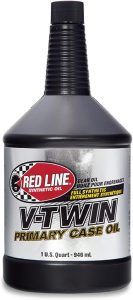
Red Line 42904 V-Twin Primary Case Oil
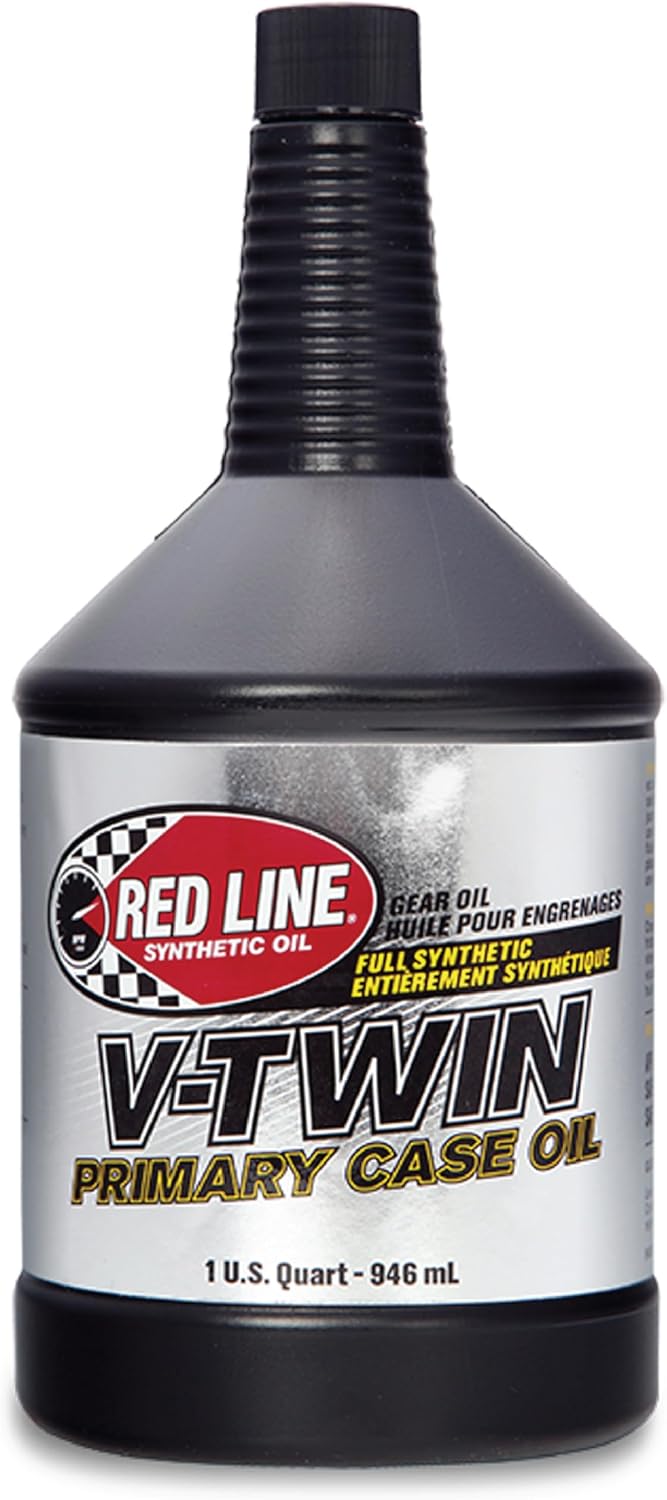
Fits: Big Twin and Sportster primary chaincase
Rating: 4.8 / 5 from 2,700 ratings
With roughly 2,700 ratings this is the most reviewed primary fluid on the market, and it is the natural partner to Red Line’s engine oil if you want a single brand across the whole 3-hole service. Primary fluid has an awkward job: it has to lubricate a chain and a compensator while letting a wet clutch grip properly, and those two requirements pull in opposite directions. Purpose-built fluid is formulated for that balance in a way engine oil is not. Riders who switch to a dedicated primary fluid from whatever was in there most often report the same two things – a lighter clutch pull and cleaner engagement off the line. If your clutch feels grabby or drags at a stop, this is the cheapest thing to try before you start pulling covers.
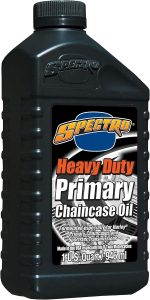
Spectro R.HDPCO Heavy Duty Primary Chaincase Oil
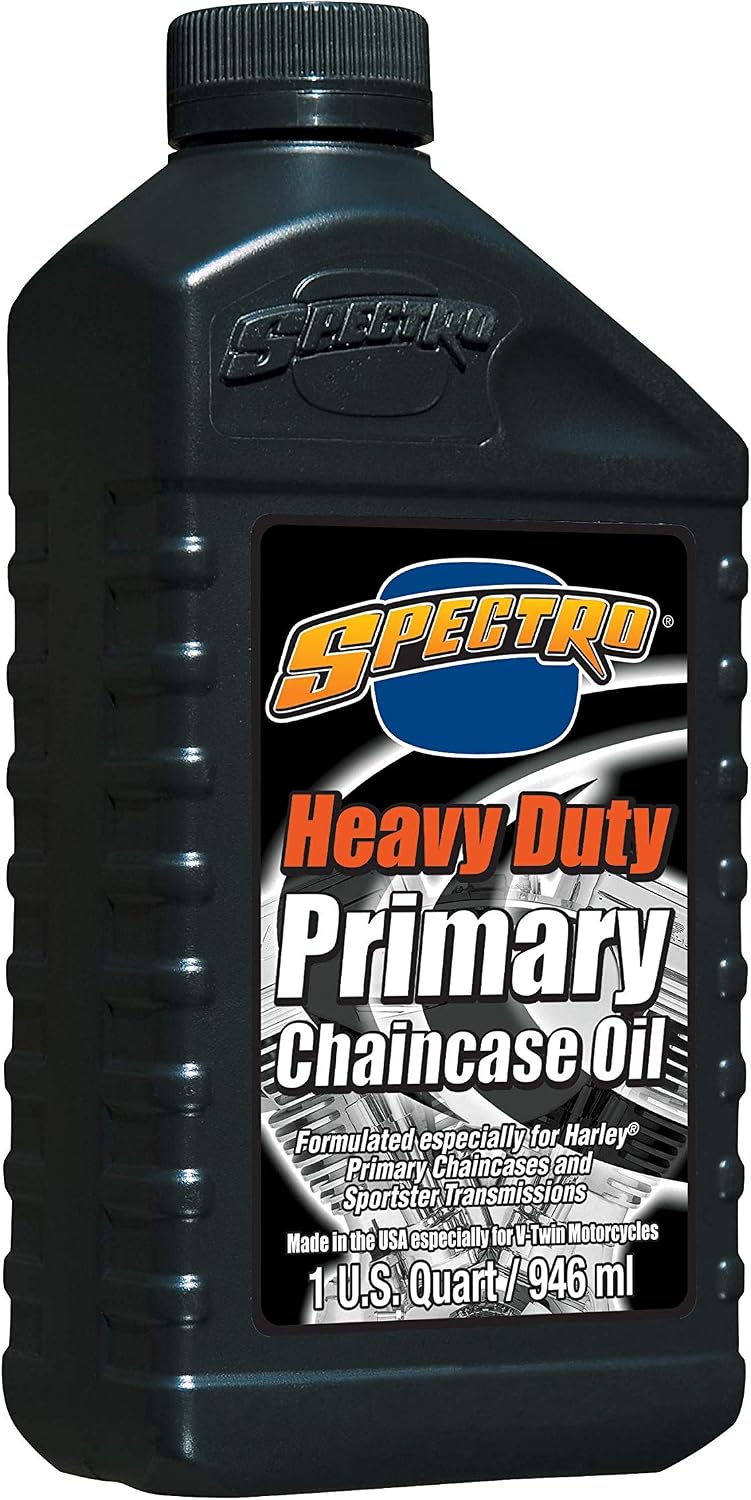
Fits: Harley Big Twin and Sportster primary chaincase
Rating: 4.8 / 5 from 352 ratings
Spectro is a specialist – the company builds lubricants for motorcycles and little else, and the Heavy Duty Primary Chaincase Oil is a long-standing favourite among riders who care about shift quality. It is an SAE 85 shear-stable petroleum formulation with a friction package tuned for wet clutches, supplied in a metal can rather than a plastic bottle. Owners consistently describe smoother shifting after switching, and it comes up often in threads from riders running aftermarket clutch packs, where fluid choice matters more than it does on a stock setup. If you are already running Spectro’s transmission oil, keeping the primary on the same brand is the tidy answer.
What owners say: “Love this primary oil. Shifts smoother. I also use their 6 speed transmission oil when I do my 3 hole oil change. – Jessica, verified purchase”
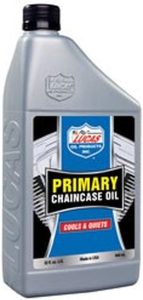
Lucas Oil 10790 Primary Chaincase Oil
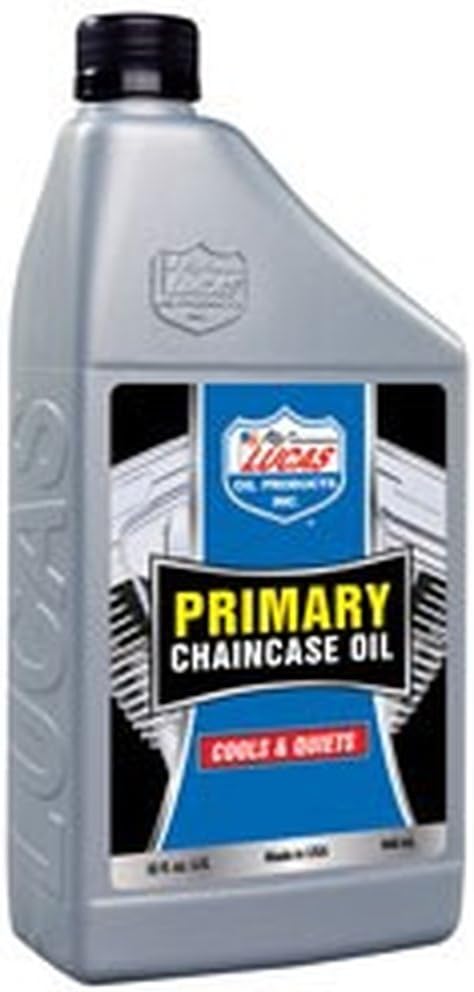
Fits: Harley Big Twin primary chaincase
Rating: 4.8 / 5 from 1,020 ratings
A long-established primary fluid with over a thousand ratings behind it. Lucas builds the 10790 on a petroleum base with their own additive package, in SAE 10W, and riders describe it as running quiet and dissipating heat well in a big-twin primary. It is compatible with Harley big twins as a direct replacement for Formula+ and it has been the default recommendation on forums for years. The one thing to watch is purchasing: Amazon currently shows this listing without a standard buy box, so it sells through third-party offers with variable pricing. Check what you are paying before you commit – at the right price it is one of the better-value primary fluids available, at the wrong price it is not.
What owners say: “Good stuff. Runs quiet. Dissipates heat. Compatible with HD big twins. Good value. – M. Goodrich, verified purchase”
Best Transmission Oil
The gearbox is a separate compartment with its own drain plug, and it is where shift quality lives.
Red Line 42804 ShockProof V-Twin Transmission Oil
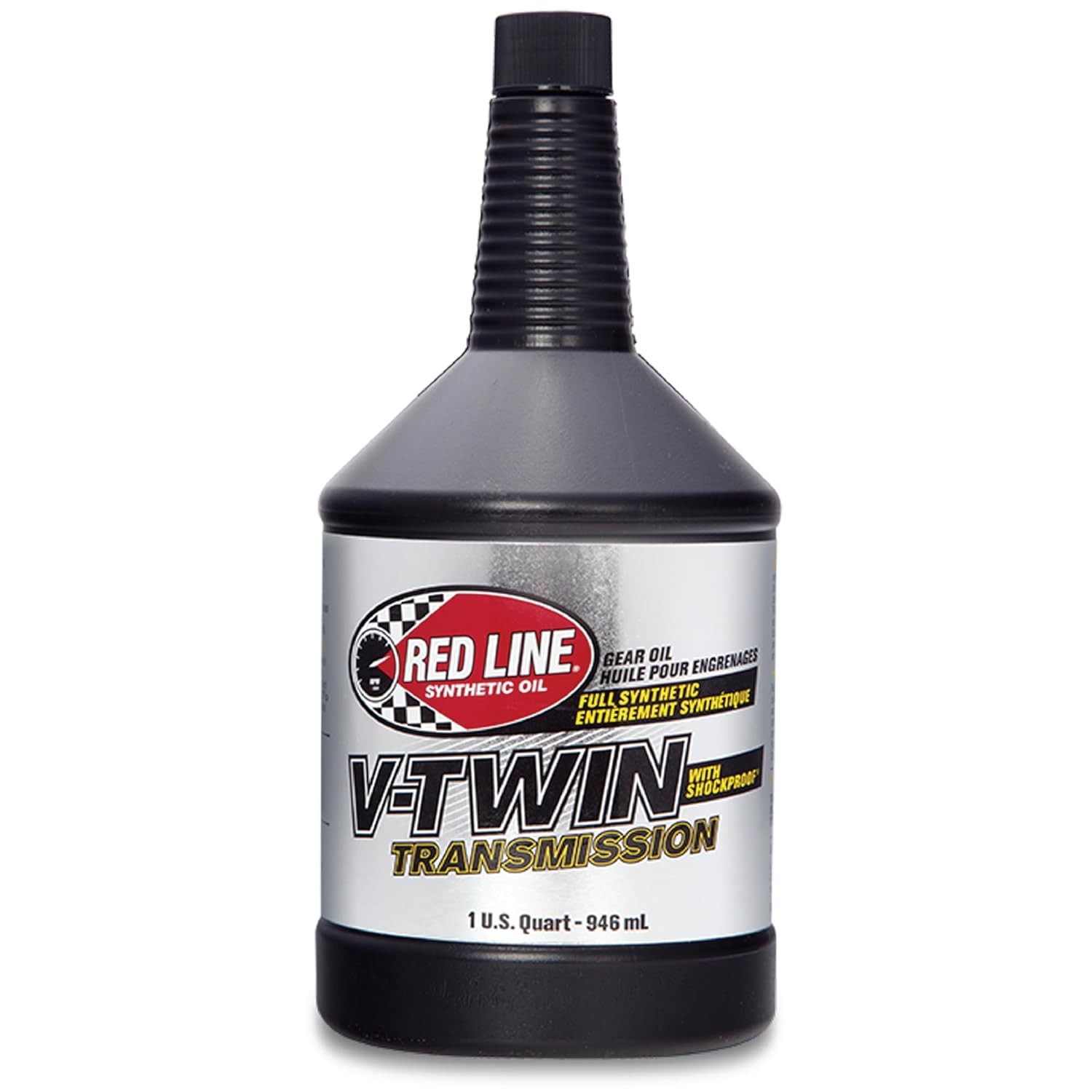
Fits: Big Twin 5-speed and 6-speed transmissions
Rating: 4.9 / 5 from 1,934 ratings
At 4.9 stars across nearly two thousand ratings, this is the highest-rated product in this entire guide, and transmission fluid is not a category that usually generates enthusiasm. Red Line’s ShockProof technology uses a suspended solid additive that carries load between gear teeth under impact – which is precisely the condition a Harley gearbox creates every time you stamp into first. The result riders describe with unusual consistency is a gearbox that stops clunking. If your bike bangs into gear, hunts for neutral at a stop, or has picked up a notchy second, this is the single cheapest thing to try before anyone opens the case. It is a full synthetic gear oil for JASO MA/MA2 applications and it is sold in single quarts, which is roughly what a Big Twin transmission takes.
What owners say: “Shifts like butter, nice and quiet, clicks into gear very smooth. Perfect for my 2011 Street Glide. – MARK S, verified purchase”
Are Harley Oil Change Kits Worth It?
A Harley oil change kit bundles the right volume of oil with a filter and usually a fresh drain plug O-ring. Buying the pieces separately is cheaper on paper. The kits win on two counts: you get the correct quantity for your engine without guessing, and you are not halfway through the job discovering the filter you have is for a different model.
What to check before you buy one:
- Does it cover all three holes or just the engine? Many kits marketed as “oil change kits” contain engine oil only. A true 3-hole oil change kit includes primary and transmission fluid as well.
- Is the filter the right one for your model? Chrome and black filters are cosmetic; the thread and gasket are not.
- Is the O-ring included? Reusing an old drain plug O-ring is how weeping leaks start.
Kits make the most sense for Big Twin owners doing a full 3-hole service, and for anyone servicing a bike for the first time who would rather not cross-reference part numbers. If you service several bikes a year, buying oil by the case and filters separately is cheaper.
Maxima 90-119014C V-Twin Quick Change Kit with Chrome Filter
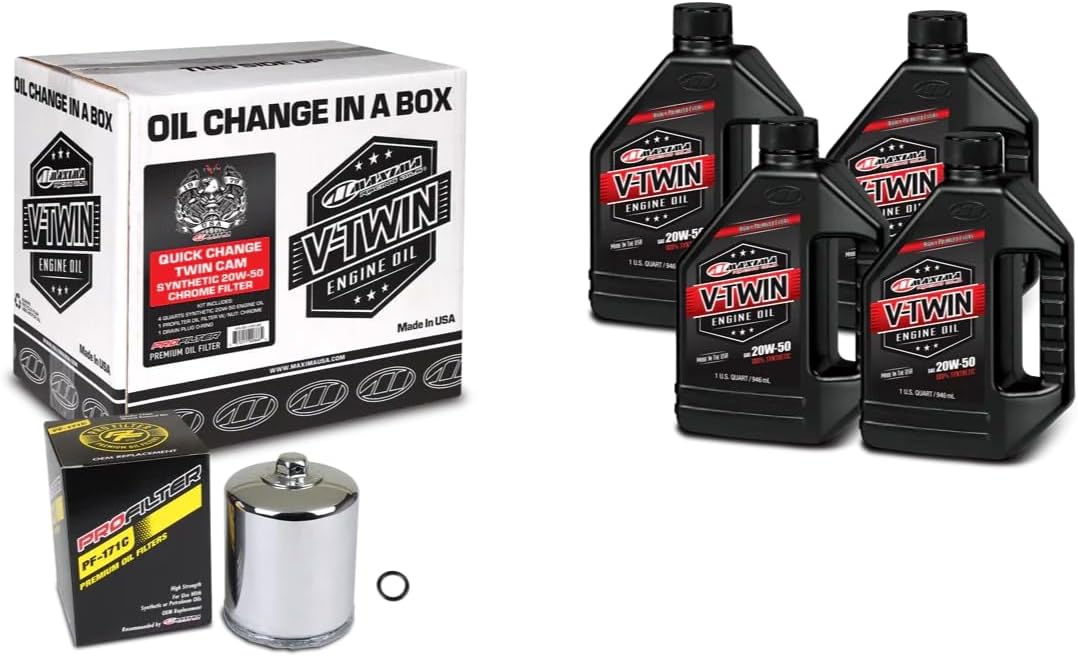
Fits: Twin Cam engines – engine oil and filter
Rating: 4.7 / 5 from 278 ratings
This is a kit rather than a bottle, and that is the point of including it. It bundles Maxima’s ester-fortified synthetic 20W-50 with a chrome oil filter sized for Twin Cam engines, so you are not cross-referencing part numbers or discovering mid-job that the filter on the shelf is for a different model. Maxima’s oil exceeds API SN PLUS and JASO MA2, and the filter has a hex on the end so it comes off with a socket instead of a strap wrench – a small thing that stops being small when the filter sits behind the frame. Two honest caveats. First, this covers the engine only, not the primary or transmission, so it is not a full 3-hole kit. Second, a recurring complaint in the reviews is a missing drain plug O-ring in the box, so have a spare on hand before you start.
What owners say: “Works as it should for my 2007 Heritage. I will purchase again for my next oil change. – JSBARTZ, verified purchase”
Best Oil Brands for Harley-Davidson Compared
Every brand below makes a 20W-50 that will protect your engine. What separates them is base stock quality, additive package and price per quart.
Who makes Harley-Davidson oil?
This question comes up constantly, and the honest answer is that Harley-Davidson does not refine oil. The bottles sold at the dealer – Screamin’ Eagle SYN3, H-D 360 and Genuine Syn Blend – are blended for Harley by outside lubricant manufacturers and sold under the Harley label. That is normal practice across the motorcycle industry and it is not a criticism: SYN3 is a competent full synthetic that meets Harley’s own spec, and using it removes any warranty argument at the dealer.
What it does mean is that you are paying for the bar-and-shield. Several independent 20W-50s match or beat it on paper for less money, and the dealer-only distribution makes SYN3 awkward to buy online.
Red Line
An ester and PAO-based synthetic aimed at the performance end. High ZDDP – around 2,200 ppm – and JASO MA/MA2 rated. This is the oil that shows up most often in threads where someone has actually torn a motor down and looked at wear. It is not cheap and it does not pretend to be. Red Line also makes dedicated primary and transmission fluids, which makes it easy to do a full 3-hole change on one brand.
Mobil 1
The V-Twin 20W-50 is the most widely used aftermarket oil in this category, and with over 2,500 ratings it is also the most scrutinised. Riders pick it for a simple reason: it performs like a premium synthetic and it is available everywhere, including local auto parts stores when you are mid-service and short a quart.
AMSOIL
Long-standing reputation among V-twin owners and the brand most often cited alongside Red Line in oil-analysis discussions. AMSOIL’s 20W-50 is formulated to work in engine, transmission and primary, which appeals to riders who want one bottle for the whole job. Distribution is partly direct, so availability fluctuates.
Castrol
Power1 V-Twin is the mainstream pick – full synthetic, exceeds API SL and JASO MA-2, priced below Red Line and AMSOIL. A sensible default if you want a known brand without the premium.
Note the trap: Castrol also sells GTX 20W-50, a conventional automotive oil in a similar bottle at a much lower price. It is not the same product and it is not formulated for a wet clutch. Check the label says V-Twin.
Maxima
Ester-fortified synthetic with a following in the racing world. Maxima’s V-Twin quick-change kits bundle oil and a filter, which is where most riders encounter the brand.
Valvoline
The 4-Stroke full synthetic 20W-50 is the value play in this list – roughly a third of the price of the premium brands, meets API SL and JASO MA2, and sits at 4.8 stars. If you change oil often and would rather spend the difference on tires, this is a defensible choice.
Spectro and Lucas
Both are strongest on the primary and transmission side rather than engine oil. Spectro’s Heavy Duty Primary Chaincase Oil and Lucas’s 10790 are two of the most-reviewed primary fluids available, and both are worth more attention than the engine oil arguments usually get.
Milwaukee-Eight Oil Sumping: What Owners Should Know
If you ride a Milwaukee-Eight, this is the one oil-related issue specific to your engine worth understanding.
Sumping is oil pooling in the crankcase instead of being scavenged back to the tank the way a dry-sump system intends. Symptoms owners report include a puff of smoke on start-up after the bike has sat, oil level reading high on the dipstick, and in some cases oil making its way into the airbox.
It is not caused by the oil you use, and no brand of 20W-50 fixes or prevents it – that is worth saying plainly, because plenty of forum advice suggests otherwise. It is a scavenging and crankcase-pressure matter, and the fixes owners pursue involve hardware, not lubricant.
Where oil choice does matter is diagnosis. If you are chasing a high dipstick reading, overfilling is the first thing to rule out, and that comes back to knowing your actual capacity – 4.8 quarts at a service refill on a 107 or 114, not five quarts because that is what the jug holds. Check the level with the bike upright and warm, following the procedure in your manual, not on the sidestand.
If you are seeing symptoms, talk to a technician who knows M8s rather than changing oil brands and hoping.
Watch: Oil Transfer Explained by a Harley Technician
Doc Harley, from the service clinic at Low Country Harley-Davidson, walks through what oil transfer actually is, why owners keep asking about it, and what is worth checking before assuming something is wrong with the motor. It covers the same ground as the section above from a dealer technician’s point of view, on a bike, with the covers off.
How Often Should You Change Harley Oil?
Harley’s own service schedule puts engine oil and filter at every 5,000 miles for most modern models, with primary and transmission fluid on a longer cycle. That is the number to work from if you ride normally in moderate conditions.
Ride harder than that and the interval should come down:
- 2,500 – 3,000 miles if you run conventional oil, ride in sustained heat, sit in traffic a lot, or tow.
- 5,000 miles on full synthetic under normal use.
- Once a season regardless of mileage. Oil degrades sitting still, and moisture collects in a motor that gets short runs. If you put 1,200 miles on the bike all summer, it still wants fresh oil before winter.
The primary and transmission are usually specified at longer intervals than the engine, but riders who do a lot of stop-start miles – or anyone chasing a notchy gearbox – benefit from doing all three together once a year. That is the whole point of the 3-hole change.
What does a Harley oil change cost?
At a dealer, expect roughly $120 to $250 for a full 3-hole service depending on region and whether you are getting Harley-branded fluids. Doing it yourself, the same job in premium synthetic runs about $60 to $90 in fluids and a filter – less if you buy oil by the case or run a value brand like Valvoline.
The job itself is straightforward: three drain plugs, one filter, a torque wrench and about an hour. The most common mistakes are overtightening the drain plugs and reusing tired O-rings.
Don’t Forget the Filter
An oil change without a new filter is not really an oil change. The filter holds several ounces of dirty oil and whatever it has already captured, and putting fresh oil through an old element defeats the purpose.
Three things matter when choosing a Harley oil filter:
- Fitment. Filters are model and year specific. Chrome versus black is cosmetic; thread pitch and gasket diameter are not. Check a filter chart against your exact model before buying.
- The anti-drainback valve. It keeps oil in the filter when the engine is off so the motor is not running dry for the first second after a cold start. Cheap filters skimp here.
- A nut on the end. Filters with a welded hex on the base can be removed with a socket instead of a strap wrench. On a bike where the filter sits behind the frame, this is worth more than it sounds.
Harley’s own filters are good and correctly specified. K&N, Hiflofiltro and Wix are the aftermarket names that come up most often, and all three are credible.
Replace the drain plug O-ring at the same time. It costs almost nothing and it is the difference between a dry primary cover and a slow weep you will be chasing all season.
Harley-Davidson Oil - FAQs
What oil does Harley-Davidson officially recommend?
Who makes Harley-Davidson oil?
Can I use automotive 20W-50 in a Harley?
Is Mobil 1 good for a Harley?
Is Maxima oil good for Harley-Davidson?
Can I use engine oil in the primary?
What is a 3-hole oil change?
How much oil does a Twin Cam 103 take?
How often should I change the oil?
Conclusion
If you take one thing from this guide, make it the three systems. Most oil confusion around Harleys comes from riders treating a Big Twin like a car engine with one drain plug, when it has three compartments doing three different jobs.
Get the grade right – 20W-50 for almost everything, JASO MA or MA2 on the label – and the brand argument matters far less than the internet suggests. A full synthetic in a Twin Cam 103 or a Milwaukee-Eight is money well spent. On an Evo that gets changed twice a season, a good conventional is genuinely fine.
Whichever you choose, change it on schedule, change the filter with it, and check the capacity for your engine before you start pouring.
#1 Pick: Best Oil for Harley-Davidson
Red Line 42504 20W-50 Motorcycle Oil
If you want one answer without reading further: a full-synthetic 20W-50 that carries JASO MA or MA2. Red Line’s 42504 is the strongest technical package in this guide – ester and PAO base stocks, ZDDP around 2,200 ppm, and matching primary and transmission fluids so a full 3-hole change stays on one brand. On a budget, the Valvoline further down this page does the same job for about a third of the price.