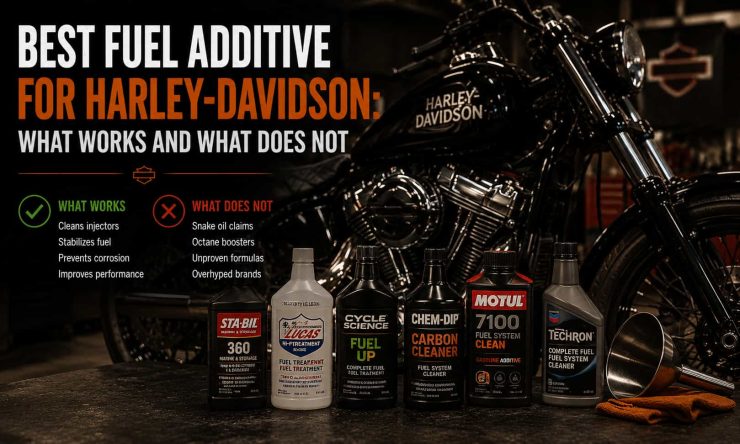
The fuel additive aisle is the easiest place on earth to spend money on nothing. Everything on
the shelf promises more power, a cleaner engine and a smoother idle, and almost none of it tells you
the one number that decides whether it does anything at all on a motorcycle: how many gallons the
bottle is dosed for.
That number matters more on a Harley than on anything else you own. A Milwaukee-Eight or Twin Cam
carries roughly five to six gallons. Nearly every additive in the shop is measured for a car tank of
fifteen to twenty. Pour in a bottle sized for a sedan and you have not treated your bike more
thoroughly – you have overdosed it by a factor of three, and on a solvent-based product that is not
a neutral thing to do.
So this guide takes a different line from the usual list. Every product below is priced per
Harley tankful, not per bottle, because that is the only comparison that means anything to
someone with a five-gallon tank. And the recommendations are honest about what happens if you skip
most of them.
Because here is the summary, up front: most Harley owners need exactly one additive, and
it is a fuel stabiliser for the months the bike sits. A fuel-system cleaner once a season is
defensible. Octane boosters, for the vast majority of stock bikes, are money set on fire – and two of
the three in this guide contain a metal compound you should understand before you pour it in.
What follows is the arithmetic behind that, then 17 products checked page by page, grouped by
what they actually do.
#1 Pick: Best Fuel Additive for Harley-Davidson
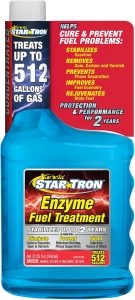
Star Tron Enzyme Fuel Treatment Concentrate, 32 oz
A stabiliser is the one additive that prevents a failure which actually happens to Harleys, and this is the cheapest per tankful by a wide margin – about 32 cents. It is also one of only two products here that name phase separation and explain how they handle it.
The top best product [hide]
Octane boosters: do the arithmetic before you buy
This is the most-searched question in this category and the one with the least honest answers, so
let us use the manufacturers’ own numbers.
Torco Accelerator – the only brand that gives you real figures
Torco publishes exact ratios, and they are worth reading slowly: 32 oz to 10 gallons gives 102
octane, 32 oz to 5 gallons gives 105 octane, starting from 91 premium.
Read that again with a Harley tank in mind. Five gallons is a Harley tank. So to reach the
headline number, you empty a whole 32-ounce bottle – the entire $34 bottle – into one tankful. Even
at the gentler ratio you are spending about $17 per fill. That is not an additive. It is buying race
fuel by dilution, and Torco is being honest about it. The number is real, and so is the price.
VP Racing – the units are doing the work
VP’s listing says boosts octane up to 5 numbers and, in the same breath, raises
octane levels by up to 50 points. Those are the same claim written twice, because a “point” here
is a tenth of an octane number. Fifty points sounds like a great deal more than five numbers. It is
not.
And both figures carry “up to”, which refers to the maximum concentration – the whole can in a
small tank. Dose it normally across fifteen or twenty gallons and the real gain is a fraction of
that.
Lucas – no number at all
Lucas 10026 does not state an octane increase anywhere. What it says is that it delivers
three times more boost than most other brands. Three times an unstated quantity is still an
unstated quantity. It is the least checkable claim in this guide.
What an owner who actually measured it says
The most useful review in the entire category is a four-star one on the VP can, from someone who
tests at a drag strip: “My expectations are low for these products… I can not detect a
difference at the strip. Temperature and humidity have larger impact than octane booster.”
That is the honest ceiling. On a stock engine that is not detonating, adding octane does nothing,
because octane is not power – it is resistance to detonation. If the engine is not knocking, there is
nothing for extra octane to fix.
When a booster genuinely earns its place
Two situations, and neither is about horsepower:
- You cannot find premium. This is the real Harley use case and the reviews are
full of it. One owner: “I always carry a few of these in my saddlebags. I’ve ran into many gas
stations that have been out of premium fuel or that their highest octane is 90.” Another rides
cross-country with one bottle every other fill. Lucas sells a 2-ounce bottle specifically dosed for a
single motorcycle tank, which tells you who buys it. - A tuned or high-compression engine that is actually detonating. If you have a big
bore, a Stage tune, high compression or you hear pinging under load in heat, higher octane is the
correct answer – and the better version of that answer is to fix the tune, not to treat every tank.
What a booster does not do: add power to a healthy stock bike, clean anything, or compensate for
running the wrong grade permanently. Check what your model’s fuel filler and owner’s manual specify
and just buy that grade.
MMT: read the label before you pour
Both VP Racing Octane Booster and Torco Accelerator work by way of MMT – a manganese compound. It
is genuinely effective at raising octane, which is why race-oriented brands use it. It also leaves
manganese deposits behind as it burns.
An owner puts the caution in seven words in the VP reviews: “Does contain MMT. Use almost
never.”
That is roughly the right posture. Occasional use – a bottle in the saddlebag for a fill-up in the
middle of nowhere, an event weekend – is a different thing from a dose in every tank for a season.
Regular use is associated with deposits on spark plugs and on sensors in the exhaust, and on a bike
with oxygen sensors feeding a closed-loop ECM that is not a trivial place to accumulate anything.
It is not a reason to avoid these products. It is a reason to keep them for the situation they
suit – the occasional bad fill, the tuned engine – and to reach for something else the rest of the
time. If you do run one regularly, pull a plug and look at it.
The dosing problem nobody mentions
Almost every additive on the shelf is designed around a car. A Harley tank is roughly a third the
size. That creates three practical problems that no listing addresses.
1. A single-dose bottle is three doses for you. Red Line SI-1 is a full 15-ounce
bottle per tank for a cleaning treatment – written for up to about 20 gallons. Chevron Techron is
20 ounces for 20 gallons. Pour either straight into a Harley and you are running roughly three to
four times the intended concentration. On a detergent that is mostly wasteful. On a petroleum solvent
it is worth avoiding.
2. You end up measuring by eye. Which means most people either underdose and
conclude the product is useless, or upend the bottle and conclude it is expensive. Both complaints
fill the review sections, and both are dosing errors rather than product failures.
3. Cost per fill looks nothing like cost per bottle. A $29.59 bottle of Star Tron
concentrate is the most expensive item in this guide and works out at about 32 cents per Harley
tankful, because it treats 512 gallons. A $6.48 bottle of Royal Purple is one treatment. The shelf
price tells you almost nothing.
Cost per Harley tankful – the comparison that matters
| Product | Type | Bottle | Per 5-6 gal tank |
|---|---|---|---|
| Star Tron Enzyme Concentrate | Stabiliser | $29.59 / 512 gal | about $0.32 |
| Lucas 10003 Fuel Treatment | Universal | $12.49 / 160 gal | about $0.45 |
| STA-BIL In-Season | Detergent | $15.71 / 160 gal | about $0.55 |
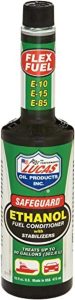
| Lucas Safeguard Ethanol | Ethanol | $11.98 / 80 gal | about $0.80 |
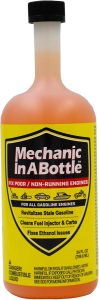
| Mechanic in a Bottle | Ethanol / carb | $23.99 | about $1.00 |
| Quicksilver Quickstor | Stabiliser | $15.99 / 60 gal | about $1.45 |
| Lucas 10302 Stabiliser | Stabiliser | $10.62 / 37 gal | about $1.50 |
| STA-BIL Storage | Stabiliser | $11.99 / 40 gal | about $1.60 |
| VP Ethanol Armor | Ethanol | $12.98 / 40 gal | about $1.80 |
| Berryman B-12 | Solvent cleaner | $6.77 per can | about $2.15 |
| Sea Foam | Universal solvent | $32.77 / 3 cans | about $3.75 |
| Techron Concentrate Plus | PEA cleaner | $15.99 / 20 gal | about $4.40 |
| VP Octane Booster | Octane (MMT) | $13.59 per can | about $4.50 |
| Royal Purple 18000 | PEA cleaner | $6.48 | $6.48, one dose |
| Red Line SI-1 | PEA cleaner | $17.28 | $17.28 full clean |
| Torco Accelerator | Octane (MMT) | $34.00 | $17 to $34 |
Figures are calculated from each label’s own dose rate against a 5 to 6 gallon tank, and prices
move – use the links for current pricing. But the shape of the table does not change: the cheapest
per-fill products in this guide are stabilisers, and the most expensive are octane boosters.
Ethanol, phase separation and the winter your bike sits still
If you buy one thing off this page, buy a stabiliser. This is the failure mode that actually
happens to Harleys, and it happens every spring to people who parked in October without thinking
about it.
What actually goes wrong
Pump gasoline is typically an ethanol blend, and ethanol attracts water out of the air. Left
standing for months, enough water accumulates that the ethanol and water drop out of the gasoline and
settle at the bottom of the tank as a separate layer. That is phase separation. The
layer at the bottom is where your fuel pickup is. Meanwhile the gasoline left above it has lost the
ethanol that was carrying part of its octane, and the light fractions have evaporated, so what is
left is stale and hard to light.
The result in April is a bike that cranks and will not fire, or fires and runs badly, and in the
worst cases a fuel system that needs cleaning out.
Which products actually address it
Only two in this guide make the phase-separation claim explicitly, and it is worth knowing how
they differ.
Star Tron states it helps prevent phase separation by dispersing water
throughout fuel as submicron-sized droplets that are safely eliminated while the engine
operates. It does not remove the water – it breaks it up finely enough that the engine burns it
along with the fuel.
VP Ethanol Armor claims it effectively separates water from ethanol-blended
fuel, reducing water absorption.
The rest are more modest. STA-BIL protects against corrosion and ethanol damage across E10 to E85.
Lucas Safeguard is built specifically for ethanol blends and states it will not harm filters, but
says nothing about phase separation. Lucas 10302’s distinguishing feature is that it contains no
alcohol – which is a sensible thing for a stabiliser going into already-alcoholic fuel.
The rule everyone learns the hard way
A stabiliser is prevention, not a cure. None of these claims to restore fuel that has already
separated. A Quickstor owner states the rule in one line: “Just make sure you have fresh gasoline
in the tank when adding.”
Stated storage life
| Product | Manufacturer’s stated storage life |
|---|---|
| STA-BIL Storage | Up to 24 months |
| Star Tron | Up to 2 years, and claims to rejuvenate old fuel |
| Quicksilver Quickstor | Up to 2 years |
| Sea Foam | Up to 2 years |
| Techron Concentrate Plus | 12 months – and it is a cleaner first |
| Lucas 10302, Lucas Safeguard, VP Ethanol Armor | No figure published |
How to lay a Harley up properly
- Add the stabiliser to fresh fuel, at the storage dose – which is usually double
the maintenance dose. Read the label. - Fill the tank. A full tank has almost no air in it, and air is where the
moisture comes from. This matters more than which brand you chose. - Run the engine for five to ten minutes so treated fuel reaches the pump, lines, injectors or
carburettor. Untreated fuel sitting in the fuel rail is not protected by treated fuel sitting in the
tank. - Put the battery on a tender, and check tyre pressures – unrelated to fuel, but it is the same
afternoon. - In spring, start it before you need it, not on the morning of the first good ride.
The best evidence in these reviews is one line from a rider who did exactly this: he stored the
bike with a full tank and the recommended dose of stabiliser mixed in, and four months later it
fired up on the first push.
Fuel system cleaners: PEA versus solvent
“Fuel system cleaner” covers two chemically different products that solve different problems, and
knowing which is which is most of the decision.
PEA detergents
Polyether amine. These are designed to stay in solution through the fuel system and clean deposits
off intake valves and out of the combustion chamber as the engine runs. Techron, Red Line SI-1 and
STA-BIL In-Season are the PEA products here. The most quoted owner comment on Techron is precisely
about this: it is praised as the product with the highest PEA content per ounce, which is the metric
enthusiasts actually compare.
Petroleum solvents
Sea Foam and Berryman B-12 work by dissolving gum, varnish and lacquer. That is a different and
very useful job: it is what unsticks a carburettor that has sat, clears a gummy pilot circuit, and
cleans out a tank that has had old fuel in it. A Berryman owner sums up the value: “Has saved me
some carb rebuilds.”
Which one does a Harley need?
Depends entirely on the bike.
- Modern EFI Harley on decent fuel: deposits build slowly. A PEA cleaner once or
twice a season is a reasonable maintenance habit. Adding one every tank is not buying you anything. - Carburetted or older bike, or one that has sat: a solvent is the more useful
tool, because the problem is varnish in the carburettor rather than deposits on valves. - A bike with a specific symptom – rough cold start, hesitation, stumble at small
throttle openings – is where owners report the clearest results, and the reviews back this up:
a rough, stalling EFI engine that “purrs like a kitten” after a treatment, a shaking cold
start that stopped.
Be sceptical, and the reviews agree with you
What is striking about this category is how many positive reviews open by conceding the
point. A five-star STA-BIL In-Season review begins “While you may be tempted to think it is snake
oil…”. A five-star Techron review is titled “Mixed Success, but still the best product out
there.” A Royal Purple buyer who liked it writes that of everything he has tried on the American
market, “the majority are snake oil and do nothing to improve.”
These are people recommending the product. Take the hint: expect a specific symptom to improve,
not the bike to feel new.
What a Harley actually needs, and when
Stripped of marketing, here is a defensible schedule.
| When | What | Why |
|---|---|---|
| Every tank | Nothing | Modern fuel already contains detergent. Nothing here needs to go in every fill on a healthy bike. |
| Once or twice a season | A PEA fuel-system cleaner | Maintenance for injectors, intake valves and combustion chamber. Optional, defensible, cheap. |
| Before any lay-up over a month | Fuel stabiliser, full tank, run the engine | The one genuinely necessary additive. Prevents phase separation and stale fuel. |
| Bike that has sat with old fuel | A solvent cleaner, or drain it | Dissolves the varnish that stabiliser was supposed to prevent. |
| Touring where premium is scarce | A small octane booster in the saddlebag | For the fill-up that only offers 87, not for every tank. |
| Tuned or high-compression engine that pings | Higher-octane fuel, and revisit the tune |
Detonation is a tuning problem that fuel masks. |
| Stock bike, no symptoms, ridden regularly | Nothing at all | Ride it. |
When an additive will not fix it
Fuel additives are cheap, which makes them the first thing people try and often the wrong thing.
These symptoms are not fuel chemistry problems, and pouring something in the tank delays the actual
repair.
- Pinging that appeared after a tune, cam or big bore. That is calibration.
Treating every tank with octane booster is an expensive way to hide it. - Running hot in traffic. Harleys are air-cooled and heat in stop-start traffic is
normal behaviour, not a fuel fault. - A misfire at a specific cylinder or rpm. Look at plugs, coil and wires first.
- A fuel pump whining or a bike that dies under load. Pump or filter, not
additive. - Poor fuel economy after a change. If something changed – intake, exhaust, tune –
the cause is that change. - A bike that sat for years. Solvent in the tank will not save a fuel system full
of hardened varnish and a rusted tank. That is a drain, a clean and probably a carburettor rebuild or
a pump. - Anything with a check-engine light. Read the code first. It costs nothing and it
tells you what is actually wrong.
Seven ways people waste money here
- Pouring a car-sized dose into a five-gallon tank. Three to four times the
intended concentration, and the most common error in the category. - Adding stabiliser to fuel that is already old. It is prevention, not a cure. Add
it to fresh fuel. - Storing on a half-empty tank. The air in the space above the fuel is where the
water comes from. Fill it. - Adding stabiliser and not running the engine. The lines, pump and injectors stay
full of untreated fuel all winter. - Octane booster in a healthy stock engine. Octane resists detonation. No
detonation, no benefit. - Running MMT boosters every tank. Occasional is fine. Constant deposits on plugs
and sensors are not what you wanted. - Judging by feel after one tank. The one owner in these reviews who measured at a
drag strip found weather mattered more than the additive. Trust a fixed symptom, not a sensation.
17 additives, priced per Harley tankful
Every product below was checked on its own listing: current price, rating, review count, the
manufacturer’s own dose rate, and what owners complain about. Prices per tank are calculated from
each label’s dose rate against a 5 to 6 gallon Harley tank, which is the number that decides whether
something is cheap or not.
Fuel stabilisers – the one category that matters
If your Harley sits through a winter, or even sits for a month between rides, this is the group
to buy from. Add to fresh fuel, fill the tank, run the engine for a few minutes. Everything else on
this page is optional; this is not.
Star Tron Enzyme Fuel Treatment Concentrate, 32 oz
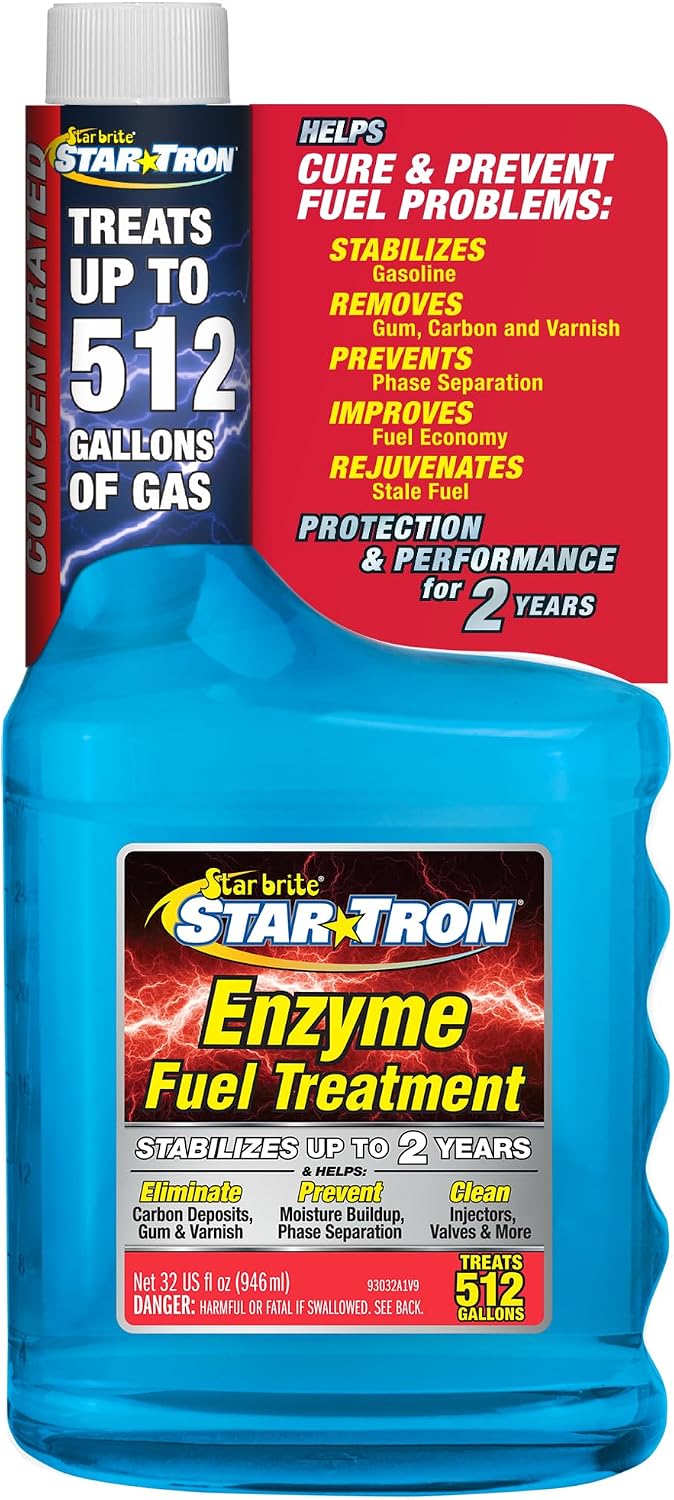
Type: enzyme stabiliser and treatment. 32 oz treats 512 gallons at 1 oz per 16 gal. Stated storage life up to 2 years. Around $29.59.
Per Harley tank: about $0.32 – roughly a third of an ounce for a 5-6 gallon tank. Double the dose for storage.
Rating: 4.8 / 5 from 9,958 ratings
The cheapest product in this entire guide to actually use, and the most expensive to buy – which is exactly why the shelf price misleads people. Thirty dollars looks steep next to a twelve-dollar bottle of STA-BIL, until you notice it treats 512 gallons. That is about thirty-two cents per Harley tankful.
It is also one of only two products here that name phase separation explicitly, and it explains its mechanism rather than gesturing at it: it disperses water through the fuel as submicron droplets that get burned off while the engine runs. It does not remove the water, it makes the water harmless.
The other distinguishing claim is that it revives old, sub-spec fuel, which no other stabiliser here promises.
Where owners push back is honest enough: enzyme chemistry is hard to verify, and one four-star reviewer says plainly that the jury is out because most of the claims cannot be quantified. That is a fair criticism of the whole category, not of this bottle in particular.
What owners say: “The best fuel treatment I’ve used for stabilizing fuel long-term and preventing clogs and gumming in small fuel jets. – verified purchase”
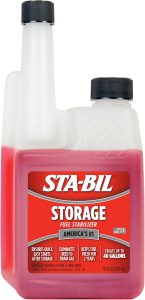
STA-BIL Storage Fuel Stabilizer, 16 oz
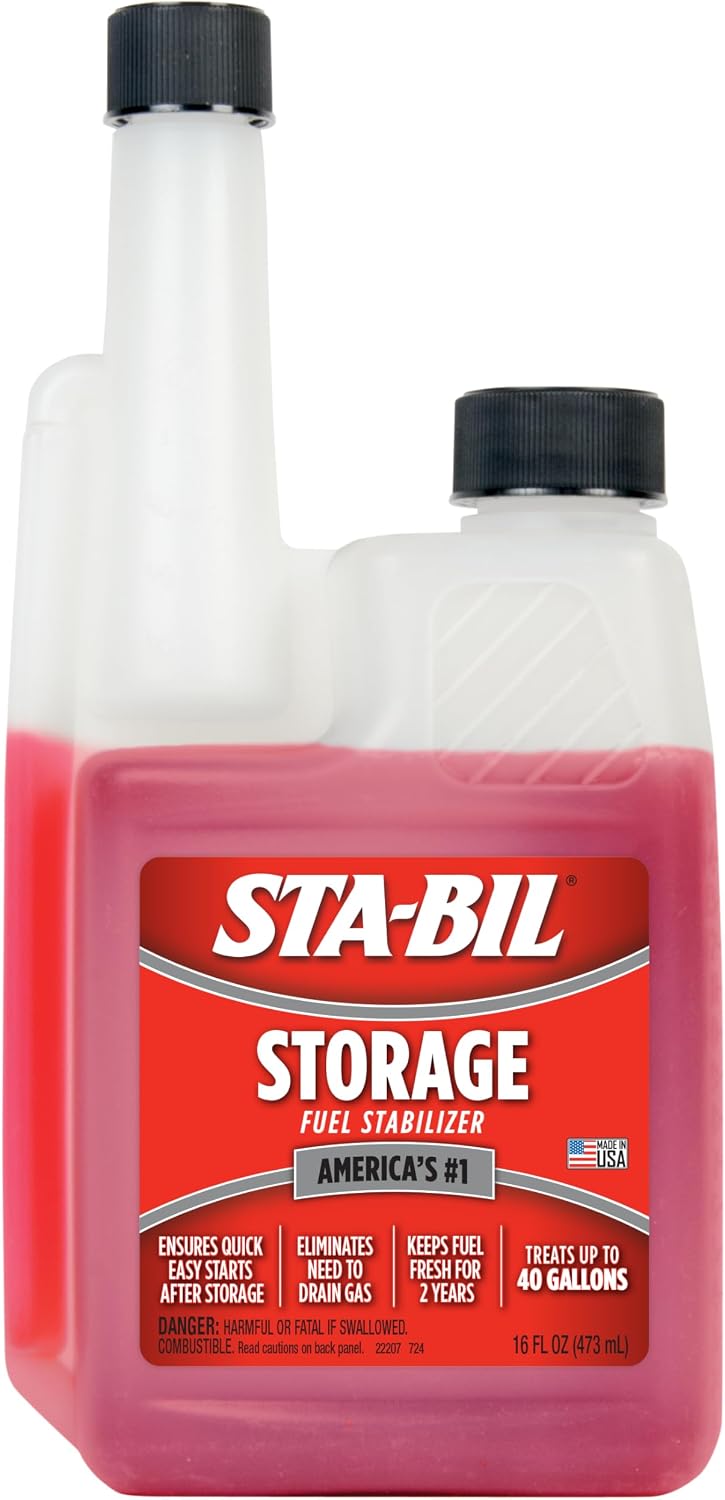
Type: storage stabiliser. 16 oz treats 40 gallons at 1 oz per 2.5 gal. Stated storage life up to 24 months. Works in E10 to E85. Around $11.99.
Per Harley tank: about $1.60 – roughly 2 to 2.4 oz for a 5-6 gallon tank.
Rating: 4.8 / 5 from 36,497 ratings
Thirty-six thousand ratings. Nothing else in this guide comes close, and for a product whose entire job is preventing a failure you will never see, that volume of feedback is worth something on its own.
The single most relevant review on this page belongs to it, from someone doing exactly what this article recommends: he stored the motorcycle with a full tank and the recommended dose mixed in, and four months later it fired up on the first push.
Twenty-four months of stated protection and coverage from E10 through E85 puts it at the top of the published-claims table, and it carries a corrosion inhibitor for the tank and fuel system – which matters on a bike that will sit through a damp winter.
Two practical notes. It is a little pricey per ounce for what it is, as a four-star reviewer concedes. And Gold Eagle sells three similarly-named products – Storage, 360 and In-Season – which causes real confusion at the shelf. Storage is the winter one.
What owners say: “Stored my motorcycle with a tankful of petrol with the recommended quantity of Sta-Bil mixed in and it fired up on the first push. – Jacob M. Joseph, after 4 months”
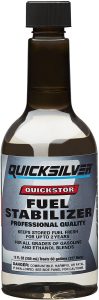
Quicksilver Quickstor Fuel Stabilizer (Mercury Marine)
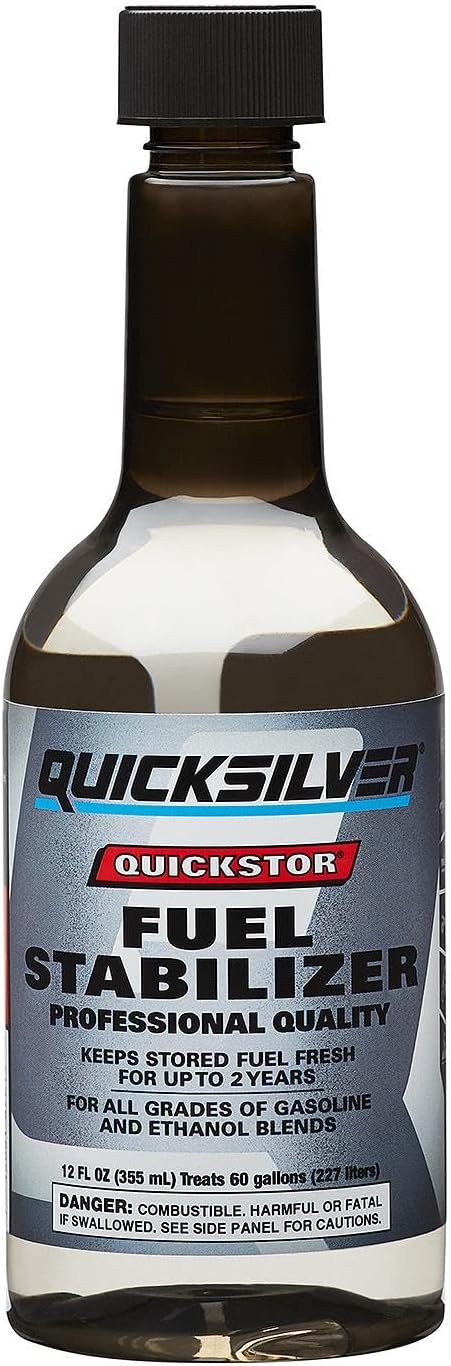
Type: OEM powersports and marine storage stabiliser. 12 oz and 32 oz. 1 oz per 5 gallons – a 12 oz bottle treats 60 gallons. Stated up to 2 years. Around $15.99.
Per Harley tank: about $1.45 – roughly 1 to 1.2 oz for a 5-6 gallon tank.
Rating: 4.7 / 5 from 430 ratings
The OEM option, built to Mercury Marine specification, and the marine pedigree is more relevant to a Harley than it sounds. Boats face the worst version of this problem – ethanol fuel sitting in a humid environment for a full off-season – so the chemistry is aimed squarely at exactly what happens to a bike in a garage over winter.
The dosing is the simplest here: one ounce per five gallons, which is almost exactly one Harley tank. No measuring cup, no arithmetic, no eyeballing. Given how many negative reviews across this category come down to dosing errors, that is a genuine advantage.
The most useful line in its reviews is not praise but a rule, and it applies to every stabiliser on this page: make sure you have fresh gasoline in the tank when adding it.
The honest caveats: it costs roughly double STA-BIL per ounce for the same two-year claim, most buyers are buying on the Mercury name rather than measured results, and the evidence base is almost entirely marine.
What owners say: “Use this every year when winterizing my vessel. Just make sure you have fresh gasoline in the tank when adding. – Garland M.”
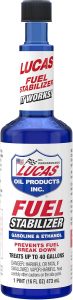
Lucas Oil 10302 Fuel Stabilizer, 15 oz
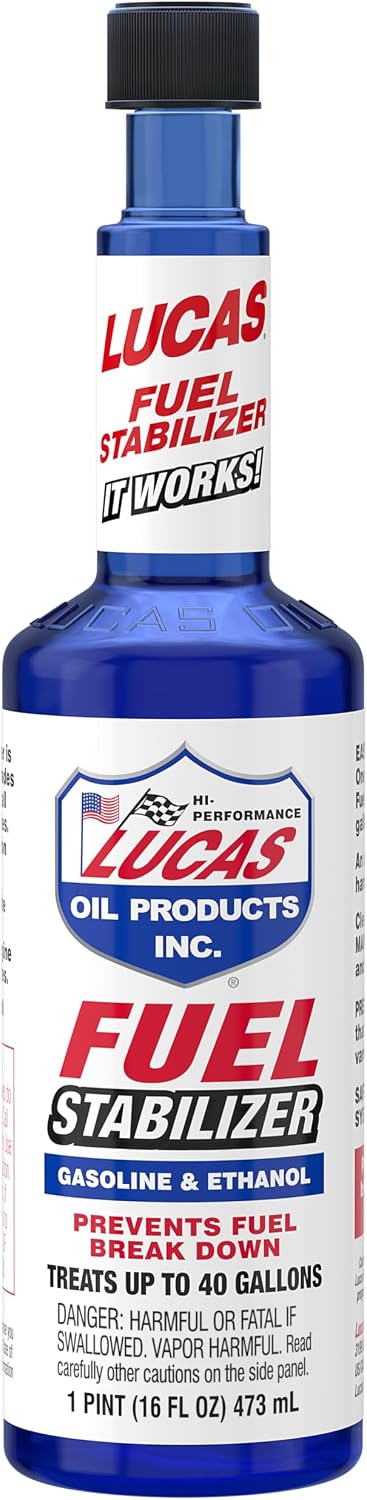
Type: alcohol-free storage stabiliser. 15 oz, roughly 37 gallons at 1 oz per 2.5 gal. No stated month figure. Around $10.62.
Per Harley tank: about $1.50 – roughly 2 to 2.4 oz for a 5-6 gallon tank.
Rating: 4.7 / 5 from 400 ratings
The distinguishing feature is one line on the label: contains no alcohol. That is a sensible thing for a stabiliser, because the fuel you are treating is already an ethanol blend and the last thing it needs is more alcohol carried in with the additive.
It covers both fuel injection and carburettors, and it claims to clean and lubricate the pump, injectors, carburettor and compression rings as well as stabilise – so it sits somewhere between a pure stabiliser and a light treatment.
Owner evidence is thin but consistent for the use case that matters: fuel kept good in a generator for over a year, and it cranked right up.
Where it falls down is comparison shopping. It publishes no storage duration at all, so you cannot line it up against STA-BIL’s 24 months or Star Tron’s two years, and at 400 ratings there is not much independent evidence either way. Several reviewers are lukewarm precisely because they cannot perceive any difference – which is the nature of preventive products, but does not help you choose.
What owners say: “Kept the fuel in my generator good for over a year. It cranked right up. – verified purchase”
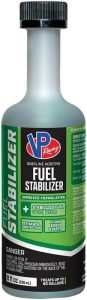
VP Racing Madditive Fuel Stabilizer with Ethanol Armor, 8 oz
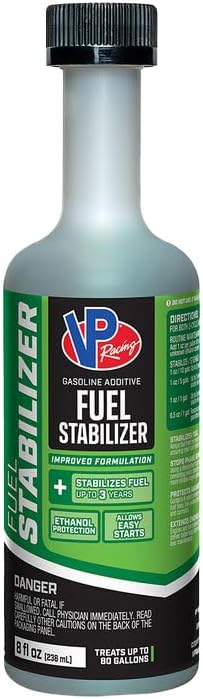
Type: ethanol treatment and storage stabiliser. 8 oz treats about 40 gallons at 1 oz per 5 gal. No stated month figure. Around $12.98.
Per Harley tank: about $1.80 – roughly 1 to 1.2 oz for a 5-6 gallon tank. Motorcycles named on the label.
Rating: 4.7 / 5 from 57 ratings
One of only two products in this guide with an explicit phase-separation claim on the listing: it states it separates water from ethanol-blended fuel and reduces water absorption. It also names motorcycles directly on the label, which most of this category does not bother to do.
The comparison owners actually make is the interesting part. One switched after years of disappointment elsewhere, on the specific grounds that this one contains Ethanol Armor chemistry that breaks down water. Whether that difference is real is not something an owner can measure – but the claim is at least specific enough to be checked against the alternatives.
The dose rate of one ounce per five gallons lines up neatly with a Harley tank, so no measuring gymnastics.
Three real reservations, though. Multiple buyers report the bottle arriving leaking, one losing about 20% of it. It is expensive per ounce – an 8 oz bottle at $12.98 next to a 32 oz STA-BIL. And with only 57 ratings there is very little to go on, with several of those being people who have not yet found out whether it worked.
What owners say: “Used Stabil for years with not much luck. This product contains Ethanol Armor, which breaks down water. – greg white”
Fuel system and injector cleaners
PEA detergents that clean injectors, intake valves and the combustion chamber over a full tank.
Reasonable once or twice a season on an EFI Harley. Watch the dose – most of these are written for a
20-gallon car tank.
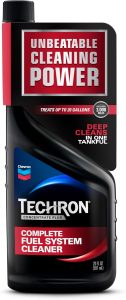
Chevron Techron Concentrate Plus, 20 oz
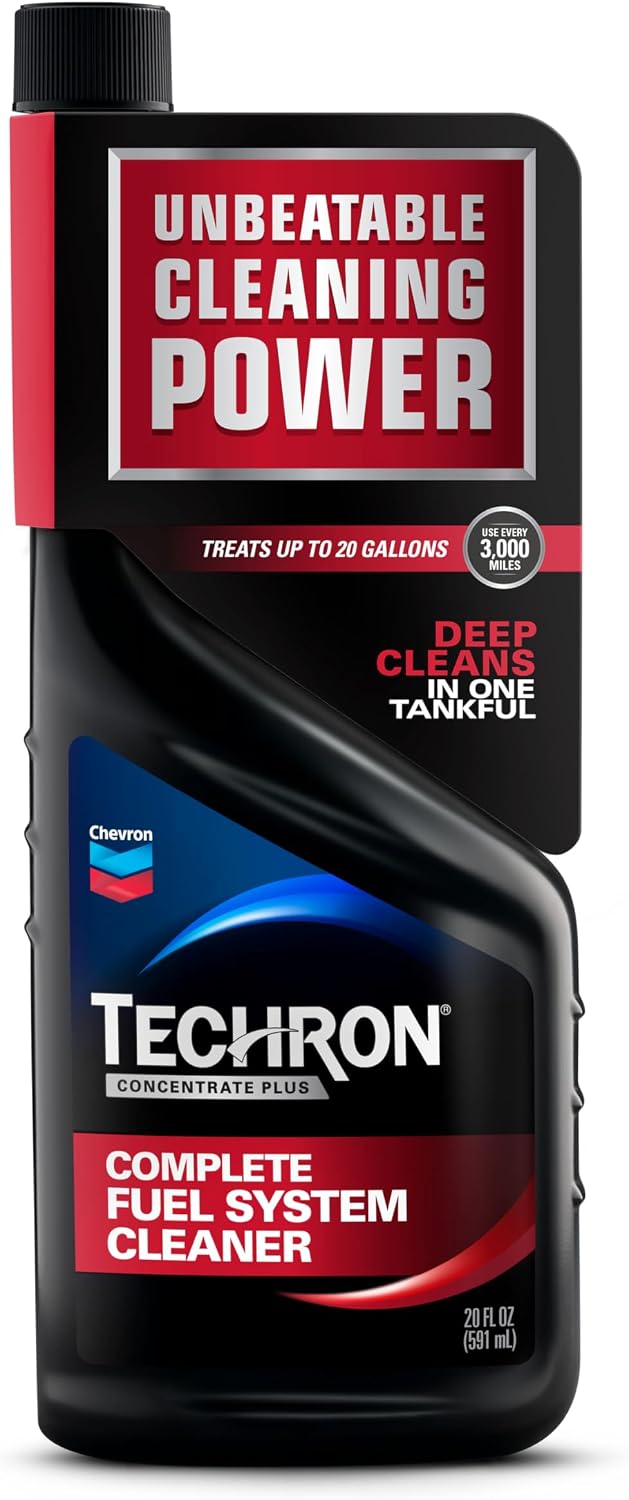
Type: PEA fuel system cleaner. 20 oz treats up to 20 gallons at 1 oz per gallon. Fuel stability claim up to 12 months. Around $15.99.
Per Harley tank: about $4.40 – a 5-6 gallon tank uses 5-6 oz, so one bottle is roughly three treatments.
Rating: 4.6 / 5 from 17,226 ratings
The benchmark PEA detergent, and the reason enthusiasts name it first is chemistry rather than branding. The most-cited owner comment gets straight to it: this is the best PEA product available in terms of the amount of polyether amine you get per ounce.
That matters because PEA is the detergent class that actually cleans intake valves and combustion chamber deposits as the engine runs, rather than dissolving varnish in the tank. On a modern EFI Harley, once or twice a season, that is the relevant job.
Chevron claims reduced rough idle, surge, hesitation and plug fouling, plus better cold starts – all symptoms rather than vague improvement, which is the right way to set expectations.
Two things to be clear about. Results are inconsistent and the brand’s own fans say so: a five-star review is titled “Mixed Success, but still the best product out there.” And the dosing is written for a car – a 20 oz bottle for 20 gallons. Pour the lot into a Harley and you have quadrupled the concentration. Measure five or six ounces and get three treatments out of it.
What owners say: “This Techron additive is the best PEA product out there in terms of the amount of PEA per oz you are getting. – MesaGuy”
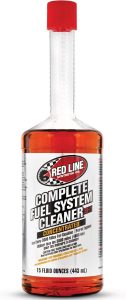
Red Line SI-1 Complete Fuel System Cleaner, 15 oz
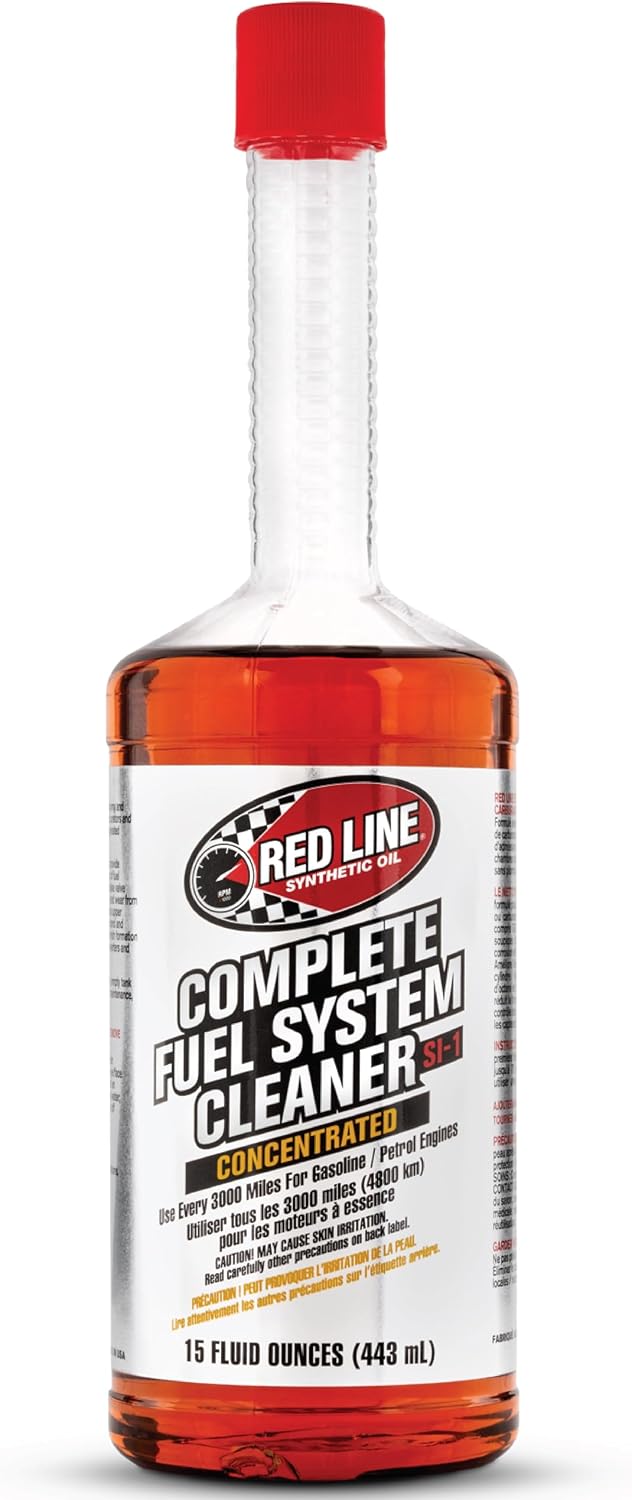
Type: concentrated PEA cleaner. 15 oz – one bottle per tank for a full clean, or diluted for maintenance. Around $17.28.
Per Harley tank: $17.28 for a full-bottle clean, or about $2.50-3.00 as a maintenance dose. Designed for a car-sized tank.
Rating: 4.8 / 5 from 10,182 ratings
The enthusiast favourite, and it names carburettors alongside injectors on the label – which is why it turns up on older Harleys as often as modern ones. High and low temperature detergents in one blend, aimed at injectors, carburettors, intake valves and combustion chamber deposits.
The best evidence is symptom-specific, which is always the useful kind. One owner’s cold-start shake disappeared entirely after a treatment. That is a checkable claim, unlike a general feeling of smoothness.
What is refreshing is the tone of its own supporters. One long review shrugs off the marketing wholesale – whether it is “the best” or “has the highest PEA”, blahblahblah – and then says it works quite well anyway, adding “as they say, YMMV.” That is roughly the correct expectation for this whole category.
Two warnings. The price has climbed sharply enough that reviewers of rival products cite it as the reason they switched. And a full 15 oz bottle is dosed for a car tank: on a Harley that is either a very expensive single treatment or something you split by eye.
What owners say: “My BMW it was shaking when I turn her on in the morning and I put this product on, no more shaking. – Bianca”
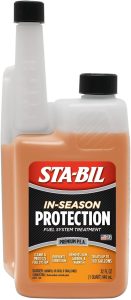
STA-BIL In-Season Fuel System Treatment, 32 oz
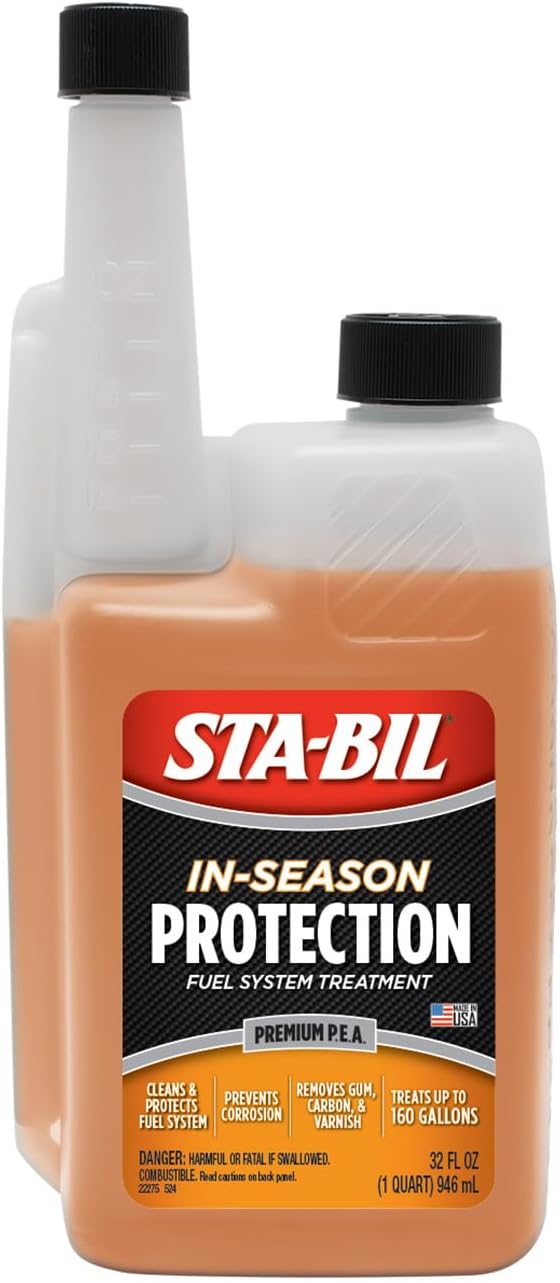
Type: in-season detergent and treatment. 32 oz treats 160 gallons at 1 oz per 5 gal. Label states: new name, same formula as 360 Protection. Around $15.71.
Per Harley tank: about $0.55 – roughly 1 to 1.2 oz for a 5-6 gallon tank.
Rating: 4.8 / 5 from 6,710 ratings
The riding-season counterpart to STA-BIL Storage, and the best value cleaner in this guide by a distance: about fifty-five cents per Harley tankful against four dollars-plus for the car-dosed products. That is because it is dosed at one ounce per five gallons rather than one ounce per gallon.
It cleans the fuel system – injectors, lines, pump – and removes water, gum and varnish, with what the maker describes as industry-leading corrosion protection for internal components. On a bike that lives in a damp garage between rides, that last part is not a throwaway.
Owner evidence covers exactly the right ground: it has been working well in a carburetted street bike, and the bottle size suits someone treating several machines.
Two cautions, both about naming. The label itself admits this is the renamed 360 Protection formula, which means people buy the wrong bottle or double up with STA-BIL Storage without realising they overlap. And the honesty of its own reviewers is worth noting – several five-star reviews open by conceding you might reasonably think it is snake oil before explaining why they kept buying it.
What owners say: “Has been working well in my carbureted CJ5 and dual carb street bike. The bottle size is great for many uses. – Alex Webster”
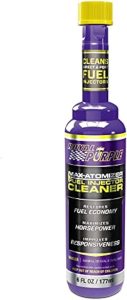
Royal Purple 18000 Fuel Injector Cleaner, 6 oz
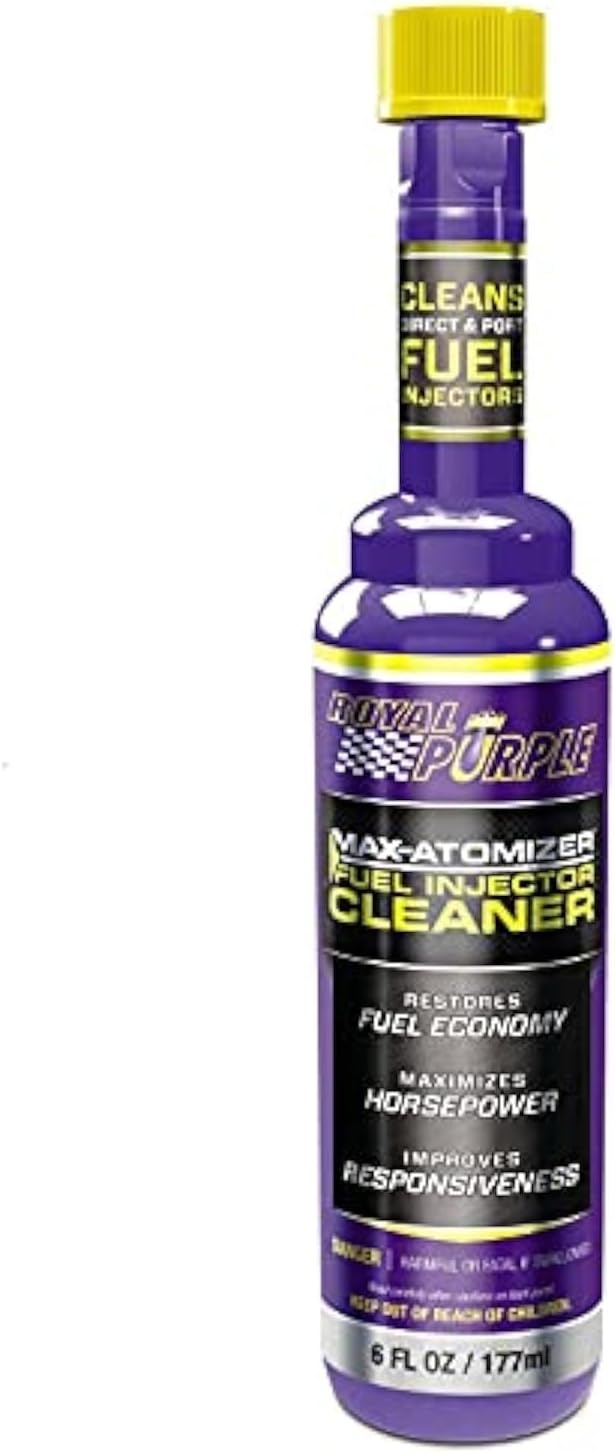
Type: single-dose detergent cleaner. 6 oz bottle, one dose per tank, rated for up to about 20 gallons. Claims it stabilises ethanol. Around $6.48.
Per Harley tank: $6.48 for one generous treatment – or split it in two. The only bottle here sized close to a motorcycle tank.
Rating: 4.6 / 5 from 3,564 ratings
The practical answer to the dosing problem that runs through this whole category. Every other cleaner here comes in a bottle written for a fifteen to twenty gallon car tank. This one is six ounces – close enough to a Harley tank that you can simply pour it in without a measuring cup or a guess.
It also carries a “stabilises ethanol” claim, and owners running E85 report using it every few tanks to smooth out the idle, which is a plausible and modest result rather than a horsepower promise.
The claims that are less useful are the ones about maximised horsepower and restored economy – not measurable by an owner, and reported subjectively when they are reported at all.
Be aware of the price per ounce: $6.48 for six ounces is over a dollar an ounce, the dearest per-ounce cleaner in this guide. You are paying for convenience and correct sizing rather than volume. And the category scepticism is voiced here as clearly as anywhere – by a buyer who likes it, no less, who notes that most products of this kind on the American market are snake oil.
What owners say: “I run E85 and this stuff every few tanks. Smoothes out the idle. – B. Stapleton”
Universal treatments and solvents
These dissolve gum and varnish rather than detergent-cleaning deposits, which makes them the right
answer for a carburettor that has sat and the wrong answer for routine maintenance on modern
injection.
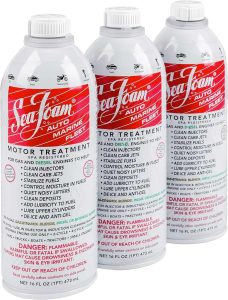
Sea Foam Motor Treatment, 16 oz x 3
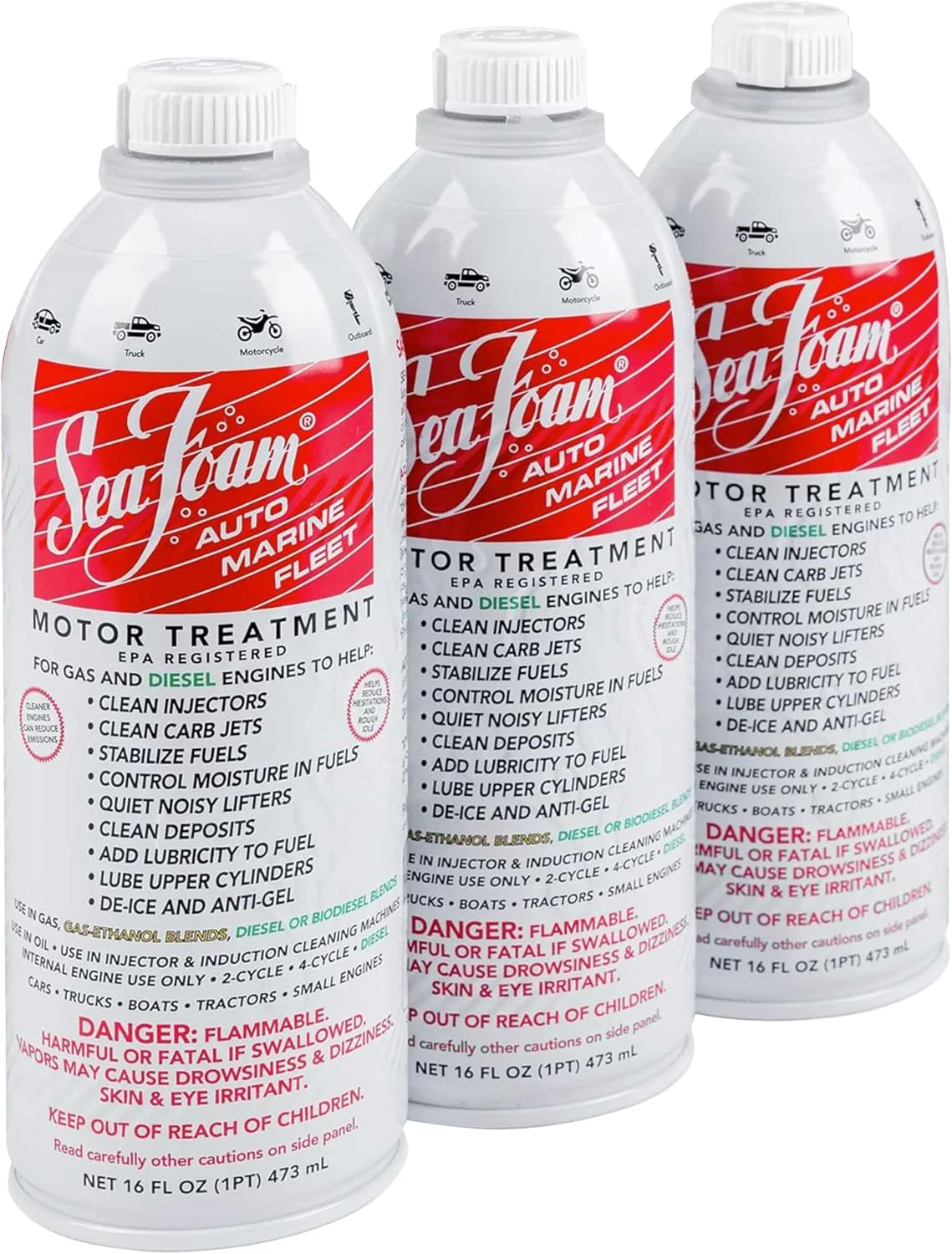
Type: petroleum solvent – cleaner, stabiliser and oil treatment. Three 16 oz cans. Cleaning dose 1 oz per gallon. Stabilises up to 2 years. Around $32.77.
Per Harley tank: about $3.75 – a 5-6 gallon tank uses 5-6 oz, so one can is roughly three treatments. Not the whole can.
Rating: 4.8 / 5 from 29,931 ratings
The one everybody has heard of, with nearly thirty thousand ratings, and a genuinely useful product provided you know which problem it solves. It is a petroleum solvent: it dissolves gum, varnish and carbon. That makes it the right tool for a carburettor that has sat, a gummy fuel system, or a tank that has had old fuel in it – and a blunt instrument for routine maintenance on modern injection, where a PEA detergent is better suited.
It also doubles as a crankcase treatment before an oil change and claims two years of fuel stabilisation, which is why it ends up being three products in one can.
The evidence for the job it does best is convincing: a small EFI engine that kept shutting off and ran rough was treated at a strong ratio and afterwards, in the owner’s words, purred like a kitten.
The critical thing on a Harley is the dose. The cleaning rate is one ounce per gallon, so a five to six gallon tank takes five to six ounces – roughly a third of a can. Emptying a full can into a bike tank is triple the intended concentration, and it is where the heavy solvent smell and smoke complaints come from.
What owners say: “Mixed a can of this 50/50 with gas and ran it through and now it purrs like a kitten, definitely works. – cliff horning”
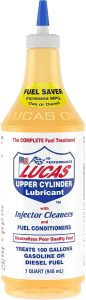
Lucas Oil 10003 Fuel Treatment, 1 Quart
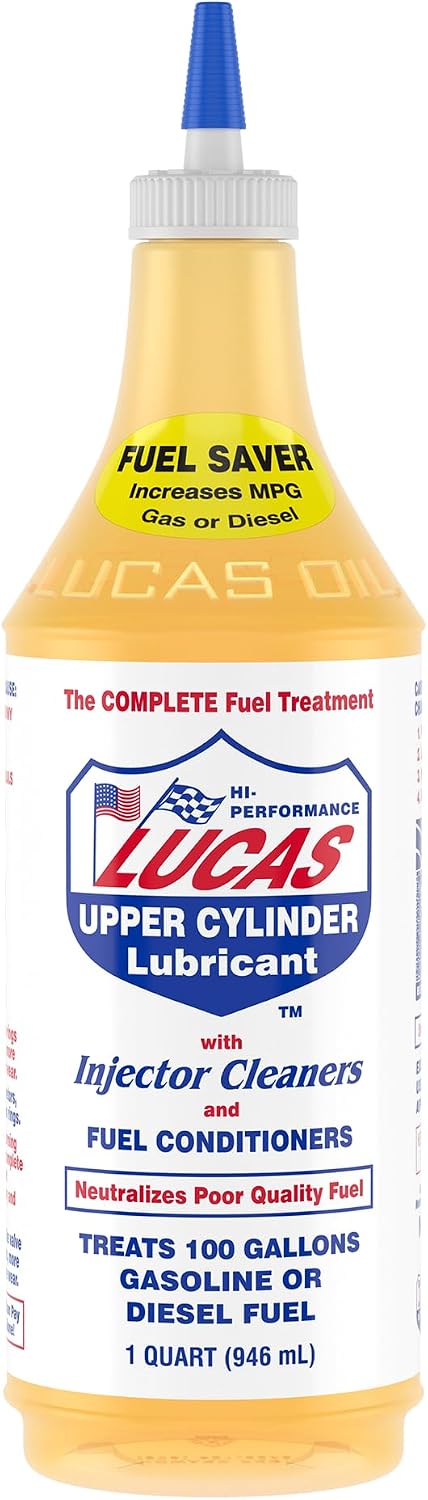
Type: petroleum treatment – upper cylinder lubricant and detergent. 32 oz treats about 160 gallons at 2 oz per 10 gal. Not a stabiliser. Around $12.49.
Per Harley tank: about $0.45 – roughly 1 to 1.2 oz for a 5-6 gallon tank.
Rating: 4.8 / 5 from 24,843 ratings
Sold as a tune-up in a bottle, and the honest description is an upper cylinder lubricant with detergent properties. It cleans and lubricates the fuel system including the carburettor and combustion chamber, neutralises sulphur, and is marketed as a lead substitute for older engines – which is where the valve-seat lubrication angle comes in and why vintage owners buy it.
At about forty-five cents per Harley tankful it is one of the cheapest things here to run, and with 24,843 ratings it is well-tested.
Set expectations carefully on two fronts. The fuel economy claims in the reviews sit inside normal riding variance – figures like 325 versus 345 miles a tank prove nothing on their own. And, importantly, this is not a stabiliser. Owners routinely confuse it with Lucas 10302 Fuel Stabilizer, which is a different bottle for a different job. If you are laying the bike up for winter, this is not the product you want.
What owners say: “Excellent fuel treatment that actually makes a noticeable difference. I followed the recommended mix ratio, and the improvement was there. – DN”
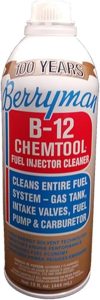
Berryman B-12 Chemtool Fuel System Cleaner, 15 oz x 3
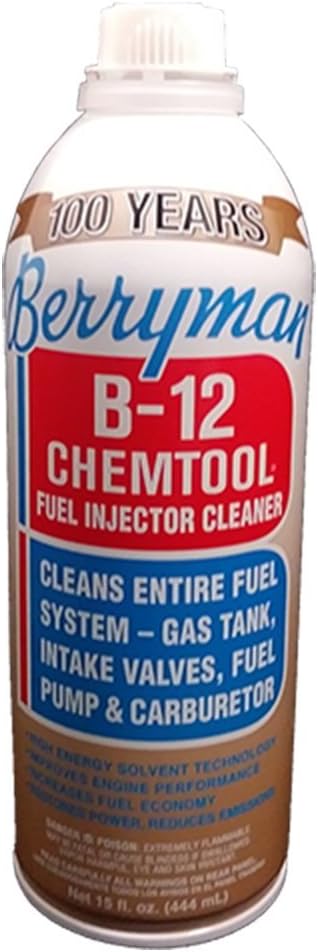
Type: professional-strength petroleum solvent. Three 15 oz cans, each treating up to 20 gallons. Not a stabiliser. Around $20.30.
Per Harley tank: about $2.15 – roughly 4 to 5 oz for a 5-6 gallon tank.
Rating: 4.6 / 5 from 191 ratings
The strong stuff, and the one with the clearest value proposition in the whole guide, stated by an owner in six words: it has saved him some carburettor rebuilds.
That is what a solvent this aggressive is for. It dissolves gum, varnish and carbon in the tank, lines, carburettor and injectors without disassembly – the classic use case being a bike that has sat with old fuel and now runs badly at small throttle openings, where the alternative is pulling the carburettor apart on the bench.
It is not a maintenance product and it makes no storage claim. Use it to fix something, not to prevent something.
Three caveats. It is genuinely aggressive, and some owners avoid it in bikes with older rubber fuel lines and seals – worth knowing before you pour it into a vintage Shovelhead. The cans dent and leak in shipping, which comes up repeatedly. And longtime buyers note it used to cost about four dollars as a single can and is now mostly sold in multipacks at a higher effective price.
What owners say: “Still a good value and great maintenance product. Has saved me some carb rebuilds. – tactical sam”
Octane boosters
Read the arithmetic section above before buying any of these. They are useful in two narrow
situations – no premium available on a trip, or a tuned engine that genuinely detonates – and useless
on a healthy stock bike. Two of the three are MMT-based.
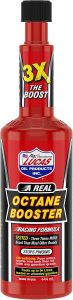
Lucas Oil 10026 Octane Booster, 15 oz
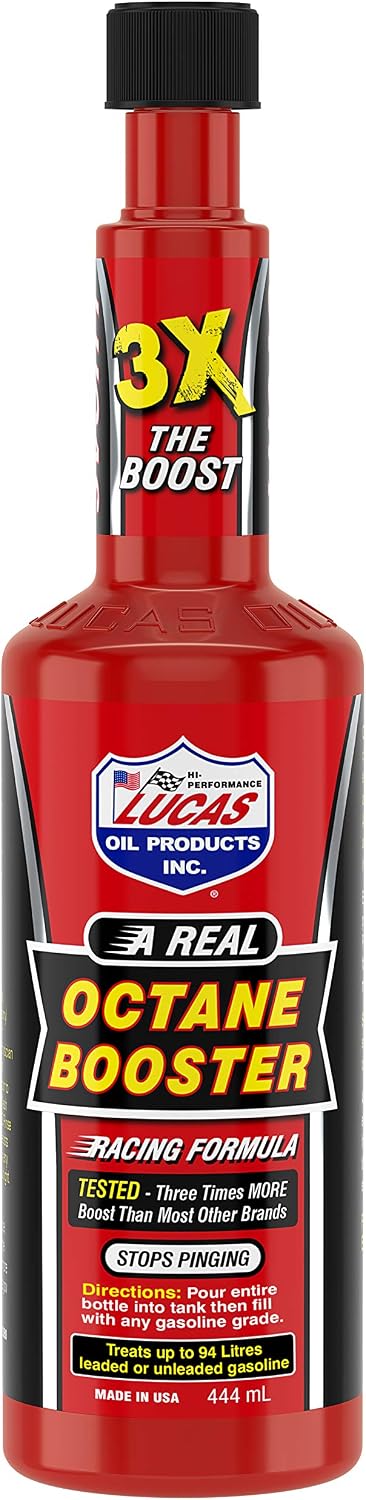
Type: octane booster. 15 oz treats about 25 gallons. Also sold as a 2 oz bottle dosed for one motorcycle tank. No octane number published. Around $8.84.
Per Harley tank: about $0.50-0.60 from the 15 oz bottle. The 2 oz pocket bottle is the practical version for a saddlebag.
Rating: 4.7 / 5 from 2,684 ratings
The one octane booster in this guide that is actually built for motorcycles, because Lucas sells a two-ounce bottle dosed for a single five-gallon tank. If you are carrying something in the saddlebag for a fill-up in the middle of nowhere, this is the sensible shape for it.
And that is exactly how the most credible owner uses it. A Harley touring rider: one bottle every other fill-up, works great travelling across the country. Another rider keeps a few in the saddlebags precisely because he keeps hitting stations with no premium, or 90 at best. That is the honest use case for the whole category.
It works in both injected and carburetted engines and is described as safe for oxygen sensors and catalytic converters, which is more than can be said for the MMT products.
Be clear-eyed about the claim, though. Lucas publishes no octane number at all. What it says is that it delivers three times more boost than most other brands – three times an unstated quantity. And on a stock, non-knocking Harley it will do nothing, because octane only matters if the engine is detonating.
What owners say: “I use this in my Harley religiously. One bottle in every other fill up. Works great traveling across the country. – J Terry, Harley touring”
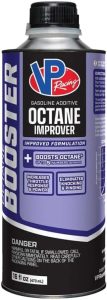
VP Racing Octane Booster, 473 ml
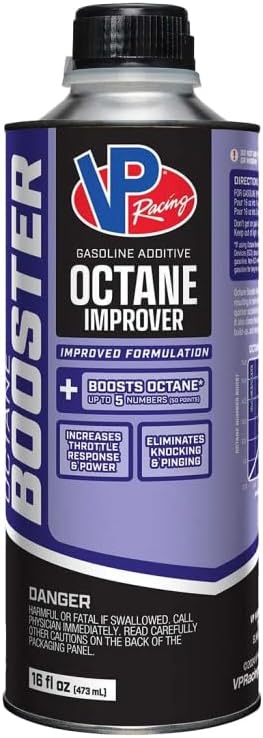
Type: MMT-based octane booster. 473 ml / 16 oz can, one can per car-sized tank. Claims up to 5 octane numbers (50 points). Around $13.59.
Per Harley tank: about $4.50 – a 5-6 gallon tank uses roughly a third of a can. CONTAINS MMT – see the warning section above.
Rating: 4.7 / 5 from 303 ratings
Read the claim carefully, because it is written twice in two different units: up to 5 octane numbers, and up to 50 points. A point is a tenth of a number, so those are the same figure – fifty simply sounds bigger. Both carry “up to”, meaning the maximum concentration in a small tank.
The most valuable review in this entire guide is here, and it is not flattering. A four-star owner who tests at a drag strip: he cannot detect a difference at the strip, and temperature and humidity have a larger impact than the booster. That is a measured result from someone who wanted it to work.
There are Harley owners reporting better throttle response and a smoother engine, and on a bike that was knocking on poor fuel that is entirely plausible.
The thing to understand before buying is the chemistry. It is MMT-based – manganese – which is what makes it effective and also what leaves deposits. An owner’s summary is worth repeating: it does contain MMT, so use it almost never. Occasional use on a trip is a reasonable trade. Every tank for a season is not what you want on a bike with oxygen sensors.
What owners say: “I can not detect a difference at the strip. Temperature and humidity have larger impact than octane booster. – John G, 4 stars”
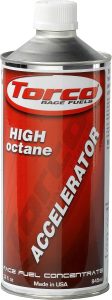
Torco Accelerator Race Fuel Concentrate, 32 oz
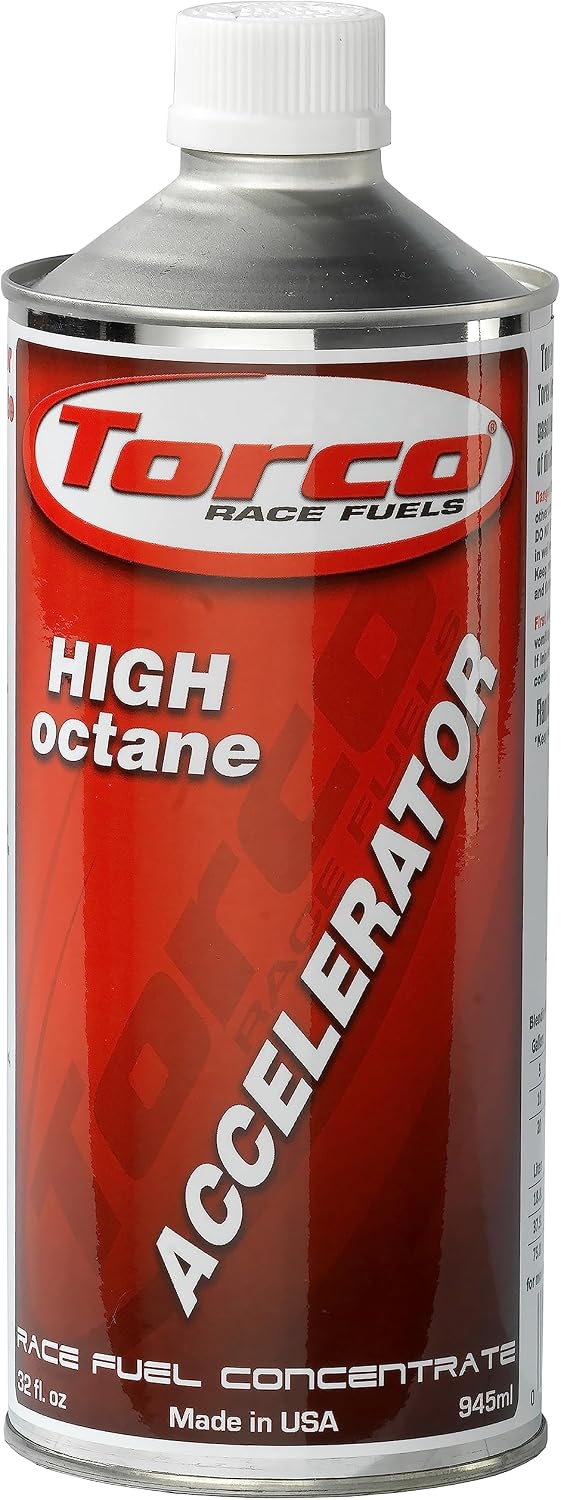
Type: MMT-based race fuel concentrate. 32 oz. Published ratios: 32 oz to 10 gallons gives 102 octane, 32 oz to 5 gallons gives 105, from 91 premium. Around $34.
Per Harley tank: $17 to $34. At the 5-gallon ratio that is the entire bottle in one Harley tankful. CONTAINS MMT.
Rating: 4.5 / 5 from 559 ratings
The only product in this category that gives you real, checkable numbers – and the numbers are the argument against using it casually. From 91 premium: a full 32 oz bottle in ten gallons gives 102 octane, and the same bottle in five gallons gives 105.
Five gallons is a Harley tank. So the headline figure costs you the whole $34 bottle, once. At the gentler ratio you are still spending roughly $17 per fill. This is not an additive in the usual sense – it is buying race fuel by dilution, and Torco is being straight with you about the exchange rate.
Which makes it the correct choice for exactly one customer: someone with a high-compression, forced-induction or seriously tuned engine that needs race-grade octane for a track day or an event, and who cannot get race fuel locally. It is explicitly rated for motorcycles, and an owner confirms the practical outcome – the knock light stays off.
For everyone else the honest comparison is the one a four-star reviewer raises himself: the jury is still out on this versus simply buying a higher octane fuel. On a stock Twin Cam or Milwaukee-Eight, buy the better grade and keep the $34. And note the MMT content here too.
What owners say: “Knock light stays off with this in gas tank. Contains MMT, a true octane booster. – Pitty”
Ethanol-specific treatments
Aimed squarely at the problem ethanol blends create in engines that sit: water absorption, phase
separation, and the drying of rubber seals and gaskets in older fuel systems.
Lucas Oil Safeguard Ethanol Fuel Conditioner, 16 oz
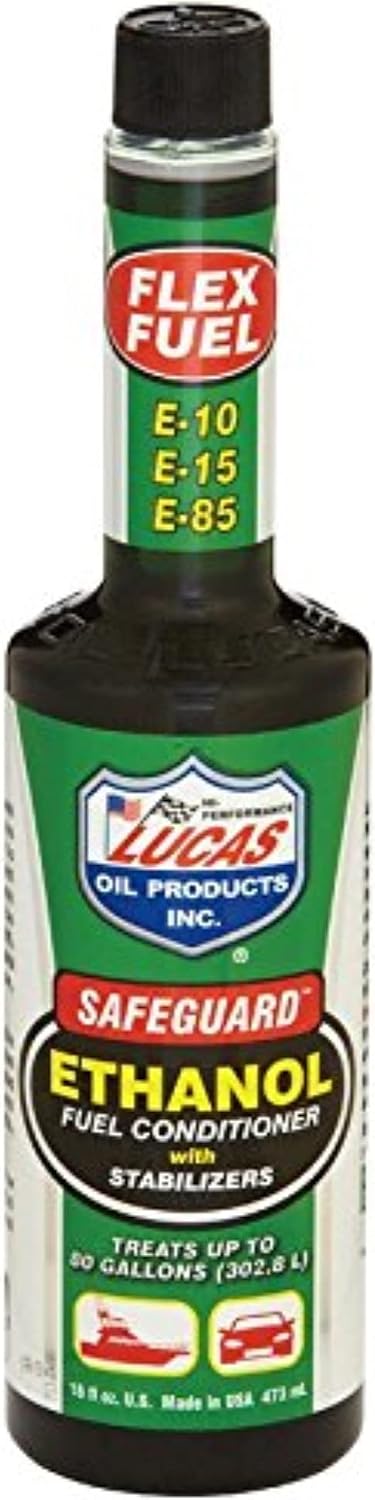
Type: ethanol conditioner and stabiliser. 16 oz treats 80 gallons at 1 oz per 5 gal. Soluble in blends up to E85. No stated month figure. Around $11.98.
Per Harley tank: about $0.80 – roughly 1 to 1.2 oz for a 5-6 gallon tank.
Rating: 4.8 / 5 from 1,160 ratings
Built specifically around the problems ethanol creates rather than added as an afterthought. It cleans injectors, valve seats and combustion chambers, stabilises fuel against gum and varnish, and – the part that is genuinely specific to ethanol – protects the oil from the byproducts of alcohol combustion.
It is soluble in every blend up to E85 and stated to be filter-safe, which matters because some treatments drop out of solution in high-ethanol fuel and end up in the filter.
The owner evidence lines up with the intended use: used in small engines, a motorcycle and a dirt bike, everything runs like a top. Small engines that sit between uses are exactly the population that suffers from ethanol.
Two limits worth knowing. It publishes no storage duration in months, so you cannot compare it against STA-BIL’s stated 24 months. And it does not claim to reverse phase separation – only to prevent varnish and gum. If there is already water in the bottom of the tank, this is not the fix.
What owners say: “I use this religiously in all of my small engines as well as a motorcycle and dirt bike. Everything runs like a top. – R. Mason”
Mechanic in a Bottle Synthetic Fuel Treatment, 24 oz
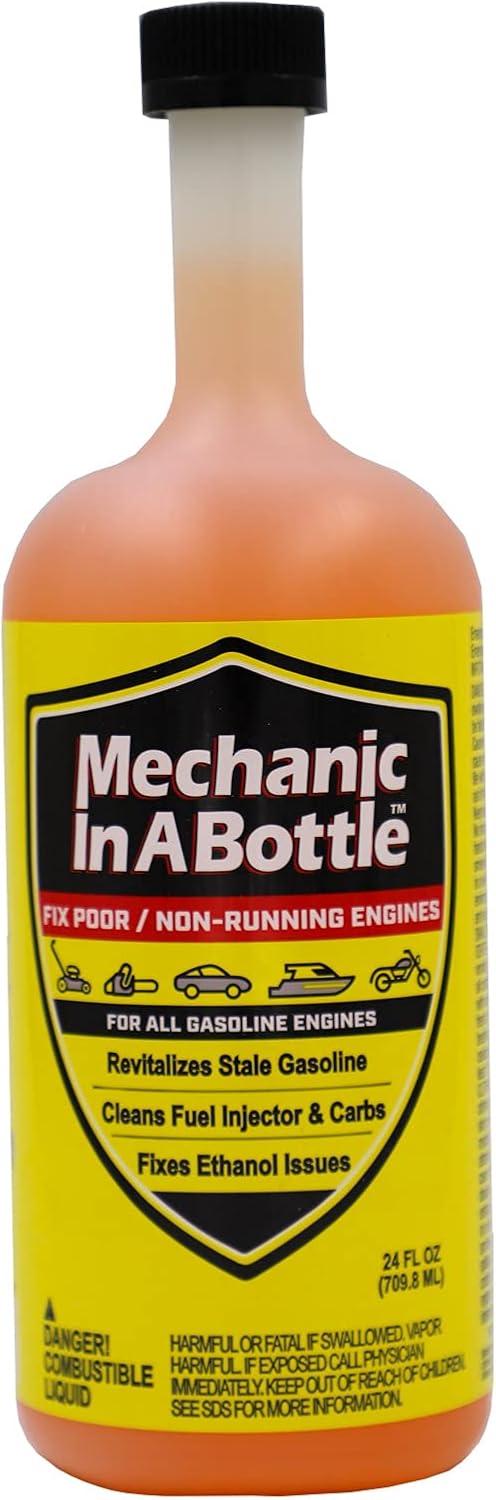
Type: synthetic ethanol and carburettor treatment. 24 oz, roughly 1 oz per 5-10 gallons. Alcohol-free. Around $23.99.
Per Harley tank: about $1.00 – roughly 1 oz for a 5-6 gallon tank.
Rating: 4.7 / 5 from 615 ratings
Aimed at the specific damage ethanol does to an older fuel system that sits, and the standout claim is one nothing else here makes: dual lubricants that recondition rubber and plastic parts dried out by ethanol. On a bike with aged fuel lines, gaskets and carburettor seals, that is a real and specific problem being addressed.
It also claims to revive decayed fuel by dissolving varnish and shellac, remove water from the system, and clean a carburettor in place without taking it apart. And it is alcohol-free, which is the sensible choice for something going into ethanol fuel.
There is an octane claim, but read it precisely: it says the octane booster replaces lost octane. That is restoring what stale fuel gave up, not raising octane above the grade you bought.
The honest weakness is the evidence base. Almost all the persuasive reviews come from lawn and garden equipment rather than motorcycles, several are single-use anecdotes, and at $23.99 for 24 ounces it is roughly double STA-BIL per ounce with no treat rate published on the listing.
What owners say: “Trouble starting a string yard trimmer was immediately eliminated when this Mechanic-In-a-Bottle was added to the fuel. – verified purchase”
Harley Fuel Additives - FAQs
What is the best fuel additive for a Harley-Davidson?
Should I use a fuel additive on my motorcycle?
What is the best octane boost additive for Harley-Davidson motorcycles?
Do octane boosters actually work?
Should you use fuel injector cleaner in a Harley-Davidson?
What does a fuel stabiliser actually do?
How long can fuel sit in a Harley before it goes bad?
Can I fix fuel that has already gone bad with an additive?
Is Sea Foam safe in a Harley?
What is MMT and should I worry about it?
Does my Harley need premium fuel?
How much additive do I actually put in a 5-gallon tank?
The short version
Buy a stabiliser. It is the only additive on this page that prevents a failure
that actually happens to Harleys. Fresh fuel, storage dose, full tank, run the engine. Star Tron is
the cheapest per tank by a wide margin; STA-BIL Storage is the most-reviewed product in the entire
category; Quickstor is the OEM-spec powersports option.
A cleaner once or twice a season is fine. Not every tank. Pick PEA for a modern
EFI bike, a solvent for a carburettor that has been sitting, and measure the dose against your tank
rather than the bottle.
Skip the octane booster unless you have a reason. Not power. Not smoothness. A
reason: a fill-up that only had 87 on offer, or an engine that pings under load. Otherwise the
arithmetic is against you – Torco needs a $34 bottle per Harley tank to reach its headline number,
and the one reviewer who measured could not detect a difference at all.
And if your bike is stock, healthy, and ridden regularly through the season, the correct additive
is none. Put the money in fuel.
#1 Pick: Best Fuel Additive for Harley-Davidson
Star Tron Enzyme Fuel Treatment Concentrate, 32 oz
Fresh fuel, storage dose, full tank, run the engine for five minutes. That single routine prevents the phase separation and stale fuel that keeps bikes from starting in spring – and it costs about a third of a dollar per tankful.