Lithium on a Harley is a real upgrade and it has a real problem, and most pages covering it only tell you about the first half.
The upgrade is genuine: a LiFePO4 battery weighs roughly a third of the lead-acid unit it replaces, cranks harder because voltage stays high under load instead of sagging, and holds charge for months without a tender. Riders who get a good one describe it in those terms – one Pan America owner reports three years without a single issue and says he has never put the bike on a tender again, calling it the best battery in 36 years of riding.
The problem is that a lot of people do not get a good one. Reading through owner reports on the batteries available here, one pattern appears again and again and it is specific: dead at around six months. Different brands, different bikes, same interval. A 2023 Ultra Limited owner who charged his over winter with a proper charger found it dead beyond resurrection at six months. Another owner’s lasted six months with self-discharge to zero in 48 hours in the garage. A third: six months, then shorting under load.
So this page is organised around the things that decide which outcome you get – the cranking-amp numbers that are not what they look like, the six-month failure pattern and what causes it, what cold weather actually does, and the charger requirement that is not optional. Then the batteries.
If you have not decided between lead-acid and lithium yet, our Harley battery guide covers sizing, CCA and the AGM comparison first.
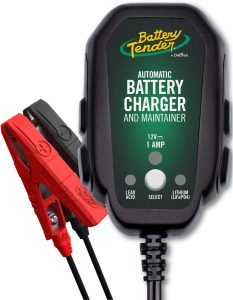
#1 Pick: Best Lithium Battery for Harley
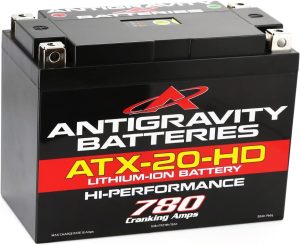
Antigravity ATX20-HD Lithium Battery, 780 Cranking Amps
15Ah of real cells, not a lead-acid equivalent, and a manufacturer that states it makes no inflated cranking claims. Expensive – and in this category that is the point.
The top best product [hide]
What Lithium Actually Gives You
Weight
The headline benefit and the one that is never exaggerated. A LiFePO4 battery in a Harley size typically weighs a third of the lead-acid equivalent – the difference is in the region of 10 to 12 lb on a Touring bike. That weight comes off high and central, which is where it matters most for how the bike feels at walking pace.
Cranking behaviour
Lithium holds its voltage under load where lead-acid sags. In practice the starter spins faster and more consistently, and it does not slow down over successive attempts the way a tired lead-acid battery does. This is the part owners notice immediately.
Self-discharge
A healthy lithium battery loses very little charge sitting. Owners report bikes starting after a full winter untouched – one KLR owner describes it firing right up after sitting unattended through the whole winter. A lead-acid battery left the same way is usually dead or damaged.
What it does not give you
It does not give you more starting power than you had if your lead-acid battery was healthy – it gives you the same job done more consistently and with less weight. And it does not last longer by default. That is the part the next section is about.
The Cranking Amp Numbers Are Not What They Look Like
This is the single most useful thing to understand before comparing lithium batteries, and it explains why two batteries with the same claimed figure perform completely differently.
PbEq: the lead-acid equivalent
Lithium cells store energy differently, so manufacturers often quote capacity as a lead-acid equivalent rather than the actual amp-hours in the battery. One reputable brand publishes it honestly – their battery is listed as 12Ah PbEq with 6.1Ah actual, and they state directly that they make no false or inflated cranking amp claims, unlike some competitors.
That transparency is the exception. Most listings give you a single large number with no explanation, and it is almost always the equivalent figure rather than the real one.
Owners have measured the gap
- One owner measured 520 CCA on a battery advertised at 700. The replacement measured 624.
- Another measured 418 against a claimed 480.
These are not rounding errors. If you are choosing between an 800-amp budget battery and a 500-amp battery from a brand that publishes actual figures, you may well be comparing the same real capability with different marketing.
What to do about it
- Prefer brands that publish both numbers. A listing that says PbEq and actual is telling you the truth; one giant number is a marketing figure.
- Treat a very high claimed CCA at a very low price as a warning, not a bargain.
- Compare amp-hours where stated, since that is harder to inflate than cranking amps.
The Six-Month Problem
This is the section that made this page worth writing. Across the batteries researched here, the failure reports cluster at a specific and short interval.
What owners report
- Six months – a 2023 Ultra Limited owner, dead beyond resurrection despite charging periodically over winter with a proper charger.
- Six months – another owner, with the battery self-discharging to zero within 48 hours sitting in the garage.
- Six months – a third, randomly going bad and shorting under load. His own conclusion: pay a little more if you do not want to be left stranded.
- Two months – one owner notes his barely outlasted the warranty, which he points out is only 30 days.
- Three months – reported twice on the same brand.
- Under a year – an owner who started the bike fewer than 200 times.
- Five rides – a battery that in the owner’s words went pop and stranded him in downtown Minneapolis.
Against that, the positive reports are real but fewer: three years on a Pan America with no tender, four years from a premium brand on another bike, two years and still going on a third.
Lithium dies differently, and that matters
One owner describes the failure mode precisely: the multimeter still shows around 13 volts, but the current is not there to crank the engine.
That is worth understanding. A lead-acid battery warns you – it cranks slower, then slower, over days or weeks. A lithium battery can read perfectly normal on a voltmeter and simply not deliver current. There is no warning period, which is why lithium failures tend to leave people stranded rather than inconvenienced.
Read the warranty before the specification
The warranty terms in this category tell you what the manufacturer expects:
- One brand here offers 30 days.
- Another offers 18 months – but an owner whose battery died in month 13 reports being refused by both the manufacturer and the retailer.
- Another offers five years, in a booklet inside the box – owners advise writing your purchase date in it immediately.
- The specialist brands offer two to three years.
A 30-day warranty on a battery is the manufacturer telling you something. Treat warranty length as a specification, and weight it heavily.
Cold Weather: The Real Risk Is Charging, Not Starting
Everyone asks whether lithium works in the cold. The answer is more specific than yes or no, and the danger is not where people expect.
Starting in the cold works better than you would think
Owner evidence is solid here. A 2016 Ultra Limited owner reports it fires right up on the coldest mornings, tested down to 30F. Another reports starting a four-stroke snowmobile at -11F, which is the coldest confirmed start in this set. A 2008 Dyna Fat Bob owner reports the bike always starts right up even after a cold start.
There is a quirk worth knowing: LiFePO4 delivers less in the first moments after a cold soak and then recovers as internal resistance drops. The standard trick is to switch the headlight on for thirty seconds before cranking – the small load warms the cells slightly and the battery then performs normally.
Charging below freezing is what damages them
This is the part that matters. Many LiFePO4 cells should not be charged below 0C, and manufacturers handle this very differently:
- One battery here states a charge and discharge window of -4F to 185F, the widest published.
- Another states -4F to 140F.
- Two state charging from -20C.
- One states discharge to -20C but charging only from 0C. That is a critical difference: the bike will start in the cold, but riding it will not properly recharge the battery below freezing.
- Several publish no temperature figures at all, including two well-known brands.
If you ride through winter, the charge window is the specification to look for – and a listing that does not publish one is not necessarily safe, it is just not telling you.
BMS shutdown in extreme cold
Some battery management systems disconnect the battery entirely if it stays very cold for long enough – one specifies shutdown after six hours below -2F. That is the BMS protecting the cells, and it is a feature, but if your bike lives outside in a hard winter it means a battery that appears dead when it is not.
The honest counterexample
One owner sums up the risk: it worked great for cold-weather starts around 50F, but it did not last through the winter – it went to half chugs, and then would not turn on at all.
You Need a Lithium Charger. This Is Not Optional.
The most common way people destroy a new lithium battery is charging it with the tender they already own.
Why a lead-acid charger damages lithium
Lead-acid chargers use desulfation and pulse-repair modes that apply high-voltage pulses to break down sulfation on lead plates. LiFePO4 has no lead plates and no sulfation – those pulses just damage the battery management system. One manufacturer states it in capitals: use only dedicated LiFePO4 chargers, and never use lead-acid chargers with desulfation or pulse-repair modes.
The charging voltage is different too. LiFePO4 wants around 14.4V to 14.6V, and your bike’s regulator should be putting out under 15.0V for lithium to be safe.
Owner confirmation
- One owner’s battery kept shutting off; support determined he needed a LiFePO4-specific 14.4V charger, since his was only putting out 12V and never fully charged it.
- Another states plainly that you do need a charger that is lithium capable.
- A third recommends a proper lithium charger specifically.
BMS lockout, and which chargers can clear it
When a lithium battery is over-discharged, the BMS disconnects to protect the cells – and the battery then reads 0V, which most chargers interpret as no battery connected and refuse to start. This is recoverable, but only with a charger that can force through it.
- One owner reports trying to reset the BMS and being unable to charge it, and returning the battery.
- Another received one that arrived uncharged, with the tender showing an error.
- Positively: one owner reports recovering a battery that had fallen to 2.9V, using a lithium charger with a recovery mode – despite the manufacturer stating that below 10.0V is unrecoverable.
The three chargers, and what separates them
- Lithium-only charger with a BMS wake-up mode. The safest option because there is no lead-acid mode to select by mistake, and it can revive a locked-out pack. This is what one battery manufacturer officially designated as their recommended charger.
- Multi-chemistry charger with a lithium mode and a force mode. Excellent capability, including reviving a pack reading 0V – but you must consciously select lithium every time. Left in a desulfation mode it will damage the battery.
- Budget switchable tender. The cheapest correct option, but two warnings: the switch has to be set, and owners state plainly that these are not rescue chargers – a dead lithium pack will not come back with one. Note also that a cheaper non-switchable version of the same product exists and is easy to buy by mistake. That is the one that kills LiFePO4.
Fitment Details That Catch People Out
Polarity can be reversed
Lithium batteries are not always laid out like the lead-acid unit they replace. One entire product line here has the terminals in the opposite arrangement to some factory Harley layouts. Check which side positive is on before ordering, because your cables may not reach.
They are smaller, and shims are often not included
Lithium packs are physically smaller than the lead-acid batteries they replace, so they rattle in the tray without packing. Several owners note this, including one who wished his had come with shims and spacers to bring the terminals to a flush mount like the stock Harley battery. Foam or rubber packing is essential – vibration is what kills batteries on a V-twin.
And occasionally larger
One battery here measures 7.01 inches against a stock 6.89. A tenth of an inch does not sound like much until the hold-down will not close.
Electrical system conflicts
Reported on other machines rather than Harleys, but worth knowing the failure mode: one owner on a BMW reports voltage spiking to 18V within a mile, caused by an interaction with a shunt-type regulator. Fault codes on some bikes with data-bus battery monitoring are also reported. Harleys are generally well-behaved here, but if your bike has an unusual charging system, check before spending.
The Sportster problem
Worth being honest about: a genuine lithium YTX14L-BS – the true L-size for 2004 and later Sportsters – is barely available. The one listing found has no reviews at all. In practice, riders fit a YTX14-BS with shims, or use one of the smaller specialist batteries. If you want lithium in a Sportster, that is the situation.
Lithium Batteries for Harley-Davidson
Eleven batteries and three chargers, currently available and checked. Read the warranty column as carefully as the cranking amps – in this category it is the more informative number.
Where a manufacturer publishes both actual and PbEq capacity, we have said so, because that honesty is itself a signal.
YTX20L-BS Size – Softail, Dyna, Touring
The most common Harley size and the best-served here.
Antigravity ATX20-HD Lithium Battery, 780 Cranking Amps
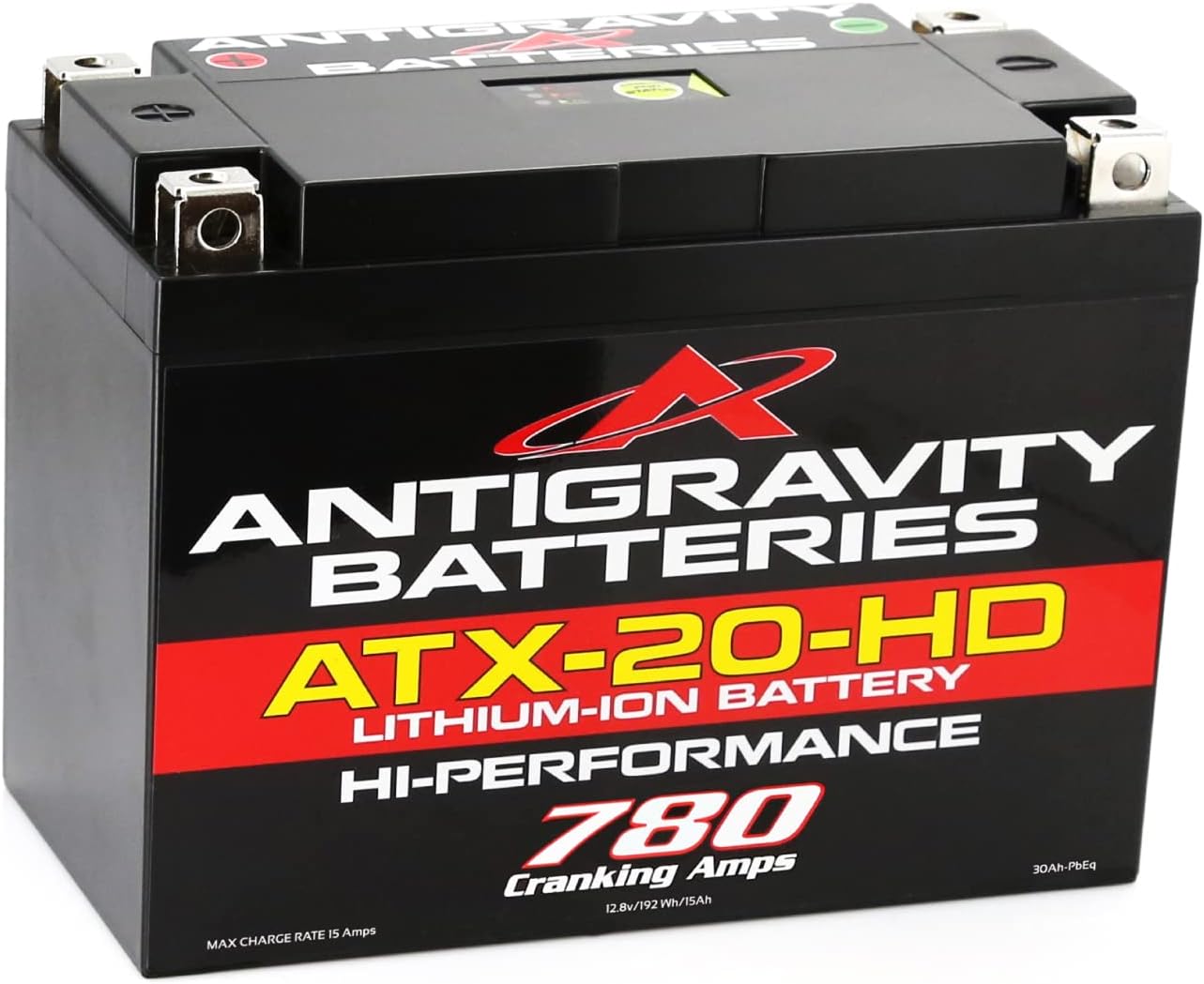
Size: YTX20 / YTX20L / GYZ20 replacement, 6.9 x 3.4 x 6.1 inches. 15Ah of real cells – the highest actual capacity here. 780 cranking amps. 5.18 lb. Quad terminals. Around $450.
Fits: Softail, Dyna and Touring models taking a group 20 battery. Quad terminal design means the posts can be oriented either way, so polarity is not a problem.
Rating: 4.4 / 5 from 24 ratings
The most expensive battery here by a wide margin, and the one that tells you the truth about what it contains.
15Ah of actual cells rather than a lead-acid-equivalent figure. That is why it weighs 5.18 lb where the budget group 20 units weigh 3.3 to 4.7 – it has more battery in it. For a Touring bike with a big audio system, heated gear and extra lighting, real amp-hours matter more than a large cranking number.
Antigravity state directly that they make no false or inflated cranking amp claims, and given that owners elsewhere on this page measured 520 CCA against a claimed 700, that matters.
The coldest confirmed start in this whole set is on an Antigravity: an owner reports it starting a four-stroke snowmobile at -11F.
At $450 it costs three to four times the marketplace options. What you are buying is real capacity, a two to three year warranty and honest specifications. Note it does draw failure reports too – one owner reports six months with self-discharge to zero in 48 hours – so it is better odds, not a guarantee.
What owners say: “This battery will start my 4-stroke snowmobile when it’s -11.”
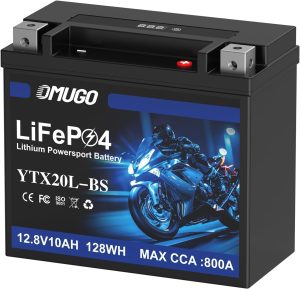
OMUGO YTX20L-BS Lithium Battery, 10Ah, 800 CCA
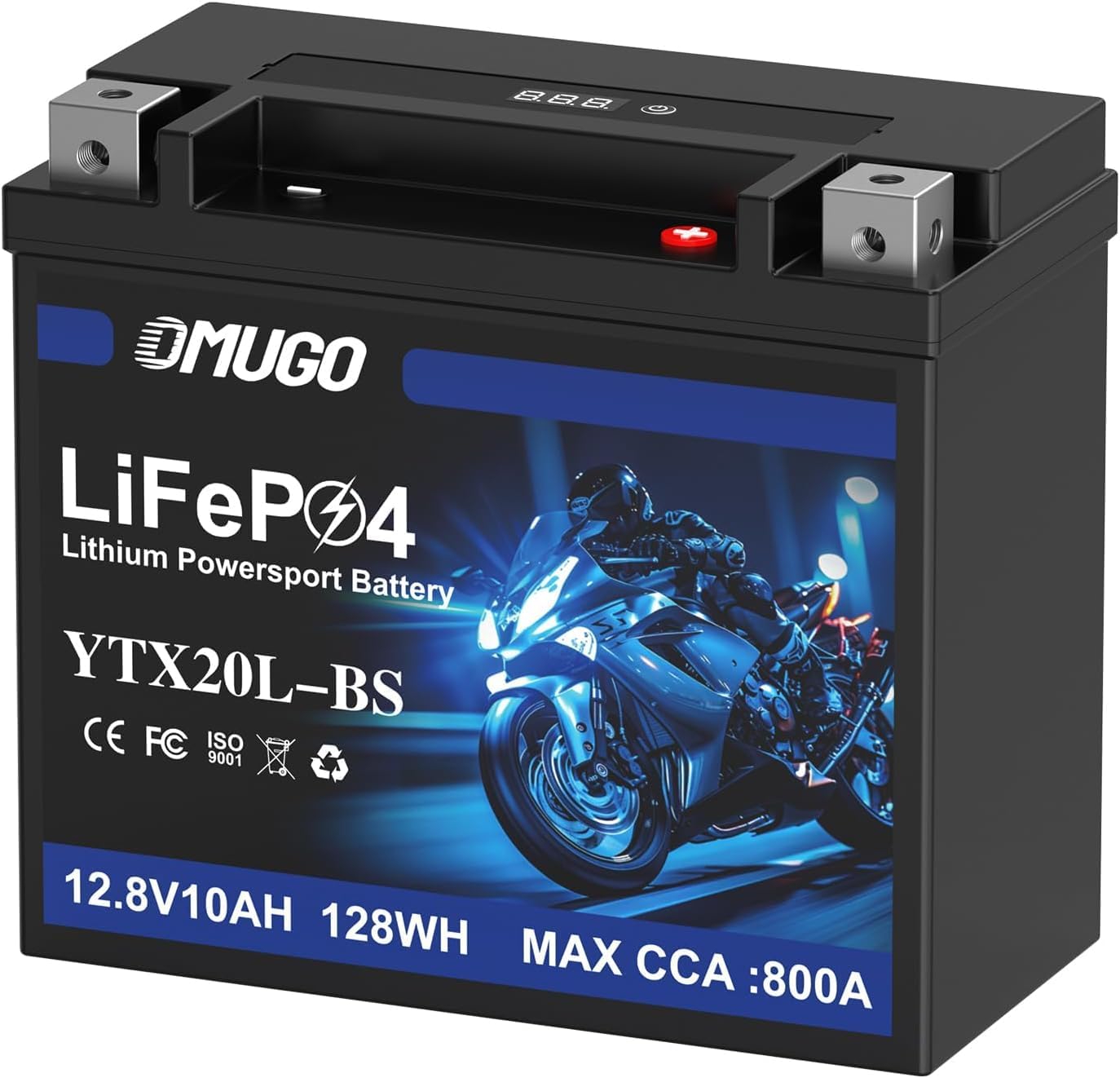
Size: YTX20L-BS, 7.01 x 3.43 x 6.10 inches – note this is 0.12 inch longer than the OEM box. 10Ah, 800 CCA claimed. 4.70 lb. MotoCore 2.0 BMS. Around $119.
Fits: Softail, Dyna and Touring taking YTX20L-BS. MEASURE YOUR TRAY – at 7.01 inches this is longer than the 6.89-inch factory box.
Rating: 4.4 / 5 from 46 ratings
The only battery here that publishes a full temperature window for both charging and discharging: -4F to 185F. Given how many manufacturers publish nothing at all, that is the specification worth having if you ride in winter.
10Ah is a genuine middle ground – more real capacity than the 5Ah budget units, less than the Antigravity, at a quarter of the price.
An owner on a big Harley describes it cranking the engine over like it is nothing.
Two practical warnings. The case is 0.12 inch longer than stock, which sounds trivial until the hold-down will not close – measure first. And the 800 CCA figure follows the pattern described earlier on this page: treat any large single number with caution unless the manufacturer also publishes actual capacity.
What owners say: “This is the best battery I have ever seen cranking my big Harley Davidson over like it’s nothing.”
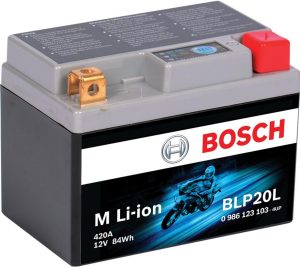
BOSCH BLP20L Lithium PowerSport Battery, Group 20
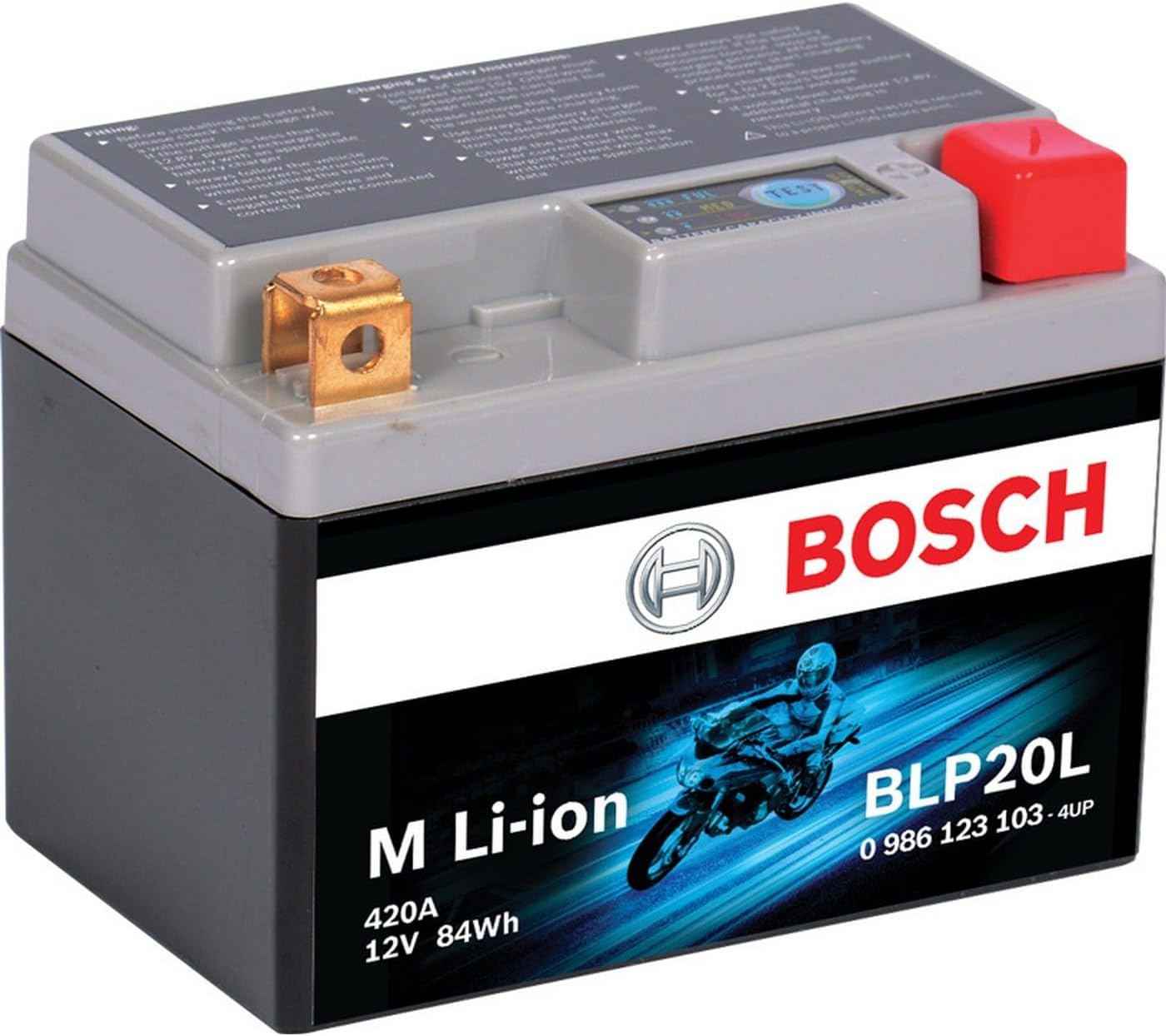
Size: Group 20 / YTX20L-BS footprint, 6.89 x 3.43 x 6.10 inches. 7Ah, 420 cranking amps. 3.5 lb. Multi-position terminals. 18-month warranty. Around $201.
Fits: Softail, Dyna and Touring taking group 20. Bosch also sell a Group 30 version with supplied plastic feet for Touring and Tri Glide trays.
Rating: 4.0 / 5 from 252 ratings
The conservative option in more than one sense. 420 cranking amps is the lowest claimed figure here by a distance – which, in a category where owners keep measuring less than advertised, may well mean it is the most honest.
The cold-weather report is the strongest specific evidence here: an owner on a 2016 Ultra Limited says it fires right up on the coldest mornings, tested down to 30F.
Bosch offer 18 months, which sits between the marketplace brands and the specialists.
Two honest points. The 4.0 rating is the lowest of the batteries here. And the warranty story is not encouraging: an owner whose battery failed in month 13 with fewer than 200 starts reports being refused by both Bosch and the retailer. A warranty is only worth what the company does with it.
What owners say: “The bike fires right up no problem even on the coldest mornings. I’ve tested it down to 30 degrees. – 2016 Ultra Limited”
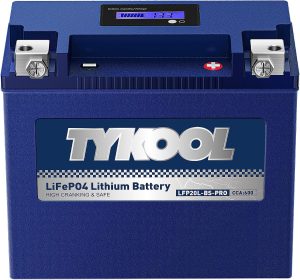
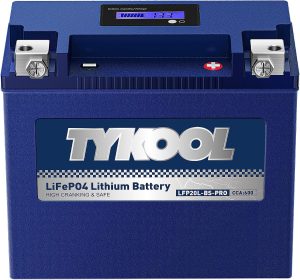
TYKOOL LFP20L-BS-PRO Lithium Battery, 12Ah
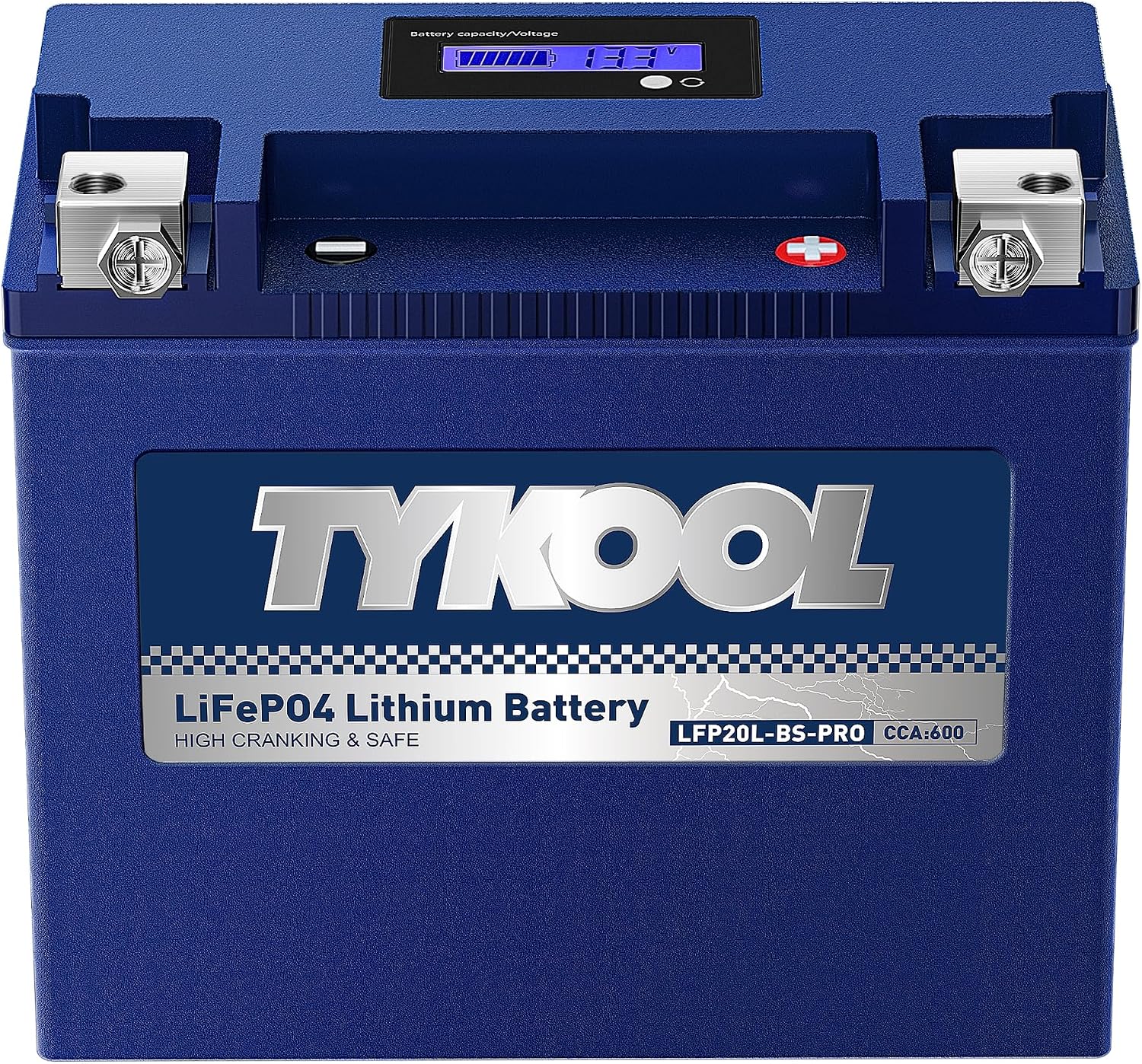
Size: YTX20L-BS / YTX20HL-BS / GYZ20L, 6.89 x 3.43 x 6.10 inches. 12Ah, 600 CCA claimed. 4.2 lb against roughly 15 lb for the Yuasa it replaces. Digital LCD readout. Around $180.
Fits: Softail, Dyna and Touring in group 20 sizes. NOTE the terminal layout is negative-left, positive-right, which is reversed from some factory Harley arrangements – check your cables reach.
Rating: 4.4 / 5 from 34 ratings
12Ah is real capacity aimed at bikes with winches, plows, LED bars and audio – the accessorised end, where 5Ah budget packs run short.
It states a temperature range of -4F to 140F, which puts it among the minority that publish anything at all, and it is sold partly for winter equipment.
An owner on a 2008 Dyna Fat Bob reports the bike always starting right up even after a cold start and after sitting two weeks.
The LCD readout on top is genuinely useful on lithium, because as this page explains, voltage alone can mislead you – being able to see it without a meter helps you catch trouble earlier.
Check the polarity before ordering. This whole product line runs negative-left, which is the opposite of some Harley layouts.
What owners say: “This lithium battery cranks faster since it has twice the CCA and it’s lighter. – 2008 Dyna Fat Bob”
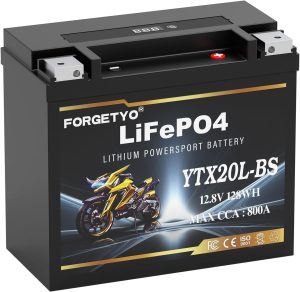
Forgetyo YTX20L-BS Lithium Battery, 10Ah
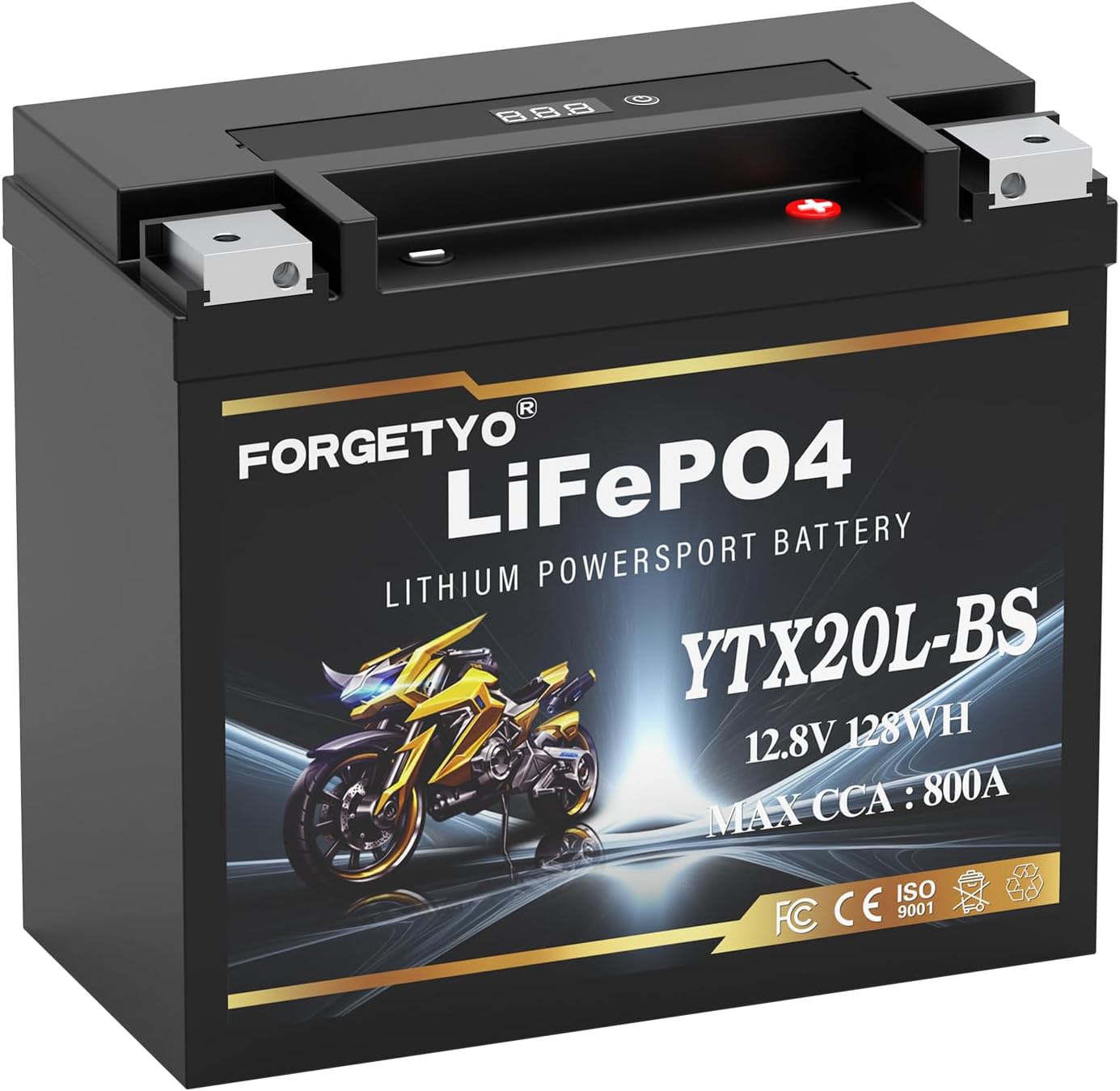
Size: YTX20L-BS, exact 6.89 x 3.43 x 6.10 OEM footprint. 10Ah / 128Wh. 3.7 lb. CHARGE temperature 0C to 45C, discharge -20C to 60C. Around $128.
Fits: Softail, Dyna and Touring taking YTX20L-BS. Terminal layout is negative-left, positive-right.
Rating: 4.4 / 5 from 101 ratings
Included specifically because of one specification, and it is the most important warning on this page.
This battery discharges to -20C but only charges from 0C. In practice that means it will start your bike on a freezing morning and then not properly recharge while you ride. On a bike used through winter that is a slow route to a dead battery, and it is the kind of detail that only shows up when you read the specification rather than the headline.
Otherwise it is a competent unit – exact OEM footprint, 10Ah, 3.7 lb, and an owner on a Softail Deluxe confirms it is a third of the weight of the stock AGM.
The other thing to know is the warranty. An owner whose battery died in about two months notes that it just barely outlasted the warranty, which he points out is 30 days. That is the shortest warranty in this entire category and it tells you what to expect.
What owners say: “Perfect fit in my wife’s Softail Deluxe. 1/3 the weight of the stock AGM battery. – Softail Deluxe”
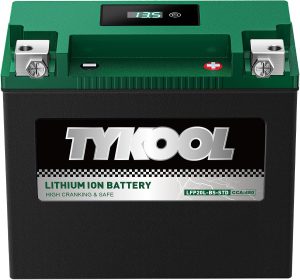
TYKOOL LFP20L-BS-STD Lithium Battery, 8Ah
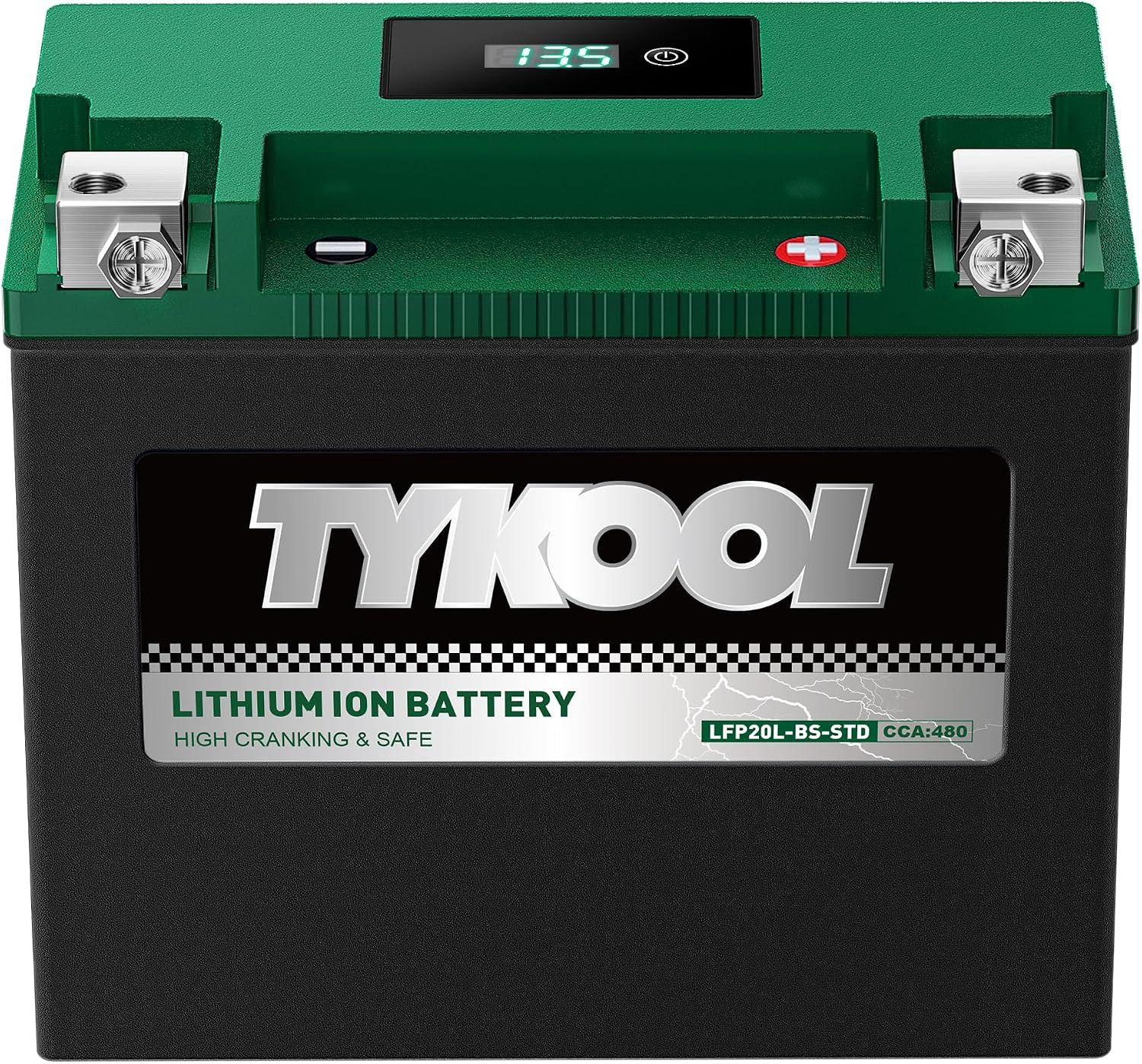
Size: YTX20L-BS and equivalents including OEM 65989-97C. 8Ah, 480 CCA claimed. 3.3 lb. LCD readout. Around $126.
Fits: Softail, Dyna and Touring taking group 20. Polarity is negative-left, positive-right – reversed from some Harley layouts.
Rating: 4.1 / 5 from 801 ratings
The volume seller in this size at 801 ratings, and the lighter, cheaper sibling of the PRO above – 8Ah rather than 12, 3.3 lb rather than 4.2.
An owner fitted one to a 1994 Dyna Convertible with a 32-amp charging system and reports it working well, which is a useful data point for older bikes where the charging system is less sophisticated.
The LCD readout carries over from the PRO and is genuinely useful on a lithium battery.
Two cautions. The 4.1 rating is modest, and the brand carries several reports of failure at around three months elsewhere in its range. And 8Ah is enough for a stock bike but thin if you run heated gear, extra lighting and a big stereo – in that case the PRO or the Antigravity is the more sensible spend.
What owners say: “Installed this in my 1994 Harley Dyna Convertible 1340cc, 32 amp charging system. – 1994 Dyna Convertible”
TYKOOL LFP20L-BS-PRO, Tall Terminal GYZ20L Variant
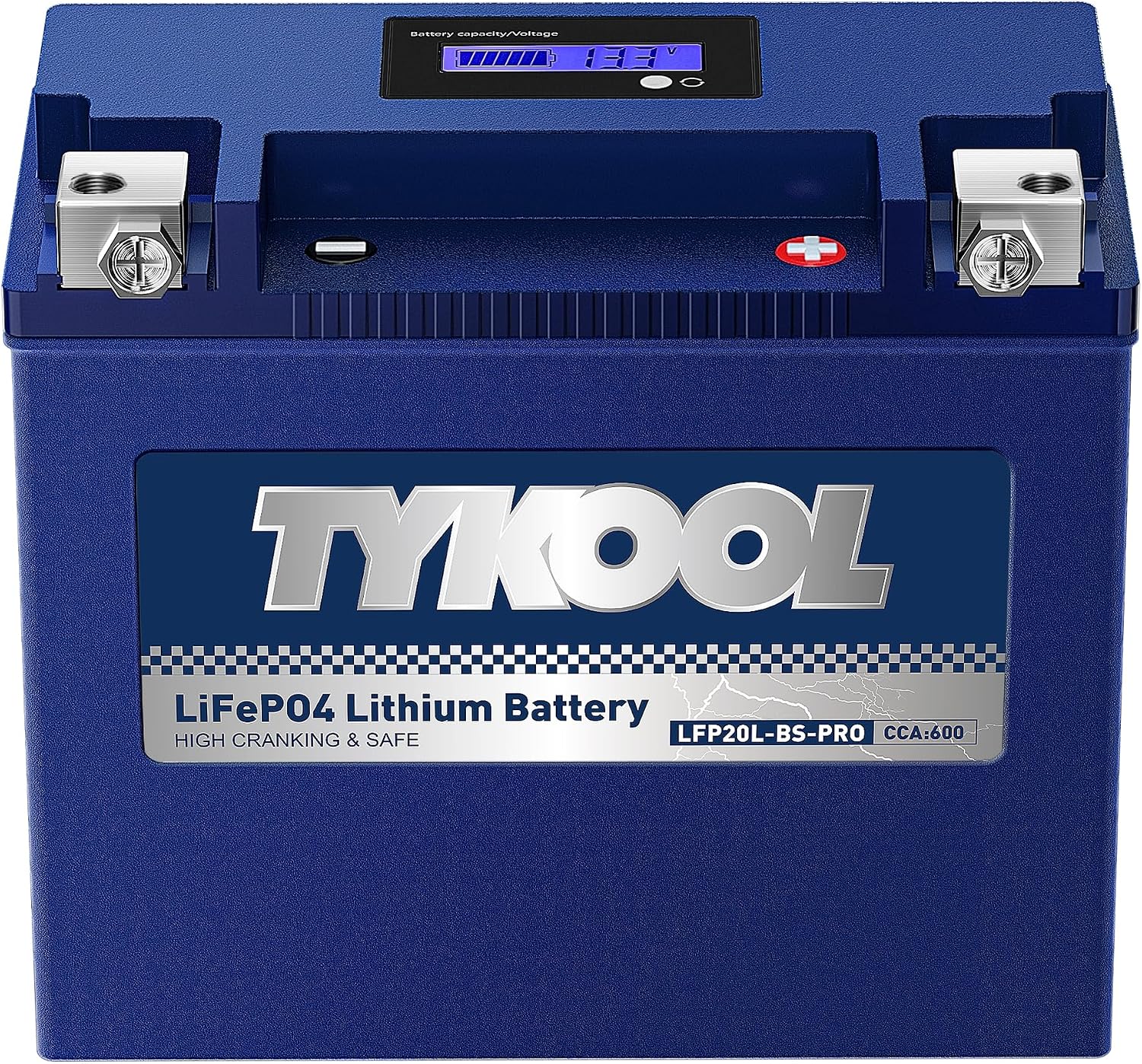
Size: YTX20HL-BS / GYZ20L / GYZ20HL tall-terminal group 20, replaces OEM 65989-97A through D. 12Ah. 4.2 lb against roughly 15 lb. Around $162.
Fits: Harley models specified for the tall-terminal GYZ20L or GYZ20HL. This is a different terminal height from the standard group 20 – check which your bike takes.
Rating: 3.7 / 5 from 173 ratings
Included because the tall-terminal GYZ20 size is what a number of Harleys actually specify, and options in it are limited – not because we recommend it above the others.
12Ah of capacity in the correct case for bikes that take the taller terminal arrangement, with the same LCD readout as the rest of the line.
The 3.7 rating is the lowest on this page and that is the reason for the caution. This brand carries multiple reports of failure inside three months, and at 173 ratings the sample is large enough that the score means something.
If your bike takes this size and you can stretch, the Antigravity ATX20-HD covers group 20 with quad terminals that work either way and has a considerably better record. If budget rules, this is a working option with your eyes open.
What owners say: “Bike always starts right up even after cold start. It sat for 2 weeks and started right up.”
Smaller Sizes – Sportster and Others
Fewer genuine options in this size. Check terminal position and plan for shims.
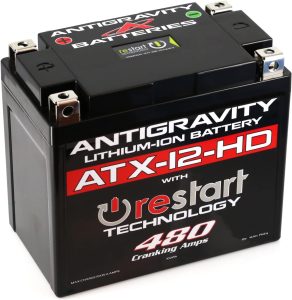
Antigravity ATX12-HD Heavy Duty Lithium Battery
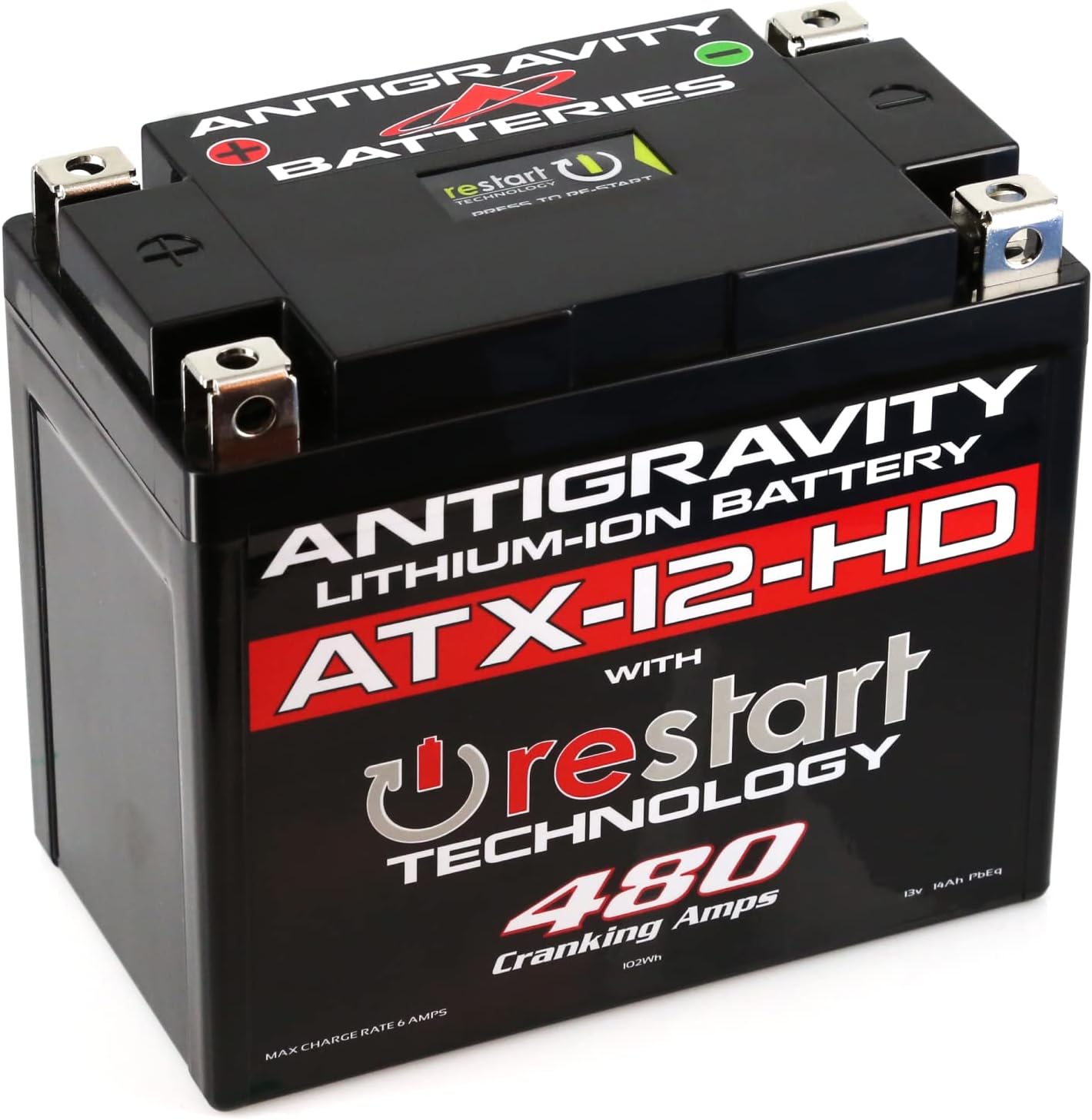
Size: YTX12 / YTX14 OEM case, 5.9 x 3.4 x 5.2 inches. 8Ah. 3.0 lb against 9-11 lb for lead-acid. Quad OEM-type terminals. Around $285.
Fits: Sportster and mid-size models taking YTX12 or YTX14. Quad terminal design solves polarity. Owners note shims are not included and are worth having.
Rating: 4.4 / 5 from 375 ratings
The battery behind the strongest long-term report in this entire article, and it is worth quoting properly. An owner bought it in October 2022 and reviewed it in October 2025 – three years – saying he has not had a single issue, has never put the bike on a tender again, and calls it the best battery he has used in 36 years of riding.
That is what a good lithium battery looks like, and it is the standard the rest of this page should be judged against.
3.0 lb against 9 to 11 lb for the lead-acid it replaces is a 6 to 8 lb saving on a Sportster, where the bike is light enough for that to be noticeable.
Antigravity’s Ultimate Protection BMS includes cell balancing, and the quad terminals mean polarity is never an issue.
Two notes. It also carries a failure report – one owner had it go pop on the fifth ride. And owners wish it came with shims and spacers to bring the terminals flush like the stock Harley battery; buy foam packing separately.
What owners say: “I haven’t had a single issue since and I’ve never placed the bike on a battery tender again. Best battery I’ve used in 36 years of riding.”
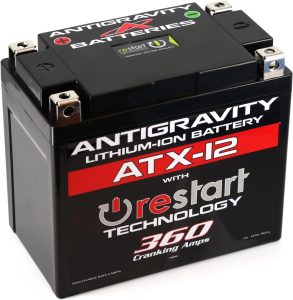
Antigravity ATX12 Lithium Battery with Built-In Jump Start
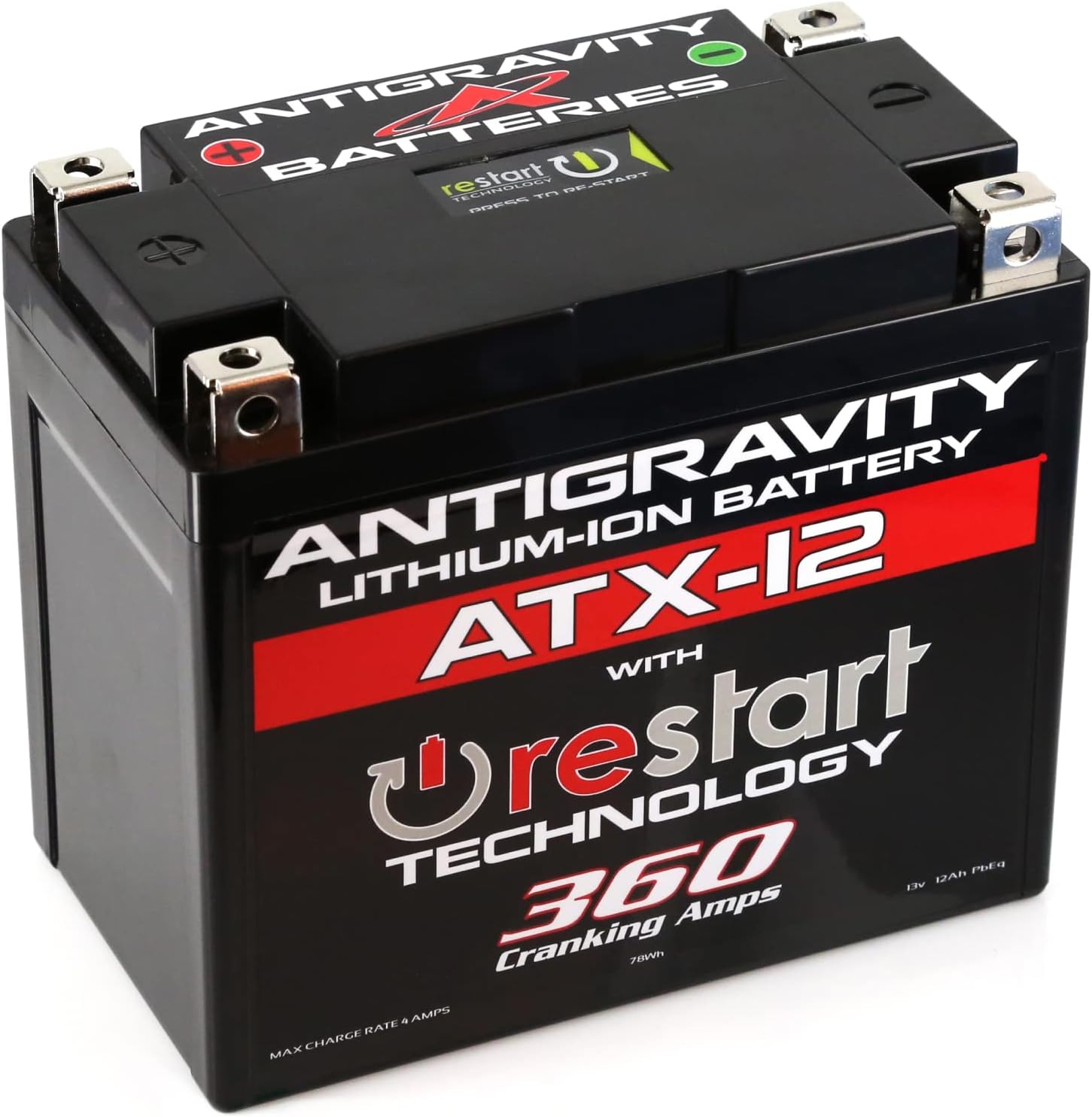
Size: YTX12 / YTX14 replacement, 5.9 x 3.46 x 5.12 inches. 6.1Ah actual / 12Ah PbEq. 360 cranking amps. 2.65 lb. Around $250.
Fits: Sportster and mid-size models taking YTX12 or YTX14. Fits without shims where other equivalent packs need them. Quad terminals.
Rating: 4.6 / 5 from 112 ratings
The highest-rated battery on this page at 4.6, and the clearest example of honest specification anywhere in this category: it is listed as 6.1Ah actual and 12Ah PbEq, with both figures published.
That single line explains the whole cranking-amp problem described earlier. When a budget battery claims 800 CCA and this one claims 360, they are not necessarily describing different capability – they are describing it differently.
The built-in jump start feature is the standout: the battery reserves capacity that you can release with a key fob to start the bike after you have flattened it. On a lithium battery that would otherwise strand you without warning, that is a genuinely thoughtful answer to the failure mode this page describes.
At 2.65 lb it is the lightest battery here, against about 8 lb for the Yuasa it replaces.
The counterweight is a real one: an owner on an Indian Scout reports it working well for cold starts around 50F but not lasting through the winter – half chugs, then nothing.
What owners say: “Fires right up after sitting unattended in the bike for the whole winter – amazing. – KLR owner”
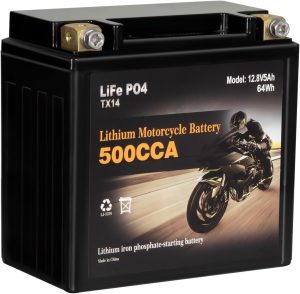
Autocessking YTX14-BS Lithium Battery, Group 14
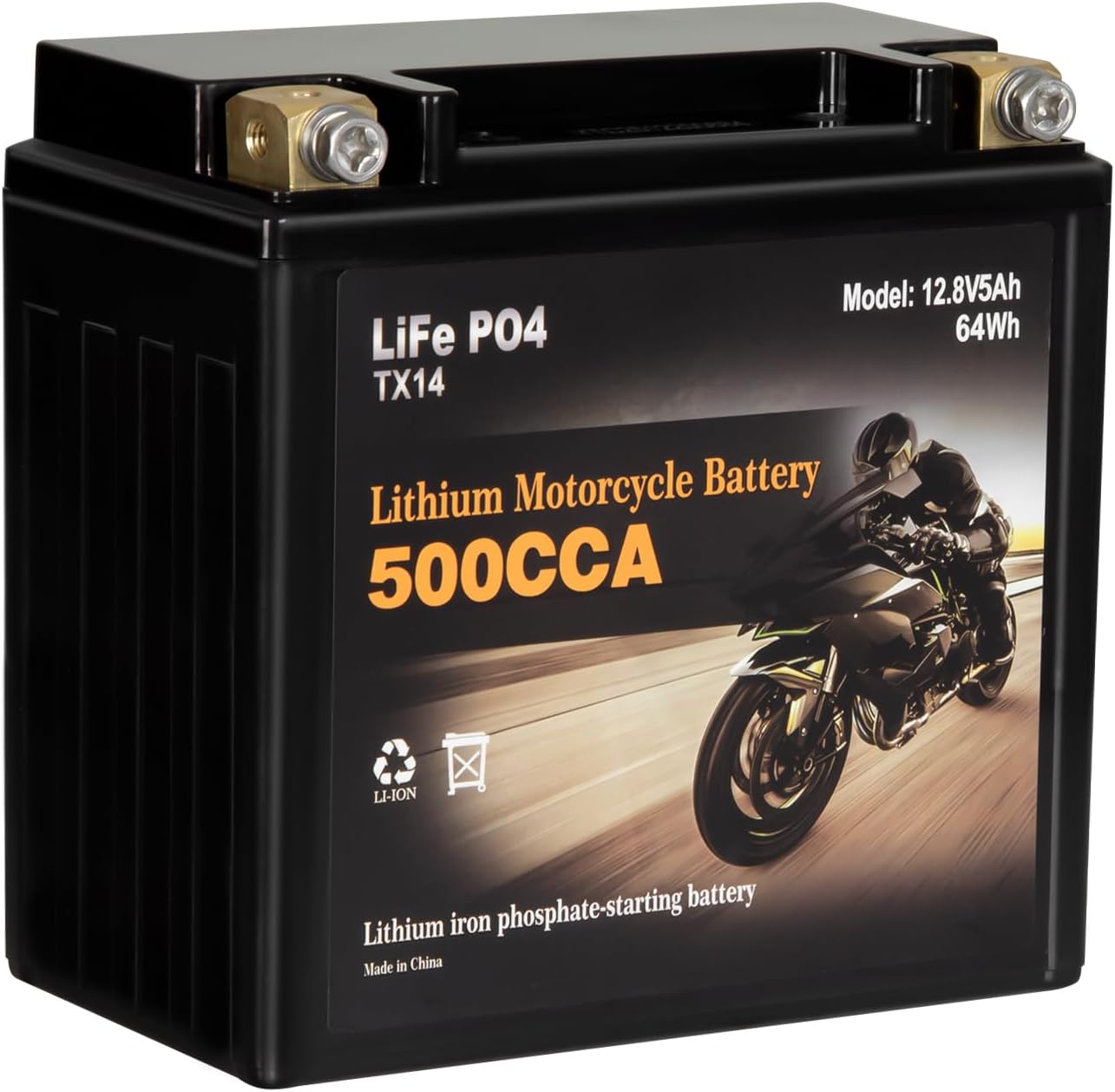
Size: YTX14-BS / Group 14, 5.94 x 3.43 x 5.87 inches, M6 terminals. 5Ah, 500 CCA claimed. 3.71 lb. Charge -20C to +45C, discharge -20C to +60C. Around $60.
Fits: Sportster-class bikes taking YTX14-BS. The same listing sells YTX20L, YTX30L, YTX12, YTX9, YTX5L and YTX14AH variants – select carefully. Polarity is positive-left.
Rating: 4.3 / 5 from 2,707 ratings
The cheapest working lithium here at around $60, with by far the largest review base of any battery on this page at 2,707 ratings.
It also publishes a proper temperature window – charging from -20C, which is better than several batteries costing three times as much and considerably better than the one that only charges above freezing.
An owner reports it fitting a 2007 Softail perfectly and having enough power.
Now the counterweight, and it is why this sits below the Antigravity despite the price. One owner reports having it six months before it randomly went bad and started shorting under load, and his own conclusion is the honest summary of this whole category: pay a little more if you do not want to be left stranded.
5Ah is genuinely low. This is a cranking battery for a stock bike, not something to run accessories from.
What owners say: “Nice battery. Fit my 07 Softail perfectly. 310 CCA is plenty of power. – 2007 Softail”
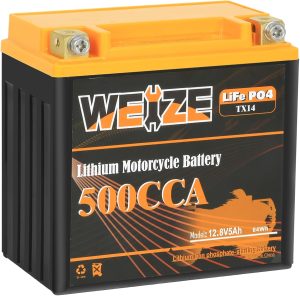
Weize Lithium YTX14-BS, Group 14, 500A
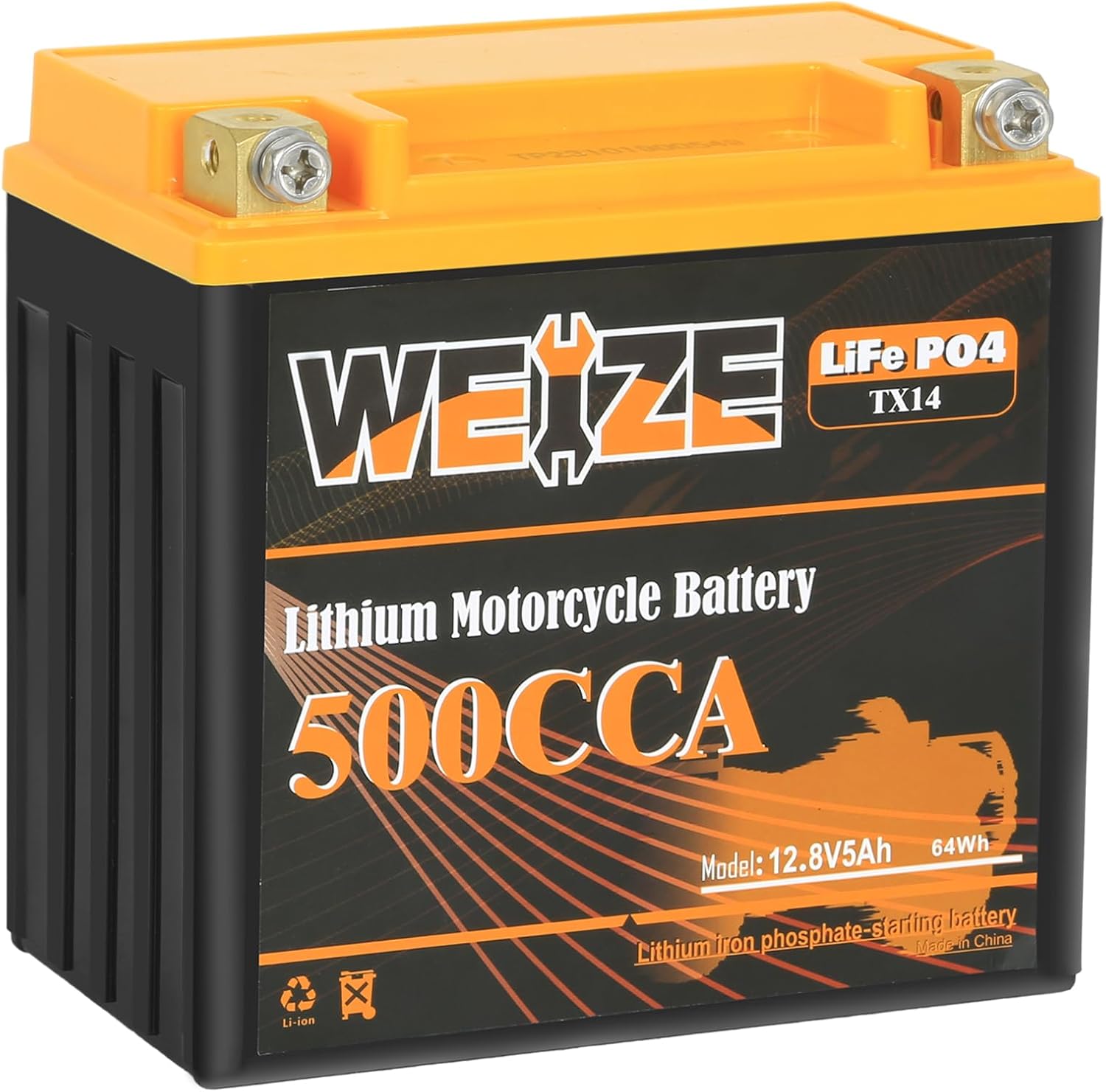
Size: YTX14-BS / Group 14, 5.94 x 3.43 x 5.87 inches, M6 terminals. 5Ah. 3.71 lb. Charge -20C to +45C, discharge -20C to +60C. Five-year warranty in the box. Around $60.
Fits: Sportster-class bikes taking YTX14-BS. The same listing carries YTX20L and YTX30L variants for Softail and Touring. Polarity is positive-left.
Rating: 4.2 / 5 from 1,733 ratings
The same price and specification as the Autocessking above, from a brand offering a five-year warranty – which on paper is the longest here by a distance.
The catch is where it lives: the warranty is a booklet inside the box, and owners advise writing your purchase date in it the moment it arrives. If you throw the packaging away you have thrown the warranty away.
The weight impression is well captured by a Road King owner who picked up the UPS box and was concerned there was no battery in it. A Fat Boy owner calls it half the weight of the AGM.
And an owner on a Harley says no HD he has ever had has started this effortlessly, which is the cranking benefit in one line.
Balance that against a 2023 Ultra Limited owner whose battery lasted about six months before being dead beyond resurrection – and he had been charging it over winter with a proper charger. Also note one owner measured 520 CCA against the claimed 700 on this brand’s larger size.
What owners say: “No HD I’ve ever had has started this effortlessly.”
Lithium Chargers
Not optional. A lead-acid tender with a desulfation mode will damage a LiFePO4 battery.
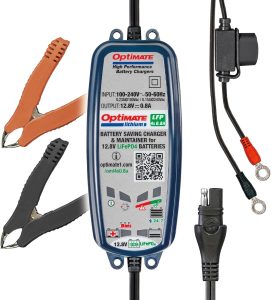
OptiMATE Lithium 4s TM-471, 0.8A Lithium-Only Charger
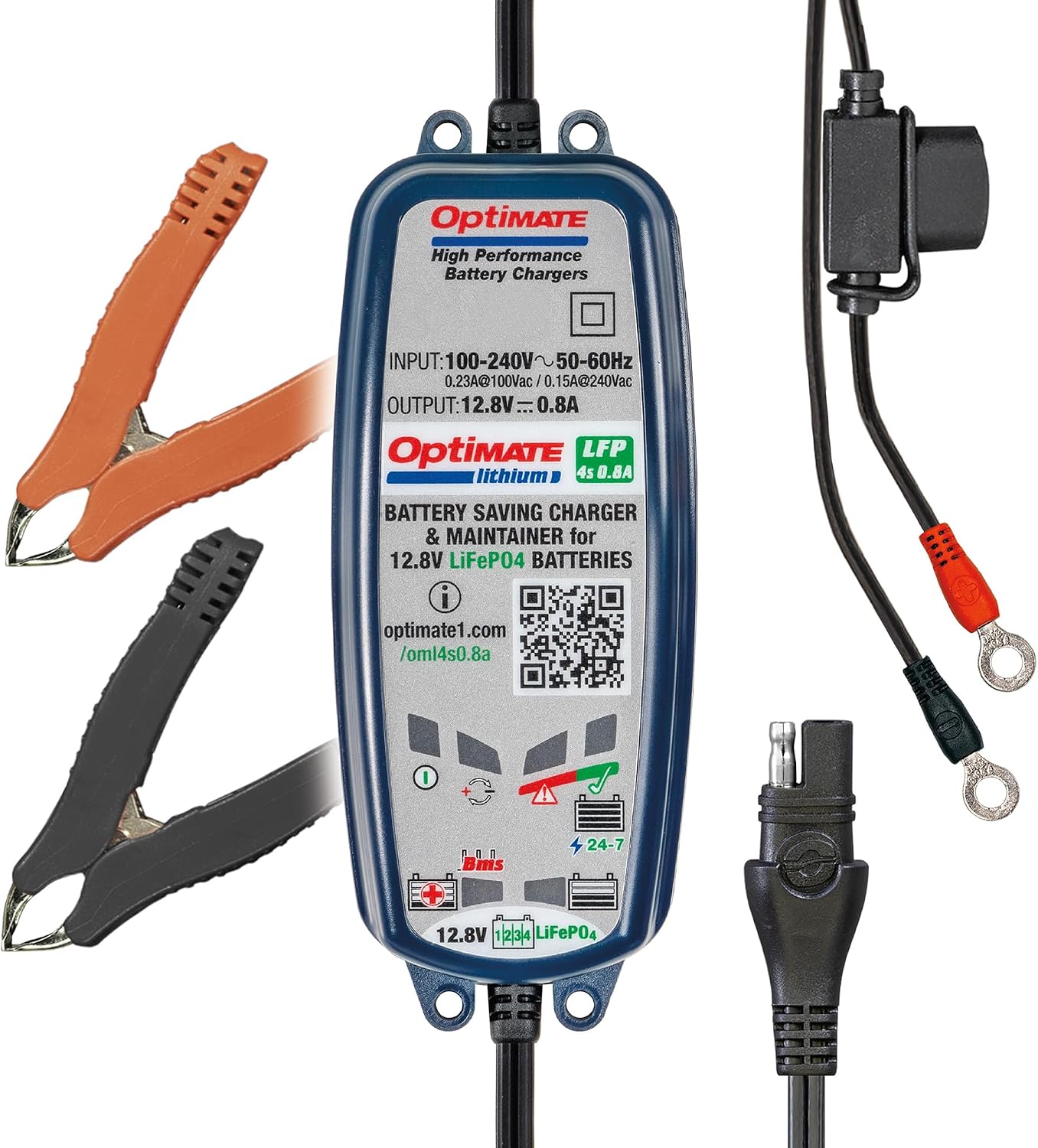
Type: lithium-only charger, 12.8V / 0.8A, 8-step program with BMS wake-up mode. Sealed weatherproof housing. A 6A version is available for larger packs. Around $77.
Fits: LiFePO4 powersport batteries. The 0.8A rate suits 2-8Ah packs; use the 6A version for 15-24Ah touring batteries.
Rating: 4.6 / 5 from 772 ratings
The safest charger here, and the reason is what it cannot do: there is no lead-acid mode to select by mistake. Given that a desulfation cycle will damage a lithium battery, removing that possibility entirely is a real feature.
The headline capability is the BMS wake-up mode. When a lithium pack over-discharges, the management system disconnects and the battery reads 0V, which makes most chargers refuse to start. This one can force through that.
The evidence is striking. One owner reports reviving a battery that had fallen to 2.9V, despite the manufacturer stating that below 10.0V is unrecoverable. Another reports a battery that sat dead on the bike for seven months and says this totally did the job.
One well-known lithium manufacturer officially designated this as their recommended charger, which tells you how the people who make these batteries view the charging question.
Note the rate. At 0.8A this is a maintainer for smaller packs; a group 20 touring battery wants the 6A version.
What owners say: “Battery sat on bike dead for 7 months, this totally did the job.”
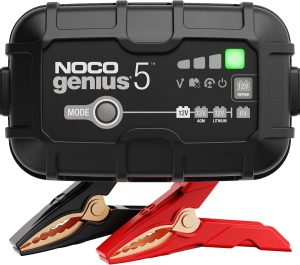
NOCO GENIUS5 5A Smart Charger with Lithium Mode
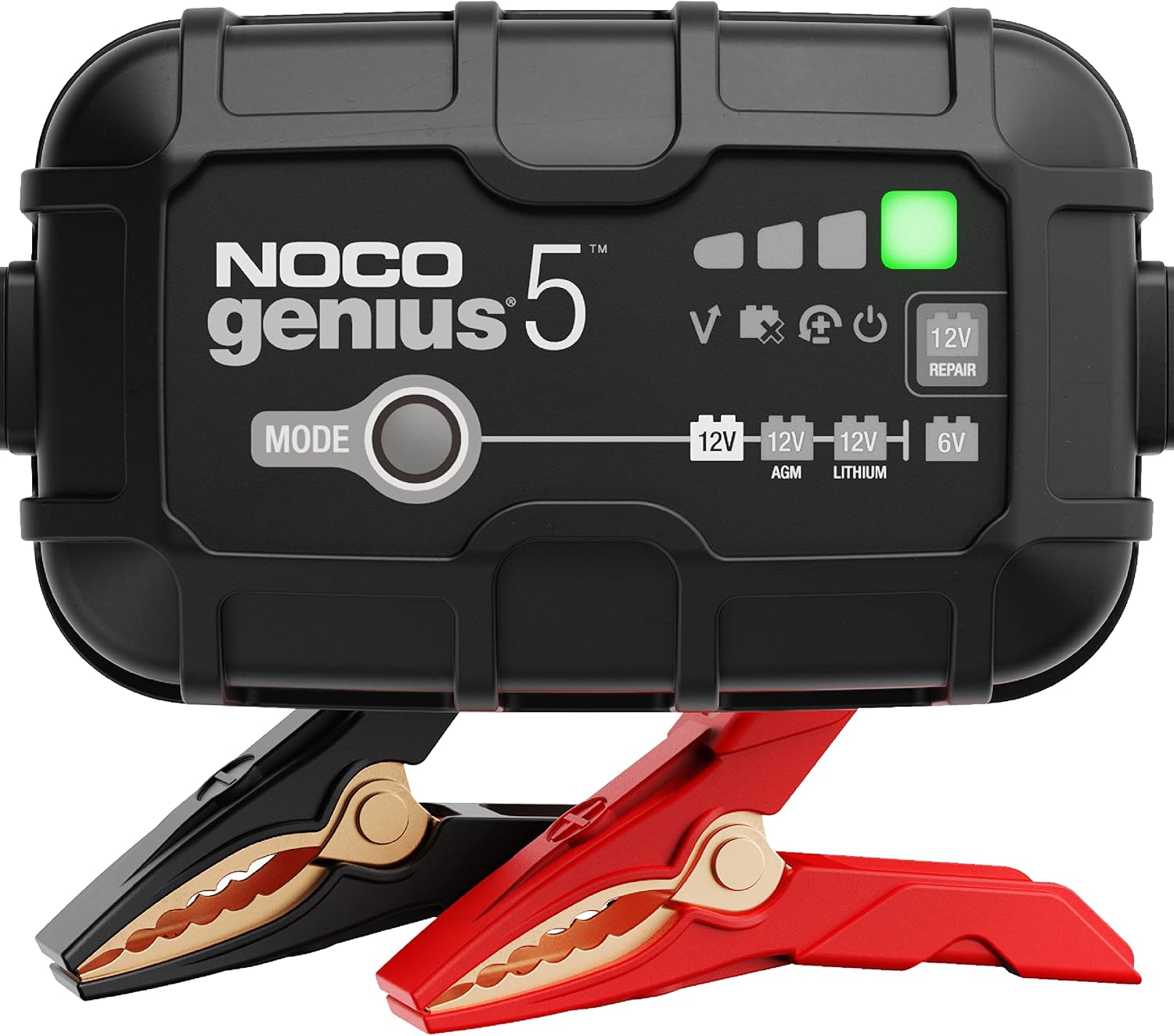
Type: multi-chemistry charger, 5A, 6V and 12V, with a dedicated LiFePO4 mode and a Force Mode for packs reading 0V. Thermal sensor adjusts charging to temperature. Around $70.
Fits: lead-acid, AGM and LiFePO4. The 5A rate suits 8-15Ah powersport lithium packs. Ships with clamps and eyelet connectors.
Rating: 4.6 / 5 from 21,142 ratings
The most-reviewed product on this page by an enormous margin – over 21,000 ratings – and the one lithium owners name most often when asked what they use.
Two capabilities matter here. The dedicated LiFePO4 mode charges at the correct profile. And Force Mode can push current into a pack whose BMS has locked out and is reading 0V, which is the situation that makes most chargers give up. An owner puts it simply: NOCO is one of the few chargers that can charge a completely dead battery.
The 5A rate is right for a group 20 Harley battery, where the OptiMate 0.8A unit would be too slow.
The one caution is the flip side of its flexibility. You must select the lithium mode every time. Left in a lead-acid or desulfation mode, this will damage a LiFePO4 battery exactly as any other lead-acid charger would. That is the trade against the lithium-only OptiMate: more capability, more responsibility.
What owners say: “NOCO is one of the few chargers that can charge a completely dead battery.”
Battery Tender Junior 12V 800mA, Switchable Lead-Acid and Lithium
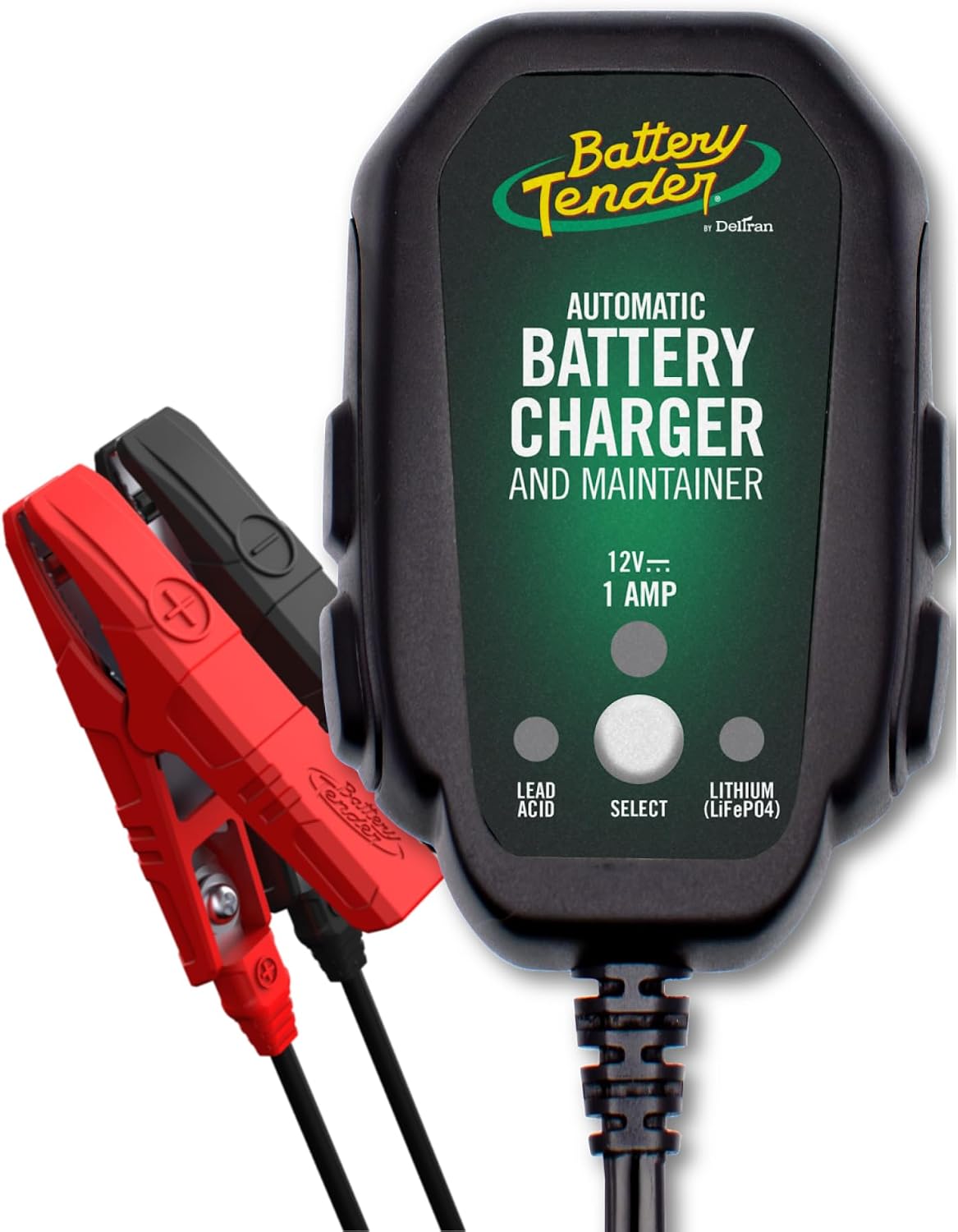
Type: maintainer, 12V, 800mA, switchable between lead-acid and lithium. Spark-proof connection. Around $40.
Fits: 5-15Ah powersport batteries as a maintainer. CRITICAL – a cheaper non-switchable version of this product exists. Make sure you buy the switchable one.
Rating: 4.8 / 5 from 5,321 ratings
The cheapest correct option at $40, with the highest rating on this page at 4.8 from over 5,300 owners.
As a maintainer it does the job well – owners report running them through hard winters, one noting a month of four-degree weather with no problem.
Two warnings, and both matter.
It is a maintainer, not a rescue charger. Owners state this plainly – they are not rescue chargers. A dead lithium pack with a locked-out BMS will not come back with this. If that is what you need, the OptiMate or the NOCO are the answer.
Buy the right version. A cheaper non-switchable Battery Tender Junior exists and looks nearly identical. That is the lead-acid-only one, and it is exactly the charger that damages LiFePO4. Check the listing says switchable, and check the switch is set to lithium before you connect it.
What owners say: “They keep your battery charged through cold weather. Even a month of 4 degree weather.”
Should You Actually Buy Lithium?
An honest answer rather than a sales pitch.
Lithium makes sense if
- You want the weight off – roughly 10 to 12 lb on a Touring bike, high and central
- Your bike sits for long periods and you dislike using a tender
- You are willing to buy a proper lithium charger as part of the purchase
- You are prepared to pay for a brand with a real warranty rather than the cheapest listing
- Your riding is in moderate climates, or you store the bike somewhere above freezing in winter
Stay with AGM if
- Your bike lives outside through a hard winter, particularly if it gets ridden in it
- You want warning before a failure rather than a battery that reads 13V and does nothing
- You are buying on price – a good AGM beats a cheap lithium comfortably, and this whole page is evidence of that
- You have a high-draw setup with heated gear, extra lighting and a big audio system, where the real amp-hours matter more than the equivalent figure
- You do not want to buy a second charger
The honest summary
Lithium at the premium end, with published actual capacity and a multi-year warranty, is a genuinely good upgrade and the owner reports at three and four years back that up. Lithium at the budget end of a marketplace is a gamble with a documented six-month failure pattern, inflated cranking figures and, in one case, a 30-day warranty.
If your budget only stretches to the cheap end of lithium, buy a good AGM instead. You will be better off.
Lithium Battery Brands
Antigravity
The specialist name that appears throughout this category, and the only one here that publishes both actual and lead-acid-equivalent capacity while explicitly stating they make no inflated cranking claims. That transparency is worth paying for given everything else on this page. Two to three year warranty. The strongest long-term owner report here – three years on a Pan America with no tender – is on an Antigravity. They also draw failure reports, so this is not a guarantee, but the odds are better.
Shorai
Long-established in motorcycle lithium and referenced by owners for multi-year service – one reports around four years. Since 2022 they have officially designated a specific lithium charger as their recommended unit, which tells you how seriously the charging question is taken by people who make these.
Bosch
A serious name entering the category, with an 18-month warranty. Mixed owner evidence here: one reports a year with zero issues, another reports failure inside a year with fewer than 200 starts and being refused by both Bosch and the retailer.
NOCO
Worth clarifying because the search results confuse people: NOCO does not sell lithium powersport batteries on this marketplace. Searching for one returns other brands. NOCO make chargers and jump starters, and their charger is a genuinely good one – just do not go looking for a NOCO battery.
Marketplace brands
TYKOOL, OMUGO, Forgetyo, Autocessking, Weize and similar supply most of the volume at half the price of the specialists. The failure reports on this page are concentrated here, the cranking figures are the ones owners have measured short, and one carries a 30-day warranty. Some owners get years out of them. Read the warranty and decide how much you want to gamble.
Harley Lithium Batteries - FAQs
Is a lithium battery good for a Harley-Davidson?
Are there any problems with Harley-Davidson lithium batteries?
Who makes the best lithium motorcycle batteries?
Do I need a special charger for a lithium motorcycle battery?
Will a lithium battery work in cold weather?
How long should a lithium motorcycle battery last?
Why does my lithium battery read 13 volts but not start the bike?
Can I fit a lithium battery straight into my Harley?
Is lithium worth it over AGM for a Harley?
Conclusion
Buy the warranty, not the cranking amps. In this category the warranty length is the most honest specification on the page. Thirty days tells you what the manufacturer expects; three years tells you something different. And a very high claimed CCA at a very low price is usually a lead-acid-equivalent figure rather than a real one – owners have measured 520 against a claimed 700.
Budget for the charger as part of the purchase. Your existing tender will damage a lithium battery if it has a desulfation or pulse-repair mode, which most do. Add sixty to eighty dollars for a proper lithium charger, ideally one with a BMS wake-up function, and factor that into the comparison against AGM.
If you ride through a real winter, check the charge temperature window specifically. Starting in the cold is not the problem – lithium does that well, especially if you switch the headlight on for thirty seconds first. Charging below freezing is what damages the cells, and one battery here permits discharge to -20C while allowing charging only above 0C. Several publish nothing at all.
And the thing worth repeating: lithium fails without warning. A lead-acid battery cranks progressively slower and gives you days to act. A lithium battery can read 13 volts on a meter and not turn the engine over. That is not a reason to avoid it – but it is a reason to buy one with a real warranty behind it rather than the cheapest listing with the biggest number on the label.
#1 Pick: Best Lithium Battery for Harley
Antigravity ATX20-HD Lithium Battery, 780 Cranking Amps
Buy the warranty, not the cranking amps. And budget for a lithium charger – your existing tender will damage a LiFePO4 battery.