Three things change when you swap the exhaust on a Harley: how it sounds, how it makes power, and how much of the job you have left to do afterwards. Most riders are here for the first one.
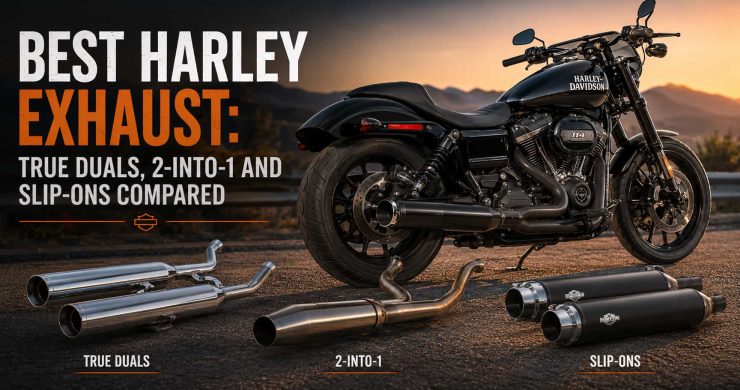
The best Harley exhaust for you depends less on which brand is “best” and more on which of three systems you are actually buying. A slip-on replaces the mufflers and leaves the stock head pipes alone. A 2-into-1 merges both cylinders into a single collector. True duals run each cylinder its own pipe from head to tail. They cost different money, sound different, and only one of them can be bolted on in an afternoon without touching the tune.
This guide covers all three: what actually changes the sound, which systems fit which bikes, whether you need a tuner afterwards, and what the law says. Plus the hardware nobody mentions until you are halfway through the job with a leaking exhaust port.
One warning up front, because it costs people real money: exhaust is the most fitment-sensitive part on the bike. A system for a 2017-up Touring will not fit a 2016. Every recommendation below lists what it fits – and where a listing does not state fitment clearly, this guide says so rather than guessing.
#1 Pick: Best Harley Exhaust
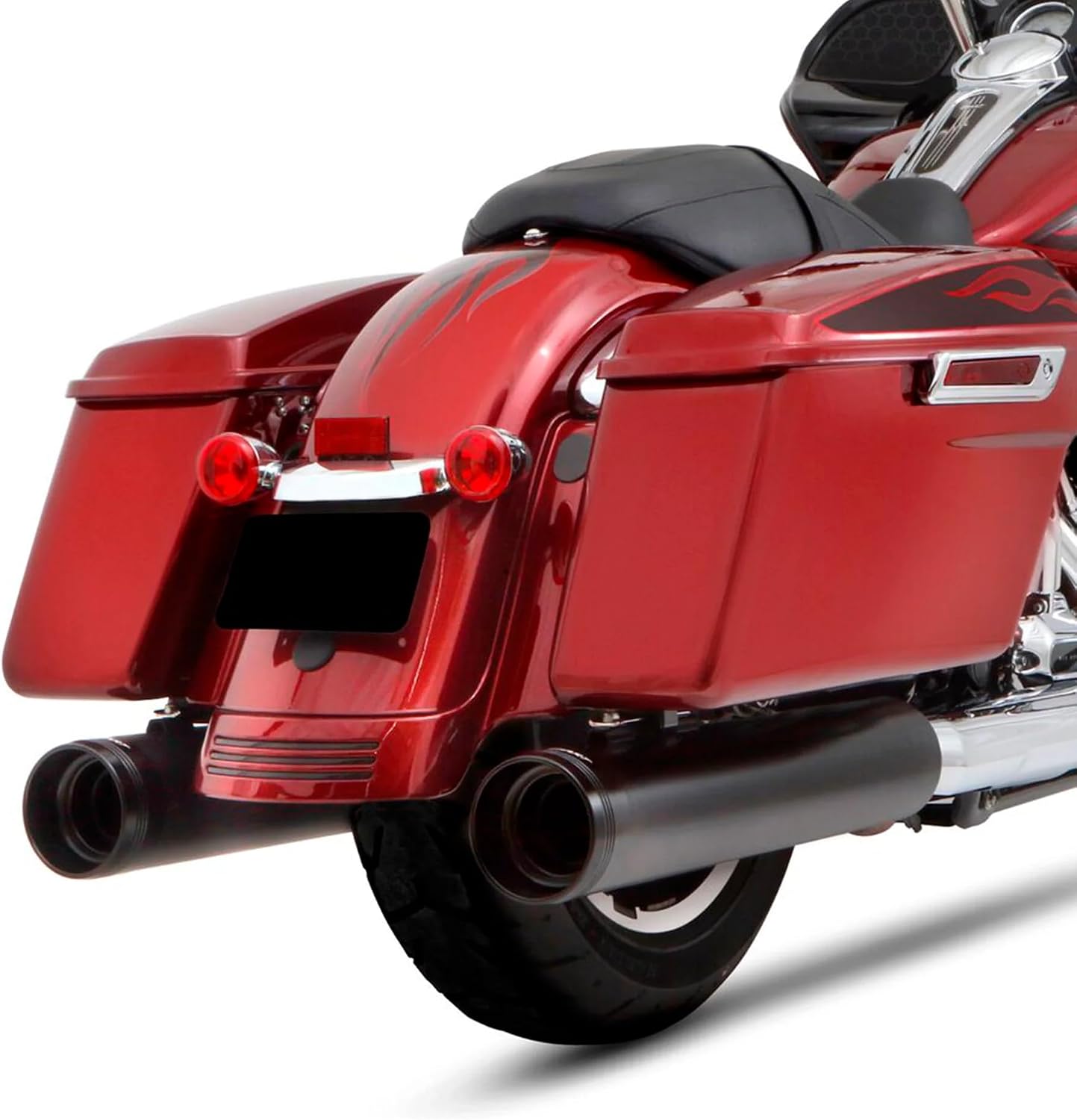
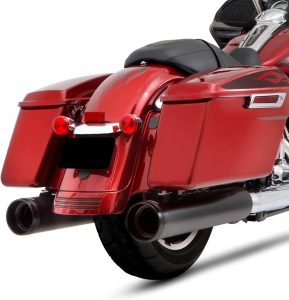
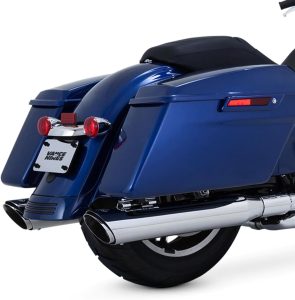
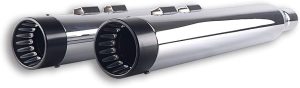
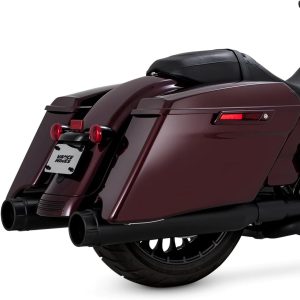
Rinehart DBX45 4.5" Slip-On Mufflers
Highest rated exhaust in this guide and the brand riders name when the subject is tone rather than volume. The 4.5-inch body gives the fuller, lower note a 4-inch cannot. Confirm the part number against your year before ordering – the listing is inconsistent on fitment.
On a budget, the SHARKROAD 4.5-inch further down covers 2017-2023 Touring for roughly a third of the price and needs no tune. For a documented name-brand option, the Vance & Hines Twin Slash fits 2017-2018 Touring and states its tuner requirement up front.
The top best product [hide]
Slip-Ons vs 2-into-1 vs True Duals
Before any brand talk, work out which of these you are buying. It determines the price, the install time and whether you need a tune.
Slip-on mufflers
You remove the stock mufflers and slip new ones onto the existing head pipes. That is the whole job – usually two clamps and a bracket per side, an hour with hand tools, no cutting and no removing the exhaust from the heads.
What you get: a louder, deeper note and a cleaner look. What you do not get: a big power change, because the head pipes and any catalytic converter stay where they are. Expect $300 to $800.
This is what most riders should buy. It is reversible, it is the cheapest way to change the sound, and if you decide later to go further, the mufflers usually carry over.
2-into-1 systems
Both cylinders feed into one collector and out through a single muffler. This is the layout that performance builders reach for, because a properly designed collector scavenges exhaust gas and typically produces the strongest midrange torque of the three – the part of the powerband you actually use on the road.
It also sounds distinctly different: one deep note rather than the staggered beat of two pipes. Baggers running 2-into-1 have a characteristic low growl that true duals do not produce.
The trade-offs are cost and heat. A full system runs $700 to $1,300, it is a bigger install, and the single collector puts more heat near your right leg. You will need a tune afterwards.
True duals
Each cylinder gets its own head pipe and its own muffler, end to end, with no crossover joining them. This is the classic look and the classic sound – the staggered, uneven beat that people associate with a Harley.
Worth understanding: a stock Touring model does not have true duals. It has a crossover connecting the two head pipes, which quiets things and evens out the pulses. Converting to true duals means replacing the head pipes, not just the mufflers, so it is a full-system job.
Performance is a mixed picture. True duals free up top-end breathing but usually give up some low-end torque compared with a well-designed 2-into-1, because each cylinder loses the scavenging effect. People buy them for sound and appearance more than for numbers, and that is a perfectly good reason.
Which one should you buy?
| Slip-ons | 2-into-1 | True duals | |
|---|---|---|---|
| Typical price | $300 – $800 | $700 – $1,300 | $800 – $1,500 |
| Install | 1 hour, hand tools | Half a day | Half a day or more |
| Tune required | Sometimes | Yes | Yes |
| Sound change | Moderate | Deep single note | Classic staggered beat |
| Best for | Most riders | Midrange torque | Look and sound |
How Harley Exhaust Actually Sounds – and What Controls It
Search for exhaust advice and the most-read thread on the internet is titled “best sounding exhaust, don’t care about more power.” That is the honest centre of this topic, so it is worth explaining what actually produces the sound rather than listing decibel claims.
Baffles do most of the work
A baffle is the restriction inside the muffler. More restriction means quieter and, usually, a deeper tone because the low frequencies pass while the sharp high end gets absorbed. Less restriction means louder and brighter. A straight pipe with no baffle at all is loudest and, to most ears, the least pleasant – a lot of noise without much character.
This is why two mufflers from the same brand in the same shape can sound completely different. It is also why you can change the sound of a system you already own without buying a new one: quiet baffles drop volume by a noticeable margin, and riders who install them typically describe the result as deeper rather than simply softer.
System layout sets the character
Two cylinders exiting separately produce the uneven, staggered beat. Merge them into one collector and you get a single, lower, more continuous note. Neither is better – they are different sounds, and it is worth listening to both before spending money.
Length and diameter set the pitch
Longer pipes and larger diameters push the note lower. Short, small-bore pipes sound sharper and rise faster. This is why 4.5-inch slip-ons sound fuller than 4-inch, and why drag pipes have a crack rather than a rumble.
Decel popping: what it is and whether to worry
Popping and crackling on a closed throttle is the complaint that follows almost every exhaust swap. It happens when unburnt fuel meets fresh air in a hot pipe and ignites there instead of in the cylinder. Opening up the exhaust makes the mixture leaner, which makes it more likely.
Some riders like it. If you do not, the fix is almost always a tune rather than a different pipe – richening the deceleration fuel map usually removes it. Chasing it by swapping mufflers is expensive and rarely works.
A realistic expectation
Slip-ons on a stock head pipe with the catalytic converter still in place will get you a fuller, louder version of the stock note. They will not turn a bagger into a drag bike. If you want a dramatic change in character, the head pipes and the cat are what stand between you and it – and that is a full-system decision with legal implications covered further down.
Listen: True Duals on a Softail
Reading about exhaust tone only gets you so far. This is a straight sound clip of a Bassani true dual fishtail system on a 2018 Softail Deluxe – no music, no commentary, just the bike at idle and under throttle. It is a useful reference point for the staggered beat that true duals produce, as opposed to the single deeper note of a 2-into-1.
Best Slip-On Exhausts for Harley
Slip-ons are what most riders should buy: the biggest change in sound for the least money and the least work. Four worth considering, from the highest rated to the best value. Check the fitment line on each one – it is not the same on any two.
Rinehart DBX45 4.5" Slip-On Mufflers
Fits: Harley Touring. The listing title says 2017-newer while the product bullets say 1995 and later – Rinehart makes both generations, so confirm the exact part number against your year before ordering. Not for Ultra Limited.
Tuner: recommended. Owners running these with an air cleaner report having the bike tuned afterwards.
Rating: 4.8 / 5 from 64 ratings
Rinehart is the brand riders name when the conversation is about tone rather than volume, and this is the highest-rated exhaust product in this guide. The 4.5-inch body gives the fuller, lower note that a 4-inch cannot, and the DBX45 is the model that built the reputation. Owners describe it as finally sounding like a Harley rather than simply being loud – which is the distinction that matters once you have heard a few bikes with straight pipes. Two honest points. It is the most expensive option here by a wide margin, and Rinehart’s presence on general marketplaces has thinned considerably, so availability moves. Second, the listing contradicts itself on fitment: the title says 2017-newer, the bullets say 1995 and later. Rinehart produces both, but you need the right part number, and that is worth a phone call rather than a guess on a $770 purchase.
What owners say: “They sound great on my ’18 touring. It actually sounds like a Harley now.”
Vance & Hines 16672 Twin Slash Round 4" Slip-On
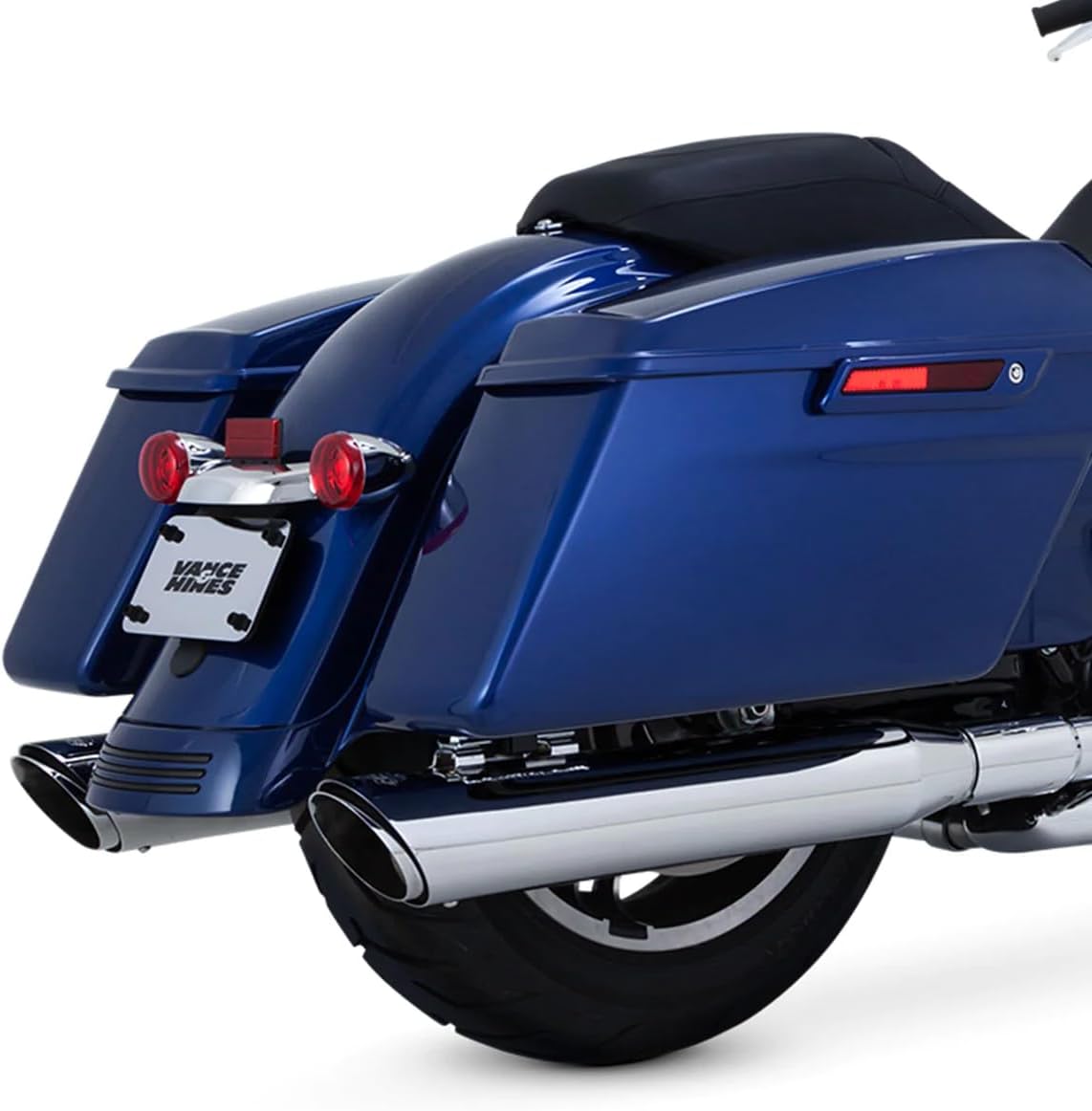
Fits: 2017 and 2018 Touring only – Street Glide, Road Glide, Ultra, Road King. Freewheeler and Tri Glide use a different part.
Tuner: recommended by the manufacturer. Vance & Hines states that a Fuelpak or FP3 fuel management system should be used when fitting these to an EFI bike.
Ships to California: No. This listing carries a shipping restriction for California addresses.
Rating: 4.6 / 5 from 75 ratings
The straightforward name-brand choice, and the one with the clearest documentation. Vance & Hines describe the target as their trademark throaty rumble, and the 4-inch round body is the shape most people picture when they think of an aftermarket bagger muffler. What sets this listing apart from most of the category is honesty about what else you need: V&H state on the page that a Fuelpak or FP3 is recommended on EFI bikes, rather than leaving you to discover it when the engine runs hot and pops on the overrun. Two constraints to be aware of before you buy. The fitment window is narrow – 2017 and 2018 Touring models specifically, not the 2009-2016 platform and not later years without checking. And it cannot be shipped to a California address.
What owners say: “Installed on my ’23 Road Glide. Sounds awesome.”
SHARKROAD 4.5" Chrome Slip-On Mufflers
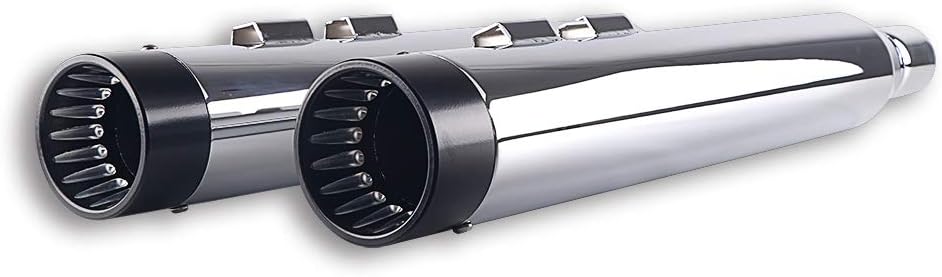
Fits: 2017-2023 Touring – Road King, Electra Glide, Street Glide, Road Glide, Ultra Limited. Requires stock head pipes. Not for Trike models.
Tuner: not required according to the manufacturer, and one owner specifically noted not having to retune where a friend’s alternative setup did.
Rating: 4.4 / 5 from 89 ratings
The value entry, and the one with the widest fitment coverage in this guide – 2017 through 2023 Touring, which is most of the bikes people are shopping for. At roughly $310 it costs less than half of the name-brand alternatives, and with 89 ratings it is not an untested listing. The manufacturer positions this as the loud version: there is no restrictive baffle, which is exactly why it is cheap to make and exactly why it sounds the way it does. Owners describe a proper rumble at cruising speed that turns aggressive under throttle. If you want a system you can quiet down later, this is not it. The recurring complaint, and it is worth taking seriously, is the chrome. Several owners report plating that peels after a season or two, and they mention seeing the same on other riders’ bikes. For a machine that lives in a garage that may not matter. For a bike that sits outside through a salted winter, it probably will.
What owners say: “These are great mufflers! Nice rumble cruising down the road and it gets very loud if you crack down on the throttle!”
Vance & Hines Torquer 450 Slip-On Mufflers, Black
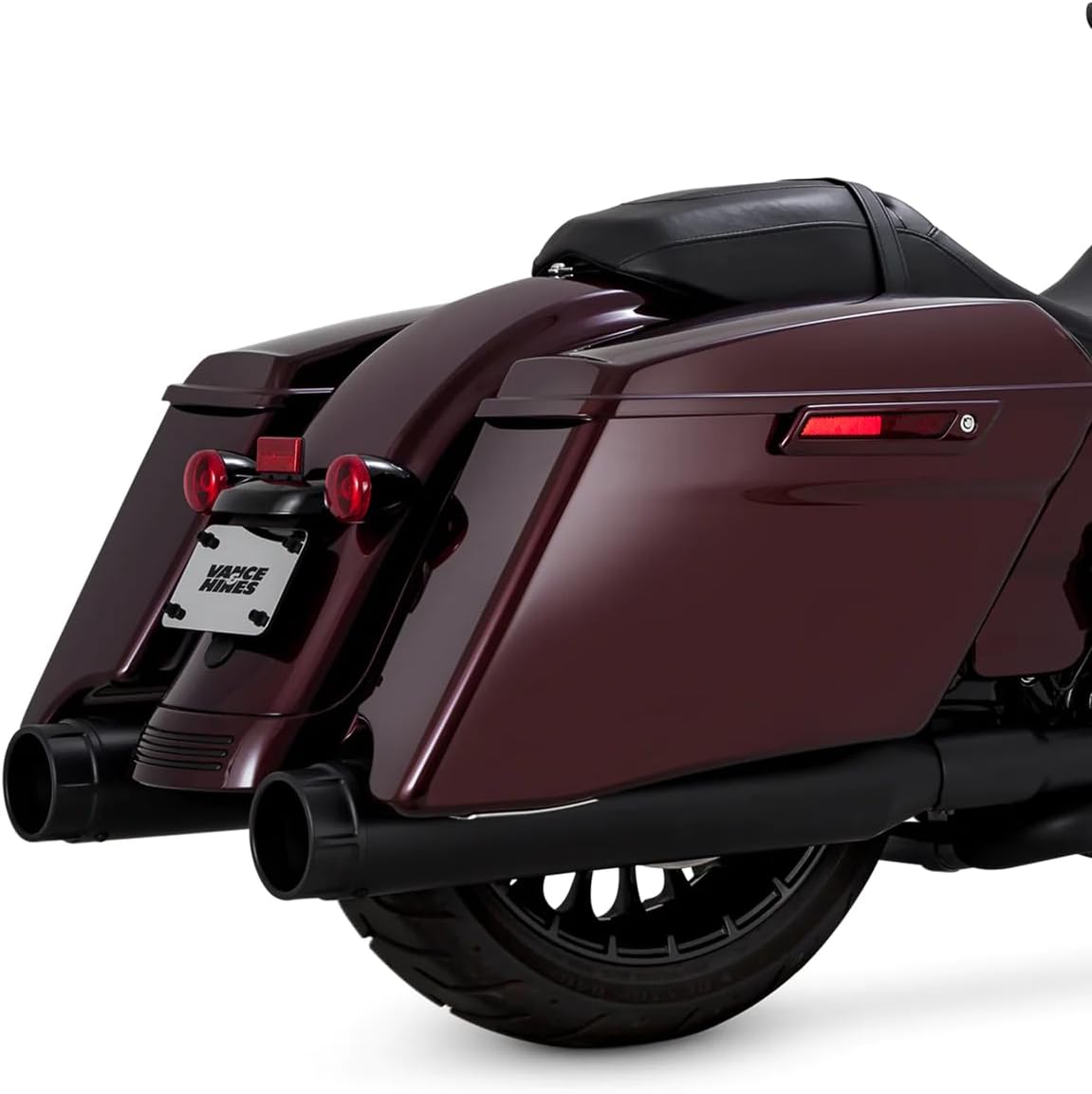
Fits: not stated on the Amazon listing. Neither the title, the bullets nor the description names a single year or model. Check the part number 46674 against the Vance & Hines catalogue for your bike before ordering.
Tuner: not mentioned on the listing or in reviews.
California: Proposition 65 warning applies. No shipping restriction listed.
Rating: 4.6 / 5 from 29 ratings
The blacked-out option for riders building a dark bike, and the 4.5-inch Torquer body is a well-regarded shape. Owners fitting them to Road Glides describe the fit and sound as exactly what they wanted, and the install as straightforward. Two things stop this being a top recommendation. First, the listing states no fitment at all – the description literally repeats the product name, with no years and no models. On an exhaust part that is a genuine problem, and the only safe route is to check part number 46674 against the manufacturer’s own fitment guide. Second, there is a consistent finish complaint: one owner reported the black coating looking badly degraded after 10,000 miles and less than eight months, with the warranty not covering corrosion. Black finishes on exhaust take more heat abuse than chrome, and this appears to be a case where that shows.
What owners say: “I love how they look on my Road Glide Special. For me they are the perfect fit, sound and quality.”
A Note on True Dual Systems and Availability
If you came here looking specifically for a true dual exhaust for a Harley, one practical thing is worth saying plainly.
Complete true dual head pipe systems are increasingly hard to buy through general retailers. The well-known kits from Rinehart, Bassani, Cobra and Freedom Performance move through motorcycle specialists, dealers and the manufacturers themselves rather than mainstream marketplaces, and listings that existed a few years ago have quietly disappeared.
That is not a reason to avoid true duals. It does mean that if a full true dual system is what you want, the realistic path is a specialist retailer or the brand direct, where you also get proper fitment filtering by year and model – which, on a full system, matters more than the price.
What remains widely available, and what this guide focuses on, is the part of the market most riders actually buy: slip-on mufflers, sound control, and the hardware that makes any exhaust job go properly.
How to Quiet Down an Exhaust You Already Own
If the pipes on your bike are right in every way except that they are too loud to live with, you do not need a new system. You need a different baffle.
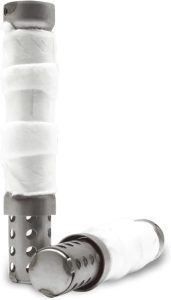
Vance & Hines Quiet Baffle
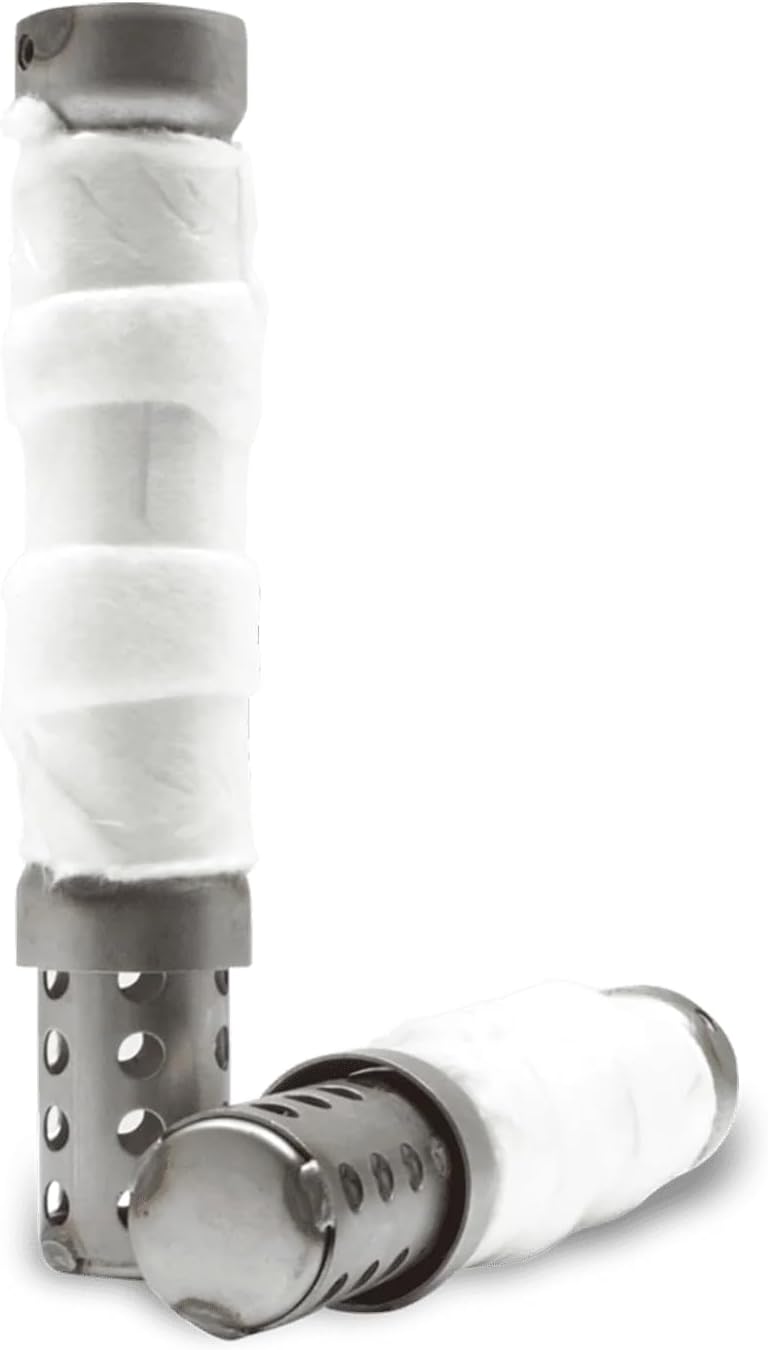
Fits: Vance & Hines Shortshots Staggered and Sideshots systems, part 21301. Sold individually – order two for a pair of pipes.
Tuner: not required. Owners report no need to rejet or change timer settings after fitting.
Ships to California: No. This listing carries a shipping restriction for California addresses.
Rating: 4.4 / 5 from 425 ratings
With 425 ratings this is the most-reviewed product in this guide, and it exists because a lot of riders discover that the pipes they bought are louder than they can live with. Rather than replacing the system, you replace what is inside it. The effect owners describe is not simply quieter – it is a deeper, more civilised note, because the baffle absorbs the sharp high frequencies while the low end passes through. A rider running Shortshots Staggered on a 2015 Softail Slim summed up the before state as loud with straight-through baffles, and the after state as something he could ride all day. Two practical notes. They are sold one at a time, so a pair of pipes needs two. And the listing cannot ship to California. If your exhaust is close to right but too loud for long rides or for where you live, this is a fraction of the price of starting over.
What owners say: “My 2015 H-D Softail Slim with the Shortshots Staggered was loud AF with the standard baffles, aka straight pipes.”
Harley Exhaust by Model
Fitment is not a formality here. Harley changed the Touring chassis and exhaust routing in 2017 with the Milwaukee-Eight, and again in detail since. A system listed for one generation will not bolt to the other.
Touring: Street Glide, Road Glide, Road King, Electra Glide
The biggest aftermarket by far, and the one where the 2017 cutoff matters most. Systems are usually sold as either 2009-2016 or 2017-up, and the two are not interchangeable. Slip-ons in 4 and 4.5 inch are the standard upgrade; 4.5 gives a fuller note and fills the space under the bags better.
Check whether your bike is a Trike or Freewheeler before ordering – three-wheelers frequently need a different part number and many two-wheel systems explicitly exclude them.
Softail
The 2018 redesign split Softail fitment the same way the 2017 change split Touring. Pre-2018 and 2018-up are different platforms. Shorty and staggered systems are the common choices, and slip-on options are narrower than on Touring.
Dyna
Discontinued in 2017 but enormously well supported, because the platform ran essentially unchanged for years. 2-into-1 systems are especially popular on Dynas, where the midrange torque gain is noticeable on a lighter bike.
Sportster
The Evo Sportster ran from 1986 to 2021 with a stable exhaust layout, so parts availability is good and prices are lower than Big Twin equivalents. Note that the Sportster S uses the Revolution Max engine and shares nothing with the Evo XL – do not cross-shop parts between them.
Road King specifically
Mechanically a Touring model, so Touring fitment applies. The difference is aesthetic: without a fairing or a tour pack, the pipes are far more visible, which is why Road King owners tend to spend more on finish than on the muffler internals.
Harley Exhaust Brands Compared
Vance & Hines
The largest name in the category and the one you will encounter most. The range runs from budget slip-ons to full race systems, and the company also makes the Fuelpak FP3 tuner – which matters, because V&H documentation tells you outright when a system needs fuel management rather than leaving you to find out. Their hardware and gasket kits are also the default replacement parts for a lot of bikes that are not running V&H exhaust at all.
Rinehart Racing
A specialist with a strong reputation for sound quality specifically. Riders who care about tone rather than volume mention Rinehart more than any other brand. Prices sit at the premium end and availability through general retailers has become patchy.
Bassani Xhaust
Long-established, particularly respected for the Road Rage 2-into-1 line. Bassani systems come up constantly in discussions about midrange torque on baggers and Dynas.
Cobra
Broad range across cruiser platforms, historically strong on true dual head pipes and Powerport designs. Like several others, distribution has shifted towards specialists.
Freedom Performance
Known for full systems at prices below the biggest names, with a following among riders building on a budget without going to unbranded parts.
Rush, D&D and Khrome Werks
Smaller specialists, each with a devoted following. Rush is associated with a distinctive raw tone, D&D with the Fat Cat 2-into-1, Khrome Werks with slip-ons for baggers.
Budget and import brands
Systems from lesser-known manufacturers now occupy a real part of the market, typically at a third to half the price of a name brand. Fit and sound are frequently fine. Where owners report problems, it is almost always the finish – chrome plating that peels or dulls after a season. If a bike lives outdoors or sees salt, that is the trade-off you are accepting.
Do You Need a Tuner After Changing the Exhaust?
On a fuel-injected Harley, usually yes – and this is the part people skip.
Modern bikes leave the factory running lean because emissions regulations require it. Open up the exhaust and you increase how much air the engine can move, but the ECU keeps delivering the same fuel. The result is a mixture that is leaner still, which shows up as extra heat, decel popping, and on a bike ridden hard, accelerated wear.
When you can get away without one
- Slip-ons only, catalytic converter still in place. The restriction has not changed much. Many riders run this combination for years with no tune and no problem. Some manufacturers still recommend fuel management even here – Vance & Hines states it outright for their Twin Slash slip-ons on EFI bikes.
- Carbureted bikes. No ECU to remap. You rejet instead, which is a different job and usually a smaller one.
When you definitely need one
- Any full system – 2-into-1 or true duals
- Anything that removes or bypasses the catalytic converter
- Exhaust combined with an air cleaner upgrade, which is the most common pairing
The usual options are the Vance & Hines Fuelpak FP3, Dynojet Power Vision, and Harley’s own Screamin’ Eagle Pro Street Tuner. Budget $300 to $500, or take the bike to a dealer or dyno shop and have it tuned properly – which is what the owner of a 2019 Road King running Rinehart slip-ons and a matching air cleaner described doing.
We cover the options in detail in our guide to the best Harley tuners and fuel management systems.
One more thing on older bikes
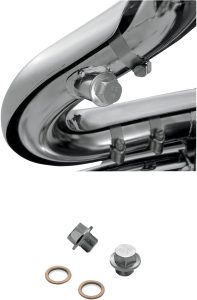
If you are fitting a newer exhaust system to a pre-closed-loop bike that never had oxygen sensors, the system will arrive with open O2 ports. Those need plugging, or the engine draws air through them and runs erratically. It is a $30 part that is easy to forget until the bike is back together.
Gaskets, Flanges and Brackets – the Parts Nobody Mentions
Every exhaust job needs consumables, and the reason to care is not tidiness. A leaking exhaust port makes a ticking or hissing noise that people mistake for a valvetrain problem, and it lets exhaust gas escape before it reaches the muffler – so the expensive system you just bought does not sound the way it should.
Exhaust port gaskets
Always replace them. They crush to seal and they do not seal a second time. A set costs less than lunch and it is the single most common cause of a new exhaust that sounds wrong.
Flanges and retaining rings
The flanges clamp the head pipe to the head. Old ones distort and old retaining rings lose their spring. Most flange kits include the gaskets, which is the sensible way to buy them.
Mounting hardware
Vibration on a V-twin loosens fasteners, and exhaust hardware sits in the worst possible place for it. Loose lower mounting bolts are a leading cause of the rattle riders blame on the muffler itself. Replace the hardware kit with the system, and check it after the first few hundred miles.
Brackets on baggers
If your bike has stretched saddlebags, stock brackets often will not let you position the mufflers evenly. Adjustable brackets solve a problem that looks cosmetic but is not entirely – a muffler sitting too close to a bag will melt it.
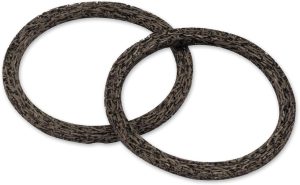
Vance & Hines Exhaust Port Gasket Kit 22899
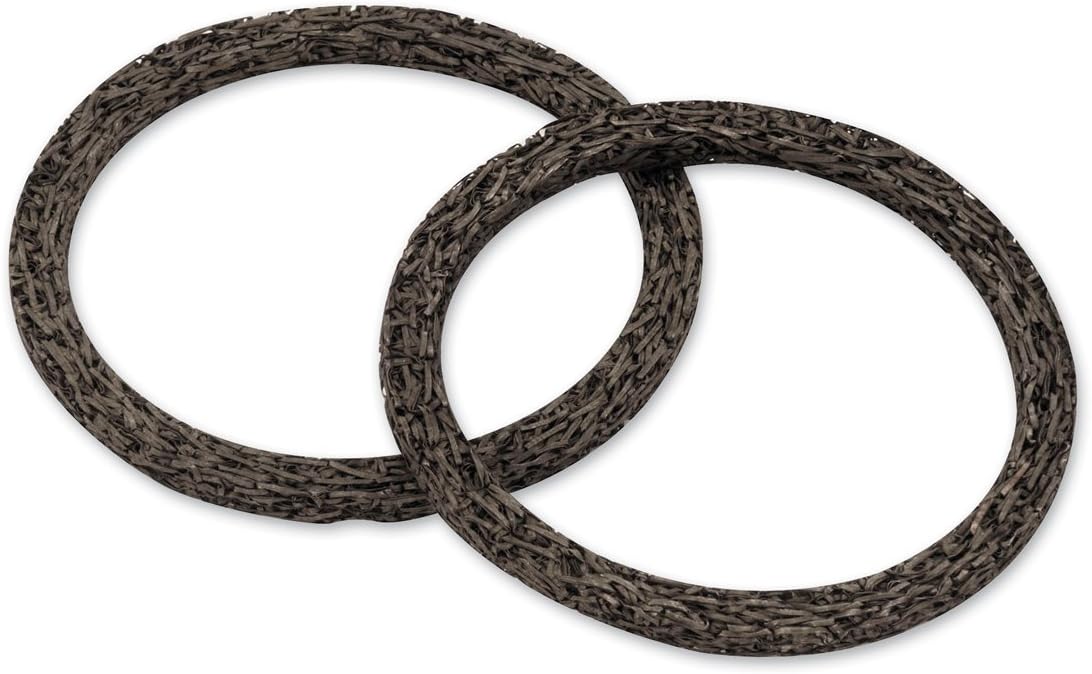
Fits: designed for the spherical exhaust port used on 2010-2011 Big Twin models, and also works with earlier-style systems.
California: Proposition 65 warning applies. No shipping restriction.
Rating: 4.6 / 5 from 593 ratings
With 593 ratings this is the most-bought item in the guide, and that tells you something: exhaust gaskets are not optional. They crush to form their seal, which means they seal properly exactly once. Reuse them and you get a leak at the head – which announces itself as a ticking or hissing that riders regularly mistake for a lifter problem, and which lets gas escape before it reaches the muffler you just paid for. Buy a set with every exhaust job and with every removal after that. Owners fitting them alongside everything from a 2022 Forty-Eight with Big Radius pipes to older Big Twins report the same thing – they seal and the noise goes away. One note from the reviews: some riders find these easier to install than the older tapered mesh design, while a minority prefer the traditional style for their particular heads.
What owners say: “These worked great for my 2022 Harley Forty-Eight with Vance and Hines Big Radius exhaust!”
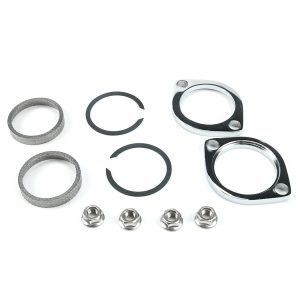
Exhaust Flange Install Kit for Harley Big Twin
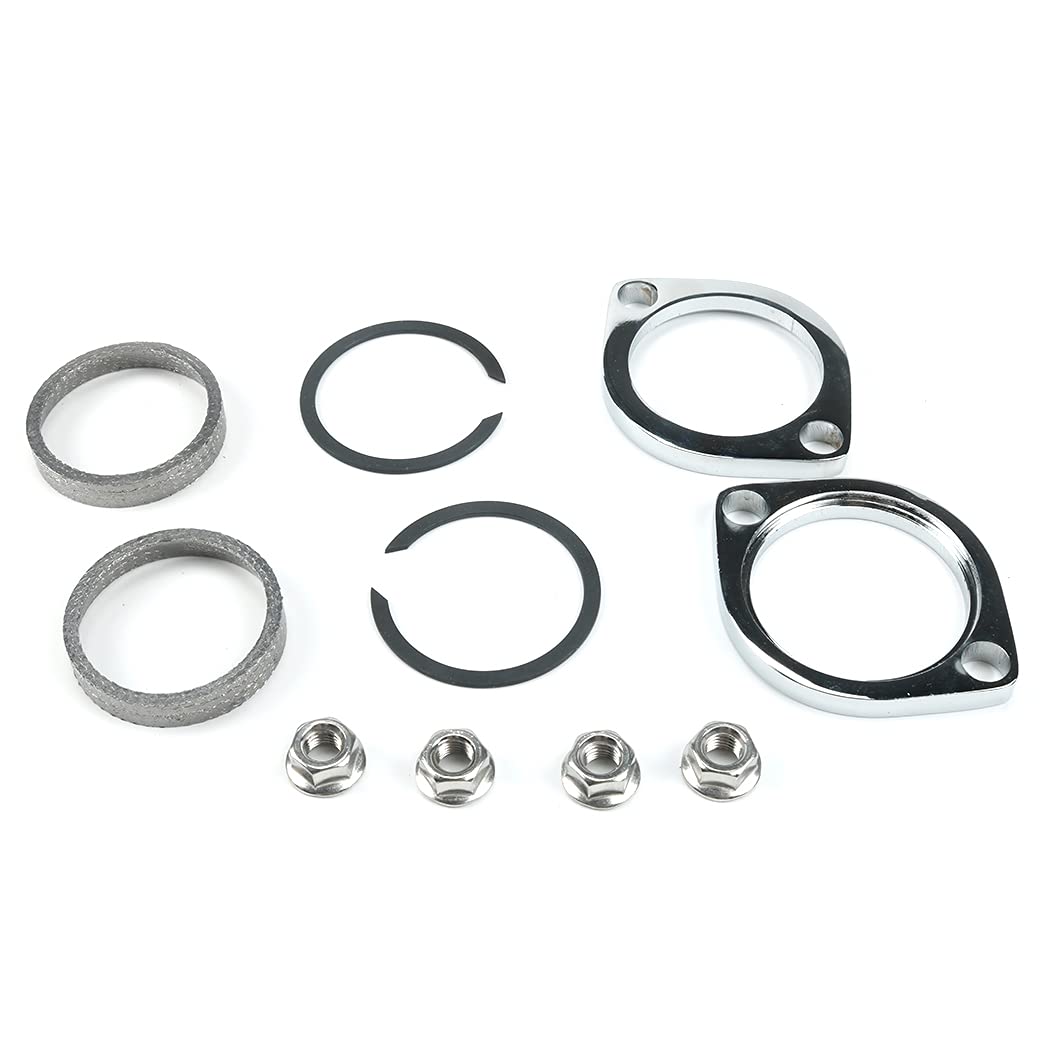
Fits: 1984-2018 Big Twin, 1986-2018 Softail, 1984-2020 Sportster, 1991-2018 Dyna. Not for V-Rod.
Rating: 4.7 / 5 from 233 ratings
The sensible way to buy exhaust consumables: flanges, retaining rings and gaskets in a single kit, covering nearly four decades of Harley models. The flanges clamp the head pipe to the cylinder head, and old ones distort under repeated heat cycles while old retaining rings lose their spring. Replacing them at the same time as the gaskets is what turns a leak-free install from luck into a certainty. This is also the kit to reach for if you are removing an exhaust that has been on the bike a long time – flanges frequently come off deformed, and discovering that with the new system already in your hands is a bad afternoon. The fitment list here is the most detailed of any hardware item in this guide, which by itself makes it easier to buy with confidence.
What owners say: “Works as it should, no issues. Put these on two different bikes, no leaks and fits perfectly.”
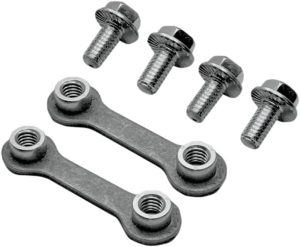
Vance & Hines Exhaust Hardware Kit 21989
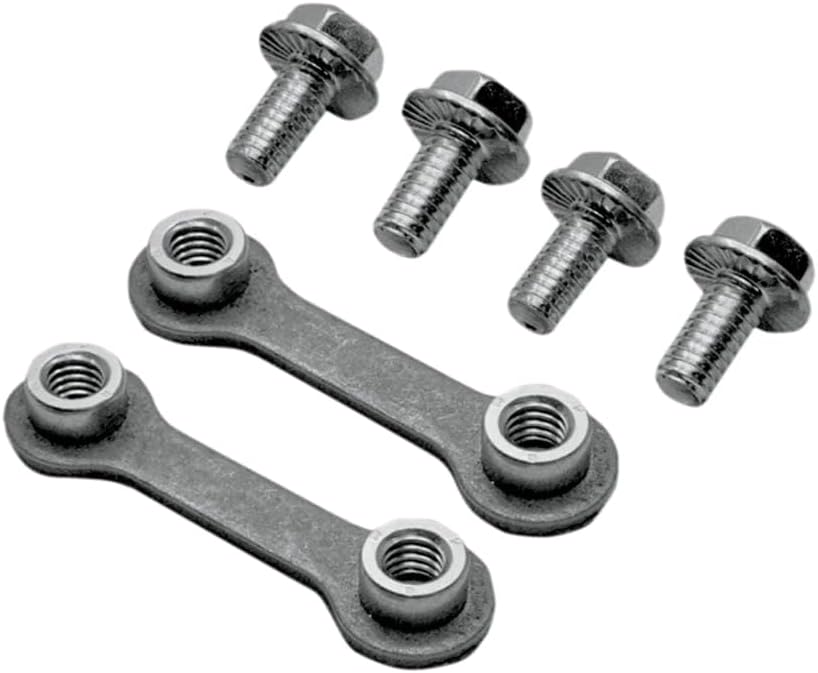
Fits: no specific years or models listed. The kit contains two dog bones and four bolts used across most Vance & Hines systems, and owners describe it as effectively universal.
California: Proposition 65 warning applies. No shipping restriction.
Rating: 4.7 / 5 from 171 ratings
Two dog bone mounting blocks and four bolts, and a good example of why small parts matter on a V-twin. Vibration works exhaust fasteners loose, and loose lower mounting bolts are one of the most common causes of the rattle that riders blame on the muffler itself. One owner describes exactly that: all four bolts on the lower support of his pipes worked their way out because, in his words, his Harley does not like bolts being tight. Replacing worn mounting hardware alongside the system, and then checking it after the first few hundred miles, is cheap and it removes an entire category of noise complaint. Worth having on the shelf even if you are not changing the exhaust right now.
What owners say: “Worked great! I noticed the bolts fell off the lower support of my pipes, yea, all 4.”
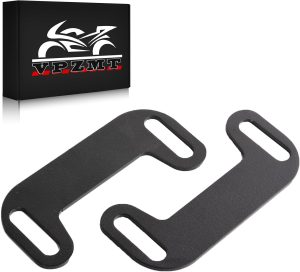
Adjustable Stretched Bagger Exhaust Bracket Set
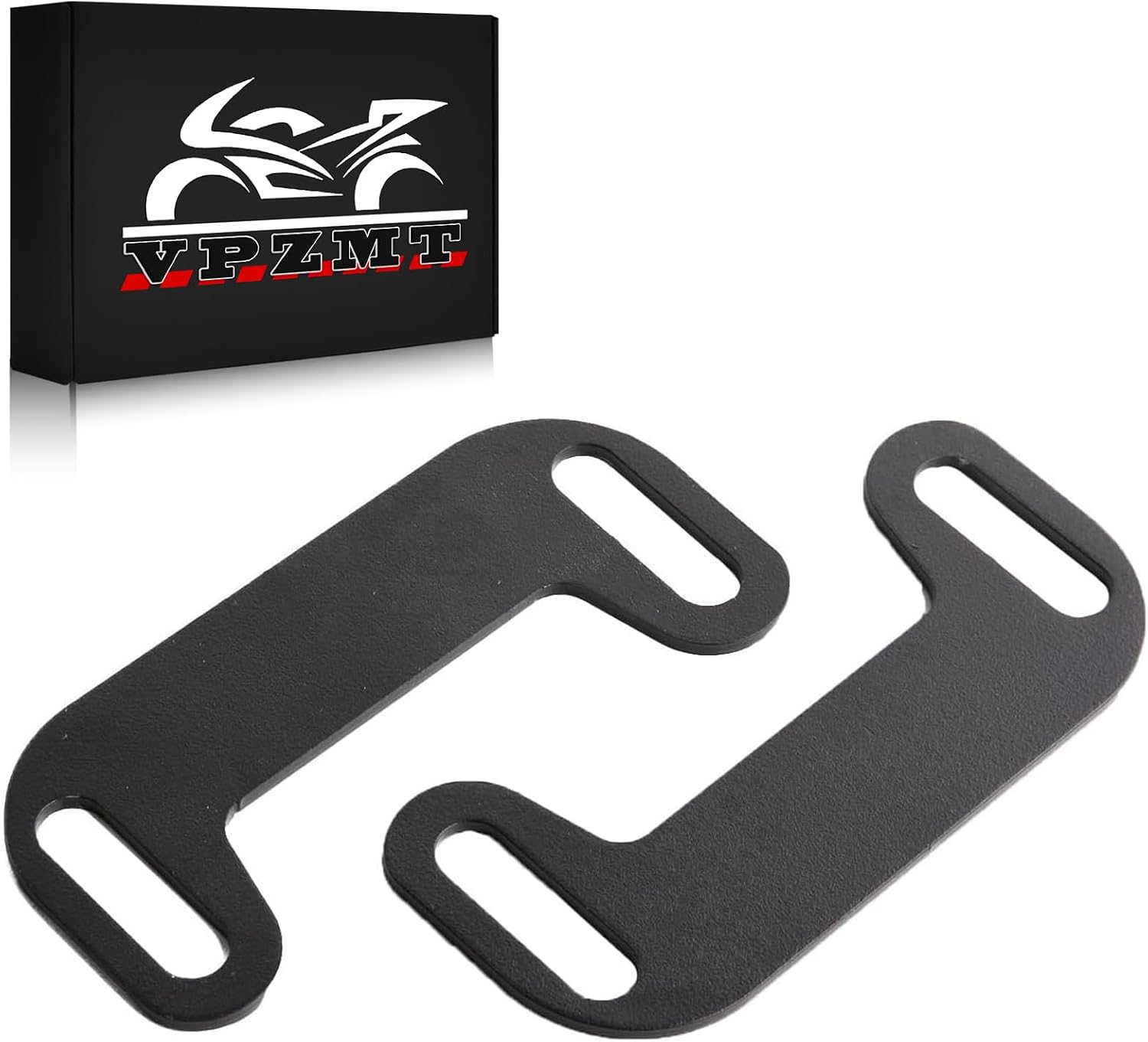
Fits: Harley Touring – Street Glide, Electra Glide, Road King, Road Glide, with stretched saddlebags up to 4.5 inches. Years not stated on the listing.
Rating: 4.7 / 5 from 108 ratings
A ten-dollar part that solves a problem stock brackets cannot. If your bike has stretched saddlebags, the factory muffler mounts often do not give enough adjustment to sit the pipes evenly and clear of the bags. These are adjustable, so you can centre the mufflers properly and set the gap. It looks like a purely cosmetic fix and mostly it is, but not entirely – a muffler sitting too close to a stretched bag will heat-damage it, and replacing a saddlebag costs several hundred times what this bracket does. One tip from the reviews worth passing on: the metal is on the soft side, so use washers with the original muffler mounting screws rather than torquing directly against the bracket.
What owners say: “Helped cure my OCD about being centered and even on each side. The stock ones don’t allow for much adjustment but these did the trick.”
Vance & Hines O2 Sensor Port Plug Kit 16925
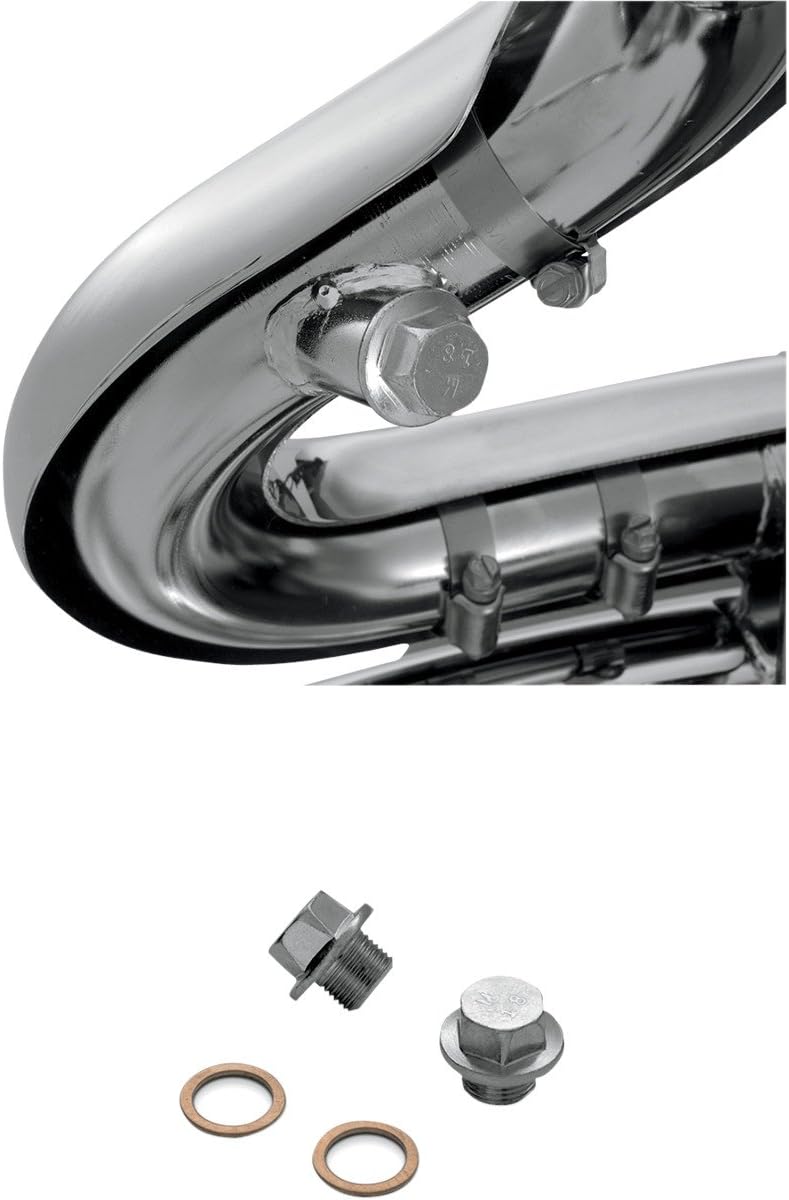
Fits: pre-closed-loop Harley models without oxygen sensors, fitting newer exhaust systems that have O2 ports. Thread size 18mm x 1.5.
Ships to California: No. This listing carries a shipping restriction for California addresses.
Rating: 4.4 / 5 from 114 ratings
A part you only discover you need at the worst possible moment. Newer exhaust systems come with threaded ports for oxygen sensors. If your bike predates closed-loop fuel injection and never had those sensors, those ports arrive open – and an open port lets air into the exhaust, which makes the engine run erratically and adds noise that is not the noise you were shopping for. These plugs seal them. An owner fitting Vance & Hines Dresser Dual headers to a 2004 Electra Glide Classic with no O2 sensor described the install as straightforward, and another hit exactly the same situation on a 2003 Deuce. If you are putting a modern system on a bike from roughly 2006 or earlier, order these with the exhaust rather than after it.
What owners say: “Purchased with V&H Dresser Dual Headers for a 2004 Electra Glide Classic (no O2 sensor) exhaust upgrade. Super easy to install.”
Is an Aftermarket Exhaust Legal?
Short answer: it depends where you ride, and the honest version is more complicated than most sites admit.
Federal emissions
Under the Clean Air Act it is illegal to remove or disable emissions equipment on a street-registered vehicle, and that includes the catalytic converter on bikes that came with one. This is why so many performance systems are sold marked for closed-course or off-road use only. That label is not decoration – it is the manufacturer stating what the part is certified for.
California
California operates its own regime, and the practical effect is visible when you shop: several exhaust products cannot legally be shipped to California addresses at all. Of the products in this guide, the Vance & Hines Twin Slash slip-ons, the quiet baffles and the O2 port plug kit all carry that restriction. If you ride in California, check before ordering rather than after.
Noise limits
Noise rules are set at state and often municipal level, and they vary enormously. Some states specify a decibel limit, some require an EPA stamp on the muffler, some enforce almost nothing. A pipe that draws no attention in one state will get you stopped in the next.
Practical advice
- Keeping the catalytic converter and fitting slip-ons is the lowest-risk change you can make.
- If you want volume control, quiet baffles let you dial it back for a trip or an inspection.
- Check your own state’s rules before buying, not after. Rules change and they are specific.
None of this is legal advice, and this guide is not a substitute for checking your local regulations.
Harley Exhaust - FAQs
What is the best exhaust for a Harley?
How can I make my Harley exhaust sound deeper?
What is the loudest exhaust for a Harley?
Do I need a tuner after installing an exhaust?
Why does my Harley pop on deceleration after a new exhaust?
Will a slip-on exhaust add horsepower?
Do I need to replace exhaust gaskets?
Is an aftermarket exhaust legal?
Will an exhaust from a 2016 Touring fit a 2017?
Conclusion
For most riders the answer is a set of slip-ons. They are the cheapest way to change how the bike sounds, they take an hour, and they leave the emissions equipment and usually the tune alone. Match the diameter to the look you want, check the year range against your bike, and replace the gaskets while you are in there.
Go to a full 2-into-1 or true duals when you want the character change badly enough to accept the cost, the install and the tune that follows. Budget for the tuner in the same purchase rather than discovering it afterwards.
And whatever you fit: sound is set by the baffles more than by the badge on the muffler. If a system is close but too loud, a quieter baffle is a far cheaper answer than starting over.
#1 Pick: Best Harley Exhaust
Rinehart DBX45 4.5" Slip-On Mufflers
Highest rated exhaust in this guide and the brand riders name when the subject is tone rather than volume. The 4.5-inch body gives the fuller, lower note a 4-inch cannot. Confirm the part number against your year before ordering – the listing is inconsistent on fitment.
On a budget, the SHARKROAD 4.5-inch further down covers 2017-2023 Touring for roughly a third of the price and needs no tune. For a documented name-brand option, the Vance & Hines Twin Slash fits 2017-2018 Touring and states its tuner requirement up front.